Does the backward bike throw exist?

Bike Throw Header universalklister blogspot com

Photograph courtesy of universalklister.blogspot.com

I taught English writing skills in a previous life.  This included how to develop an argument and then choosing specific language to clearly convey that argument.  To this day I am annoyed by the use of imprecise language to describe something.

One particularly irritating example comes from articles about how to transition from pedalling while seated to pedalling while standing.  Cyclists often do this on climbs, as the gradient becomes more steep.  A rider can apply more force to the pedals whilst standing than is possible seated.

These articles invariably state that if done incorrectly, your bike is thrown backwards into the following cyclist.  Phrases like “… consequently your bike is thrown backwards a couple feet into the guy’s front wheel who is following you,” “… sending your bike back 6 inches in a split-second upon standing,” and “… he will push his bike backwards into the following rider’s front wheel” are common.

Everytime I read statements like this, I wonder if the writers realize that they are saying that done incorrectly, standing up to pedal causes the bicycle to reverse direction.  To stop moving forwards and start moving backwards.

It is possible to throw your bike forwards.

Bike Throw Forward tourchaser

Photograph courtesy of tourchaser.com

An article by Lennard Zinn in Velonews, titled Technical FAQ:  Physics and the bike throw,  addresses how a forward bike throw works.

Lennard Zinn is a longtime technical writer who currently hosts the popular bike tech Q&A column on VeloNews.com. He is also a framebuilder, a former U.S. National Team rider, and author of many bicycle books.

A few days ago I wrote to Lennard, asking if it was in fact physically possible to throw a bike backwards by standing up in the saddle.  Here is my question to him:

Dear Lennard,
In a post last July, you discussed the physics of the forward bike throw. 

My question is whether it is physically possible to throw a bike backward. One very often reads that when a rider stands out of the saddle, the bike is pushed backward into the trailing rider’s front wheel.

I can imagine that this is possible at very low speeds, i.e. the bike’s forward motion slows to a stop and begins to move backward. But can this happen when a bike is traveling at speed? Does the bike physically go into reverse relative to the ground, or does it just slow down and appear to move backward in the eyes of the rider behind, whose forward speed has not changed?

I offer an analogy. Some people think a skydiver moves upward when his or her parachute opens because videos shot from beside the skydiver show the individual disappearing out of the top of the frame when the parachute opens. This is of course an illusion caused by the deceleration of the skydiver relative to the videographer, whose parachute has not yet been deployed.

If physics show that a bicycle does indeed move backward rather than just slow down, albeit sharply, when a rider stands in the saddle, please explain it to me. If not, I will continue to be peeved at statements like this one (taken verbatim from a leading online cycling site):

“What you need to do is shift up one or two gears (harder) just before standing up. Get on top of that gear and then stand up. This will prevent you from throwing your bike backwards into the guy behind you.”

To my mind, standing up has the same effect as hitting the brakes hard. Your bike slows down rapidly. The following rider crashes into you because they weren’t able to quickly scrub off speed to match your new, slower velocity. You don’t get hit by the rider behind you because your bike is suddenly moving in reverse.
— Johan

I was pleasantly surprised to see that a few days ago, Lennard addressed my question in his latest Velonews post, Technical FAQ:  The backward bike throw.  His response is below:

Dear Johan,
It is as you said; the bike does not move backward relative to the ground, except perhaps at very low speeds. Instead, it moves back relative to the rider in the same way that the bike throw moves the bike forward relative to the rider, and it is analogous to the skydiver example you gave.

For the sake of simplicity, assume that the bike and rider continue to move at constant speed over the instant that the rider stands up. In other words, the center of mass (COM) of the bike and rider move the same speed in the instant just before the rider stands up as in the instant just after he or she stands up. But in standing up, the rider must move forward relative to the bike to get his or her center of mass over or forward of the bottom bracket — and quite a bit forward of the bottom bracket if it’s a steep climb. So, the rider’s COM is moving faster than the COM of the bike and rider together during this split second of standing up in order to get his or her COM ahead of where it would have been if he or she had stayed seated.

If the COM of the bike and rider together is moving at constant velocity during this instant, by Newton’s law of conservation of momentum, the COM of the bike must move back relative to the rider’s COM in order that the COM of both together maintains constant speed. In the case of a modern road racing bike and an adult rider, the bike is much lighter than the rider. In order to keep both sides of the equation balanced, the bike will move backward relative to the COM of the bike and rider much faster than the COM of the rider will move forward relative to the COM of bike and rider.

As you said, Johan, if the rider is rolling along at a speed close to zero when he or she stands up, it is possible for the bike to actually move backward relative to the ground, and if he is stopped, it most certainly will. A trials rider performing stunts at a standstill is a good demonstration of this.

In the case of riding in a paceline, it doesn’t actually matter that the bike does not move backward relative to the ground in order for the rider behind to run into the rider ahead when he or she stands up out of the saddle; all that matters is that the bike has moved backward relative to the rider. Since the COM of the lead bike and rider is moving at the same speed as the rider behind in a paceline, if the lead rider’s bike suddenly decelerates (because standing out of the saddle causes it to suddenly move backward relative to the COM of bike and rider), the following rider can easily crash into the lead rider’s bike if he or she is not paying proper attention and allowing sufficient space.

I guess you’re going to continue to be peeved at online cycling tips like the one you quoted. That tip may have been worded incorrectly, but it did communicate the issue a beginner riding uphill in a paceline should be aware of. Had the last sentence read something more like, “This will prevent your bike from rapidly slowing down right in the path of the guy behind you,” it would have been more accurate. Problem is, the uninitiated, without understanding the explanation above, would assume that meant that the rider was going to be slowing down simply because he or she stood up, rather than that the bike would be slowing down instead. He might not understand why and thus might not appreciate the problem the sentence is attempting to warn him about. The image of throwing the bike backward, however, does communicate the issue to a beginner, even if the bike does not actually go backward relative to the ground. So I think you may want to reconsider being peeved about it; it just might save you someday from some newbie getting out of the saddle right in front of you and your bike running into his.
― Lennard

Lennard answered my question in the caption to the header photograph that accompanies his post:  The backward bike throw does not exist, but standing up on the pedals does slow down a bike momentarily.

I was also pleased to see that Lennard, in true English teacher fashion, offered a better alternative to an example of the imprecise statements that irritate me.

“This will prevent you from throwing your bike backwards into the guy behind you” can be more accurately written as “This will prevent your bike from rapidly slowing down right in the path of the guy behind you.”

Now, as my Biker Chick would note . . . .

Bike Throw Smug Alert quickmeme com

Graphic courtesy of quickmeme.com

Bicycle Out, Train Home

I wrote about taking road bicycles onto KTM Komuter trains in Bikes on Trains in Kuala Lumpur.  Since then I have incorporated a train into my ride a few more times.

Once was over the Chinese New Year holiday in early February.  In the last week I’ve done two more bike and train rides.

The KTM Komuter network operates on two lines.  The Port Klang line runs east to west, from Batu Caves to Port Klang.  Batu Caves is less than 15km / 10mi from home, so a train ride from there doesn’t make sense.  Port Klang, at 50km / 31mi away, is further, but not far enough away to make a one-way ride to that station seem worth it.  And the ride to Port Klang through an entirely urban landscape is boring anyway.

The Seremban line runs from Tanjung Malim in the north to Rembau in the south.  Tanjung Malim is about 90km / 56mi from Kuala Lumpur.  Rembau is more than 120km / 75mi from Kuala Lumpur.  Those are reasonable distances to cover during a morning’s ride.  Much of the riding in either direction is through countryside and villages, so the views from the bike are pleasant.

KTM Map

We covered both directions last week.

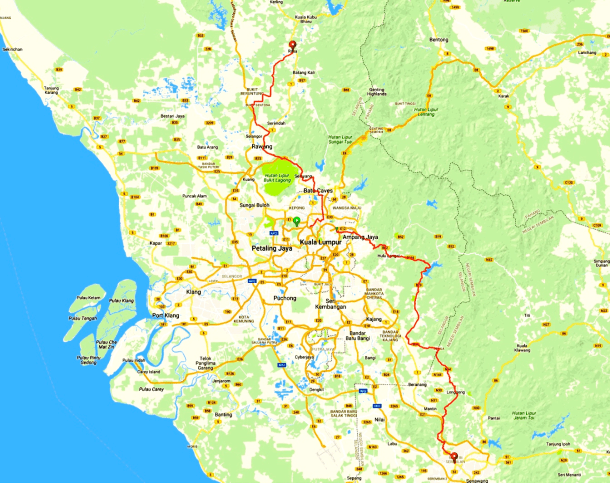
Train Routes

Map courtesy of Ride With GPS


Five of us did a mid-week ride to Rasa station in the north.  The destination was meant to be the railway station in Kuala Kubu Bharu.  Afternoon plans meant that we had to be on the train by noon.  A series of flat tires in Rawang and Bukit Beruntung slowed us down.  We were at risk of missing the train at Kuala Kubu Bharu.

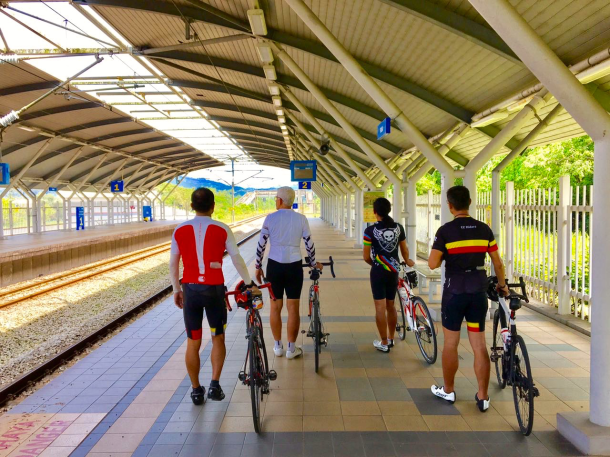
Rasa Station 4 Leslie

Photograph courtesy of Leslie Tong

So we had something to drink in Rasa town, and were in the station with plenty of time to spare.

Rasa Station 1 Evelyn

Photograph courtesy of Evelyn Bird

Rasa Station 2 Leslie

Photograph courtesy of Leslie Tong

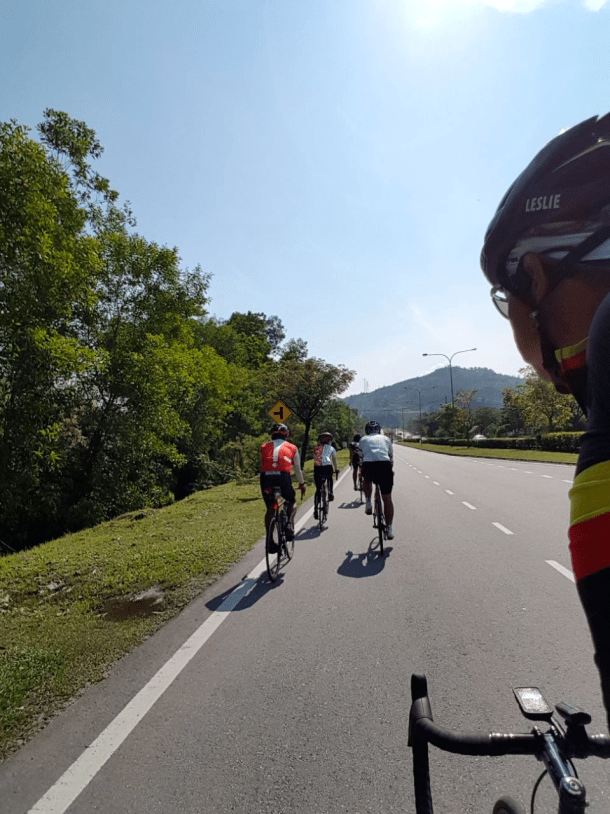
Eight of us rode out on Friday morning, bound for Seremban.  The early challenges were to get over the Ampang Lookout Point and Bukit Hantu climbs.

It was a clear morning, so it was worth stopping halfway up Lookout point for a photograph.  The Twin Towers are just about visible to the left of Liang’s head.

Seremban Lookout Point Leslie

Photograph courtesy of Leslie Tong

We needed a bit of sustenance after the 200 meters / 650 feet or so up climb to Lookout Point, and before the 259 meters / 820 feet up Bukit Hantu.

Seremban Batu 14 Breakfast Mark

Photograph courtesy of Mark Lim

Coming off the descent of Bukit Hantu, it was nice to see the Semenyih Dam full again after such a long time.

Seremban Tekala Mark

Photograph courtesy of Mark Lim

25km / 15.5mi later we were in the town of Broga, and desperate for a drink.  It was turning into a hot day.

This caught our attention.

Seremban Broga Drinks Menu Mark

Photograph courtesy of Mark Lim

Waiting for our coconut shakes and pineapple shakes to arrive.

Seremban Broga Evelyn

Photograph courtesy of Evelyn Bird

Delicious!

Seremban Broga Drinks Mark

Photograph courtesy of Mark Lim

Seremban was 30km / 18.5mi away.  Unlike Wednesday’s ride, we all got there with only one flat tire between us.  Which happened, unfortunately, just seven kilometers from Seremban.  Or to put a positive spin on things, fortunately, because the flat came just after a 150 meter / 490 feet climb.  Which gave everyone the opportunity for a rest.

Seremban Flat Leslie

Photograph courtesy of Leslie Tong

We got to Seremban in time for food and drinks at the Pasar Besar Seremban, which is the main wet market in the city.  The fresh vegetables, meat and fish are sold on the first floor, and part of the second floor.  The rest of the second floor is occupied by food stalls.

There are ramps leading up to the second floor, so we rode our bicycles right up the the food stalls.

Seremban Market Evelyn

Photograph courtesy of Evelyn Bird

The railway station is a short ride from the market.  Marvin forgot his cycling shoes, but his sandals were a good stand-in.

Seremban Station 4 Mark

Photograph courtesy of Mark Lim

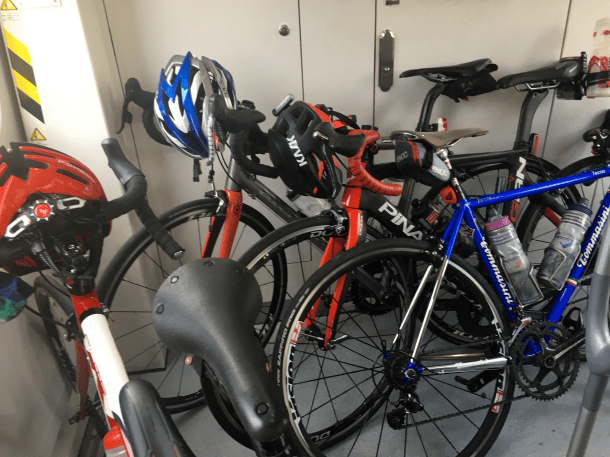
We discovered that Fridays are not the best day to ride the train with our bikes.  There were a lot of people waiting on the platform for the 2.15pm train.  Luckily there was space in the last carriage for us and our bikes.

Seremban Train

More people with luggage got on at each successive station, and before long it was standing room only, with people squeezed in between our bikes.  Friday afternoons must be a popular time for people to start their weekend trips.

Quite a lot of people got off at the Bandar Tasik Selatan station, which is linked to the Terminal Bersepadu Selatan, KL’s main long distance bus terminal.   Some people got on at that station too though.  So it wasn’t until the train had passed through KL Sentral station that seats became available again.

Lay and I got off the train at Bank Negara station.  The others in our ride group got off one stop later, at Putra station.

We needed food and drink en route to home from the station.  League of Captains provided the coffee, and Souled Out on Jalan Ampang provided the satay.

We may never go this far to get our bicycles onto train tracks,

Seremban Rail Bike

but we will definitely be on the train with our bikes again and again.


The Real Threat: The Hit & Run Driver

hit-and-run-banner

Lately I have been thinking a lot about road accidents involving cyclists.  Prompted in part by a 31st January 2017 online survey conducted by the editors of Bicycling, titled How Safe Do You Feel When You Ride?  

A few days ago, there was a tragic accident in which eight young cyclists were killed and eight others seriously injured.  Since then, the topic of cycling and safety has been all over the Malaysian newspapers.

This accident will probably lead to even more non-cyclists asking me if it is safe to ride a bicycle in Kuala Lumpur specifically, and in Malaysia in general.  There is of course inherent risk in any sport.  Cycling is no exception, and due care must be taken when heading out onto the streets to ride a bicycle.

Police statistics show that cyclists make up 3% of road accident fatalities in Malaysia. Interestingly, in Malaysia one is more likely to be killed while riding a motorcycle than while riding a bicycle.  By a margin of 20 : 1.

hit-and-run-traffic-deaths-malaysia

Pie chart courtesy of Polis DiRaja Malaysia

3% looks like small number, but in human terms it means that some 200 cyclists are killed in accidents on Malaysian roads every year.  That is 200 too many.

Newspaper reports of cyclists killed in an accident with a motor vehicle make for very sad reading.  All too often accompanied by outrage and anger at the revelation that, once again, the cyclist was the victim of a hit and run driver.  The driver flees the scene of the accident, thereby attempting to evade being identified and held responsible.

I cannot find statistics on the prevalence of hit and run accidents in Malaysia, but data from other countries is eye-opening.  The Chicago Department of Transportation reported that between 2005 and 2010, 25% of all bicycle crashes were hit and runs.  “City of Chicago 2012 Bicycle Crash Analysis Summary Report and Recommendations,” www.cityofchigago.org (2012)

Over 900 cyclists were injured or killed as a result of hit and run collisions in London in 2015.  Nigel Wynn, “Over 900 cyclists injured in hit-and-run incidents in London last year,” www.cyclingweekly.co.uk, (November 23, 2016) 

Hit and run accidents appear to be a growing problem.  It turns out that there has not been much research on the psychology of a hit and run motorist.  It may be tough to research because many hit and run drivers are never caught. So, any conclusions can only be partial ones, based on the few who were caught or those who turned themselves in.

Unsurprisingly, a lot of the people who decided not to stay and face the consequences of their actions are those who wanted to avoid interacting with the authorities, at any cost. They may, for example, have been driving under the influence of alcohol or drugs, or were uninsured, or did not have a valid driver’s licence, or had previous driving offences, or were people in leadership positions or celebrities and therefore were averse to the potential publicity.  Meredith Cohn.  “Hit-and-run drivers not uncommon, but not well understood,” www.baltimoresun.com, (February 6, 2015)

A comprehensive paper on the topic of hit and run drivers was written by Ludo Kluppels, a traffic psychologist in the Public Affairs, Innovation and Regulatory department of the Belgian Road Safety Institute.

hit-and-run-brsi

Logo courtesy of the Belgian Road Safety Institute

Kluppels reports that in the vast majority of cases studied, a flood of emotions, including fear, shame and guilt best describes the moment and the first seconds after the impact. Guilt is a very nasty feeling; especially when the consequences of the act are enormous. A strong feeling of guilt can lead to denial, or to blaming the victim (“what was he doing here at this time of day!”; “It’s not my fault, there was nothing I could have done”).

In general, most people have enough self-control to handle these emotions and to act in a responsible way.

hit-and-run-flee-the-scene

In some cases, however, the flood of emotions overwhelm the self-control capacities.  The ‘flight or fight’ instinct kicks in.  The thinking part of the brain (frontal cortex) shuts off and leaves only two alternatives:  ‘run away – flight’, or ‘attack the threat – fight’!  In such a state of mind running is probably the best reaction, and the driver flees the scene.

McLeod, et al report that in that split-second decision, one of the crucial issues is the perceived probability to get away with it. That is why more hit and run accidents take place at night where the lighting is poor, or on more deserted roads where no one else is around.  All these conditions strengthen the idea that nobody has seen what has happened, and that nobody could identify the driver.

Kluppels further states that once the decision to flee the scene of the accident has been made (based on fear of punishment, blame, or on the basis of denial of guilt), it is not very easy to undo this decision. Further reasoning and actions have the tendency to justify the previous one. Even when emotions cool down, the human mind always tries to gain some justification for itself.

A worrying part of Kluppels’ findings have to do with drivers who lack moral judgment. There is a small group of offenders for whom it is not the fear or the overwhelming flood of mixed emotions that leads to an inappropriate decision, but rather a lack of emotion and the human capacity to take responsibility, and to care about others.  Almost every offender in this small group tries to justify his decision with arguments that do not demonstrate high ethical insights.

Kluppels divides the real ‘rational’ hit and runners into two types: the ‘gambler’ and the ‘asshole’.

hit-and-run-gambler

The gambler is someone who likes to take risks.  He is self-confident and energetic and enjoys playing with the limits.  He feels in control and thinks he can reach the sky. To flee from an accident is a challenge for him (“how high is the risk of being caught?”).  He is challenging fate.  He doesn’t care about what other people say or whatever the consequences may be.

hit-and-run-asshole

The asshole is a more rational person who simply doesn’t care about other people.  He is selfish and has his own rules.  He is convinced that accidents are the fault of the victims, who are too stupid to properly react to his driving style.  Leaving the scene is a better idea than being unfairly punished.  He lacks empathy with others and is only interested in what affects himself.

Where the first one, in general, loses his gambling behaviour and his light-hearted way of life the moment he becomes a parent, there is not much hope that the asshole will change his egocentric lifestyle, whatever he experiences.  Ludo Kluppels.  “Beyond shame and guilt: What’s inside a hit and run accident,” Belgian Road Safety Institute, http://traffic-psychology-international.eu/, (January 2016)

R0829_HitRun_PS_C.jpg

Photograph courtesy of Paul Squire, Riverhead News-Review

Whatever the reason, motorists who leave the scene of a crash have chosen to prioritize only themselves and what consequences may happen to them.  They have chosen not to render aid to the victim which could save the victim’s life or diminish the impact of their injuries.  This is senseless and immoral.

So can we prevent hit and run accidents?

hit-and-run-stay-at-the-scene

Given the multiple and poorly-understood motivations behind the hit and run phenomenon, a specific strategy to prevent hit and run offences is not possible. There must be a focus on the issues that lie behind the motivations to flee.

An obvious place to start is to review the penalty for leaving the scene of an accident.  In some places the penalty for driving without a licence, or driving under the influence, (both very common in hit and run incidents), are harsher than the penalty for leaving the scene of an accident.  Thereby perversely incentivizing someone who is unlicensed, or drinking and driving, to flee the scene of an accident.

On the other hand, we shouldn’t be too optimistic about the deterrence effect of high sanctions.  There are many crimes for which the penalty is severe, but the severity of the sanction has a very small impact on the prevalence of offences.

To me, a significant contributor to hit and run accidents, and to many other antisocial acts, is a breakdown in moral codes, citizenship and caring about others.  The stronger our morals, the easier it is to overrule our emotions and to take responsibility.

Unfortunately there is no quick fix for a lack of moral judgment that leads to the inability to discern right from wrong.  Education that emphasizes moral codes, citizenship and caring about others seems to be the only long-term solution.

Right Decision, Wrong Decision Road Sign

Cycle Computers

In May 2009 I bought my first bicycle.  A Trek FX7.5.  Before long the data geek in me was on the hunt for a cycle computer, so I could track speed and distance.  The gadget geek in me narrowed my search down to SpeedTrap compatible models.

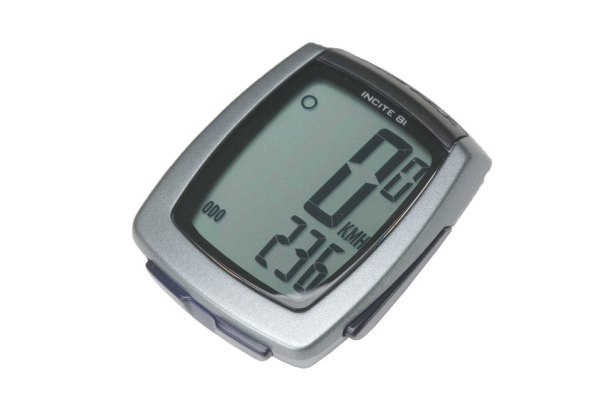
SpeedTrap is the Trek / Bontrager name for the ANT+ 2.4 GHz digital wireless speed sensor that fits into a recess in the fork leg of the FX7.5 and other models in the Trek Range.  The Trek Incite 8i was my first cycle computer.

trek-incite-8i

Photograph courtesy of Evans Cycles

In January 2010 I got my first road bike.  I needed another cycle computer to go with it, because the Easton EC90 SLX fork on my new bike didn’t have a SpeedTrap mount.

By that time I was riding farther afield, and had already gotten lost a few times.  So a GPS-enabled device with mapping seemed like a good idea.  DC Rainmaker’s excellent in-depth review of the Garmin Edge 705 convinced me to break out my credit card and get one.

Garmin Edge 705

Fast forward to the end of 2016.  Cycle computer technology has, along with the technology in most consumer electronics, progressed by leaps and bounds since 2009. Today’s cycle computers have touch screens, are Bluetooth and wifi enabled, receive GLONASS as well as GPS signals, function as remote controls for certain lights and cameras, display missed phone call and text notifications, and do a host of other things that the Edge 705 is incapable of.

My Edge 705 is more than five years old.  It still works well, apart from the occasional spontaneous shut down, which I think I cured recently by doing a hard reset.  My Edge 705 does, however, show its vintage everytime I have to tether it to a PC via a USB cable to download ride data to Garmin Connect and Strava.  Newer devices do that wirelessly.

A more serious problem is ever-shortening battery life.  I had taken to carrying a power bank on longer rides.

The DC Rainmaker website was again my source for reviews of potential replacements for my Edge 705.  The Edge 820 is the latest Garmin offering, and DC Rainmaker’s preview post made it an appealing option.  Appealing, that is, until a trickle of negative comments from early buyers turned into a deluge.

garmin-edge-820

Photograph courtesy of Garmin

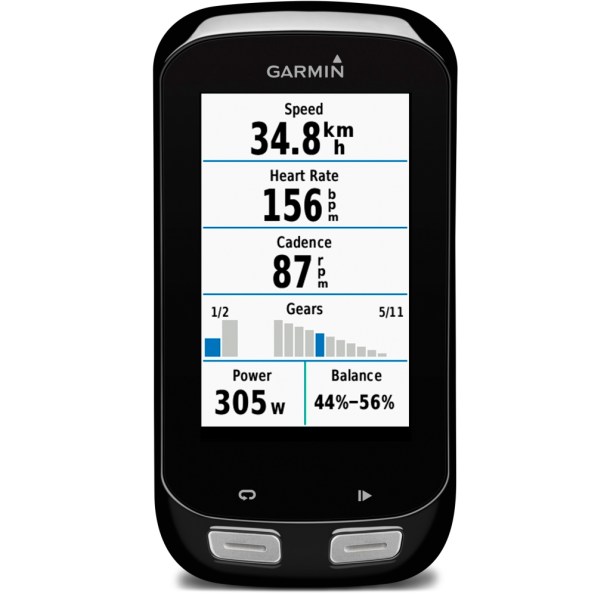
There were too many issues with the Edge 820 for my liking.  So I decided to buy a Garmin Edge 1000.  That model came out almost three years ago, but firmware updates have given the Edge 1000 most, if not all, of the capabilities of the Edge 820.  And three years should have been enough time for Garmin to flush all the bugs out of the Edge 1000.

garmin-edge-1000

Photograph courtesy of Cycle Solutions

Some people complain about the size of the Edge 1000.  At 58.0 x 112.0 x 20.0 mm (2.3″ x 4.4″ x 0.8″), it is not a svelte unit.  But those dimensions give the Edge 1000 a 30% larger display than the Edge 820, which in turn has a slightly bigger display than the Edge 705.  A key consideration, given the age of my eyes.

In November 2016 I went shopping online, and found the best deal at Bike Tires Direct.  34% off the RRP.  An Edge 1000 was soon on its way to me.

My excitement upon the unit’s arrival was quickly extinguished when it crashed and died during initial setup.  I was left with a paperweight.  A major bummer.

A visit to AECO Technologies, the authorized Garmin distributor for Malaysia, did not immediately solve the problem.  The unit would have to be sent to Taiwan for repair, at my expense.  Garmin does not provide a world-wide warranty for the Edge 1000, so I would have to foot the bill for shipping and repairs.

garmin-edge-1000-repair-cost


The alternative was for me to send the unit back to Bike Tires Direct in the United States, where the unit may have been repaired under warranty.  I decided to swallow the cost and work face-to-face with AECO Technologies folk, rather than communicate via emails and telephone calls to Bike Tires Direct and Garmin in the United States.

Anyway, the cost to send the unit to Taiwan for repair was slightly less than what I had saved via the discount I received from Bike Tires Direct.  That’s my story, and I’m sticking to it.

Six weeks later AECO called to say that the Edge 1000 was back.  It turned out to be a new unit, so there must have been something seriously wrong with the unit that failed.

Happily I had no problems setting up the replacement unit.  And it is working perfectly.

It is, however, going to take me some time to decide on my preferred layouts for all the data screens.  With the Edge 1000 you can have five data screens per activity profile, with each screen containing up to ten data fields.  You also have a map page, a compass page, an elevation chart page, the lap summary page, and the virtual partner page.  Each of those special pages allows you to specify two additional data fields on them.

And the list of data fields to choose from is extensive.

garmin-edge-1000-data-fields

Table courtesy of DC Rainmaker

If you set up the maximum of ten activity profiles, you could have up to fifty data screens and fifty special pages to manage.  With a total of six hundred data fields.  Talk about overload!

That is all too much for me.  I deleted all but one activity profile.  For the time being I have turned off two of the five data screens, and three of the five special pages.

If managing activity profiles doesn’t take up enough of your time, you can fritter more time away by going online to the Garmin Connect IQ Store.  You can spend hours scrolling through the Applications, Data Fields and Widgets available there.

This is my favourite data screen layout – for now anyway.  My EDGE is a customizable Data Field downloaded from the Connect IQ Store.  This one data field takes up an entire data screen, but it contains multiple data items which are user selectable.  The analog speedometer is particularly cool.

garmin-edge-1000-screen

A final note.

I own two Edge 705s (it’s a long story).  On one unit, some of the threaded plastic holes, where the screws holding the case together are inserted, have cracked.  So four of the six screws are missing.  Garmin no longer stocks spare parts for the Edge 705.  Not even replacement screws.  The advice from a technician at AECO is to use the damaged Edge 705 as the donor of spare parts, as needed, for the other unit.

Fortunately, replacement batteries for the Edge 705 are available from a number of online vendors.  I bought one from BatteryShip.com.  It was simple to install.

garmin-edge-705-replacement-battery

Photograph courtesy of BatteryShip

Now have a rejuvenated Edge 705 as a backup for my Edge 1000.  For which replacement batteries are also available.  Contrary to what AECO told me about the Edge 1000 battery being non-replaceable.

A final final note.

Don’t get me started on the 36 hour battery life of Bryton cycle computers.


Chinese New Year 2017 Tour

gong-xi-fa-cai

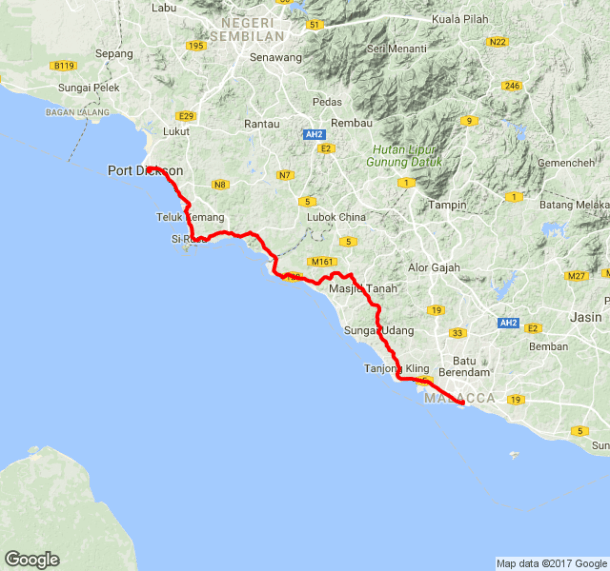
Danial, Safwan and I kicked off the Year of the Fire Rooster with a three day / two night credit card tour from Kuala Lumpur to Port Dickson, Melaka, and Seremban.

cny-2017-day-1-route

Map courtesy of Strava

On the morning of Day 1, Safwan and Danial rode from Bangsar to the McDonald’s at Ampang Park.  I met them there.  This would be the standard start to each day.  Breakfast at McDonald’s.

cny-2017-day-1-ampang-park-mcd-danial

Photograph courtesy of Danial Marzuki

The ride along the MEX Highway was quieter than usual.  Being the second day of Chinese New Year, the roads everywhere were relatively empty.

We made a short “nature calls” stop at the Seri Kembangan R&R.  Then another stop at the PETRONAS station in Dengkil, for provisions.

Other than a few stops for traffic lights, like this pretty long wait at the junction of the Nilai – KLIA Highway (Federal Route 32) and Jalan Besar Salak (Selangor State Route B48), we kept moving for the next two hours.

cny-2017-dengkil-danial

Photograph courtesy of Danial Marzuki

Our next stop for a drink and a bathroom was at the Shell station in Sepang.

cny-2017-sepang-shell-danial

Photograph courtesy of Danial Marzuki

After that is was over the lumps on Federal Route 5 to Lukut, and then the flatter closing 12km / 7.5km to Port Dickson.  About 100km / 62mi for the day.

It was lunch time when we arrived in Port Dickson.  We had cendol and rojak at Azmi Cendol, and the guys bought cheap flip flops from a nearby shop,  before we rode to the Waterfront Boutique Hotel.

cny-2017-waterfront-hotel-danial

Photograph courtesy of Danial Marzuki

After a shower, in my case whilst wearing my kit so it got a wash as well, I took a short nap.  Then we met in the lobby for the short trip around the corner to Starbucks Coffee.  A venti Mocha Frappuccino hit the spot.

That evening we revisited Restoran Seri Mesra Ikan Bakar for dinner.  We had eaten there during a BCG Tour to Port Dickson.  Fortunately we didn’t have to cycle the 11km / 7mi to the restaurant.  Darshini had made a day trip to Port Dickson, so we had a car ride there and back.

There was the option for another Starbucks after dinner, but I was fading.  We planned a 7.00am start, so I fell into bed and was soon fast asleep.

My kit was dry, and more importantly, not smelling funky, at the crack of dawn.  We checked out of the hotel and rolled the few hundred meters to McDonald’s for breakfast.

cny-2017-day-2-start-danial

Photograph courtesy of Danial Marzuki

Melaka here we come!

cny-2017-day-2-route

Map courtesy of Strava

The roads between Port Dickson and Melaka, along Federal Route 5, Federal Route Route 138, Melaka State Route M142, and back onto Federal Route 5, are very pleasant.  The road surface is good, and there isn’t much heavy vehicle traffic to contend with.

cny-2017-day-2-otr-danial

Photograph courtesy of Danial Marzuki

33km / 20.5mi from Port Dickson, we crossed the Sungai Linggi, which at that point doubles as the border between the states of Negri Sembilan and Melaka.  We did notice that the road narrowed a bit, and changed colour, once we crossed into the state of Melaka.

cny-2017-melaka-border-danial

Photograph courtesy of Danial Marzuki

We made an early lunch stop at Restoran Kuala Seafood, in Kampung Kuala Sungai Baru.  Not everything on the lunch buffet menu was ready yet, but there was enough on offer for us to fill our tummies.

Our lunch stop, or more accurately, our brunch stop, came about halfway to Melaka.  We made a semi-emergency stop 10km / 6mi further on, at the Petron station in Masjid Tanah.  Danial needed an ice-cream to quell the flames in his stomach from the too-spicy curry he ate at lunch.

We had planned to ride non-stop the rest of the way to Melaka town.  We got to Tanjung Kling before large raindrops began to fall.  We ducked under the first shelter we could find, and waited out the rain.

cny-2017-day-2-rain-danial

Photograph courtesy of Danial Marzuki

I was quite smug about having packed shoe covers and a rain vest.  I put those items on as we waited for the rain to stop.  Twenty minutes later we rolled out onto the wet road.  We could hardly have gone more than a kilometer before the road changed to being completely dry, and the sun was out.  I wasn’t so smug anymore.

We had been caught, quite literally, under a cloudburst.  And now it was sunny and dry, and I was getting hot under my vest.  We started making jokes about my rain gear having the power to repel rain.

It was 12km / 7.5mi to Melaka from Tanjung Kling.  There was a traffic jam for most of that distance into Melaka.  I was glad to be on a bicycle.  We stopped on the bridge over the Sungai Melaka for a photograph of the river.  A river that is much cleaner these days.

cny-2017-day-2-melaka-river-danial

Photograph courtesy of Danial Marzuki

Then it was off the bridge and around the corner to the Fenix Inn.  The bicycle-friendly hotel that we have stayed at before.

Our post-ride routine was identical to the one the day before.  A shower with kit on, a short nap, and then a walk to the Starbucks Coffee next door to the hotel.  The guys even had to buy flip flops.  It turned out that the RM2.50 / USD0.60 flip flops they had bought in Port Dickson weren’t such a good deal after all.  They were more stiff plastic than rubber, and were very uncomfortable.  So the guys left them in Port Dickson.

I was happy to wait until dinner to eat anything.  Danial and Safwan were peckish, and wanted to try the chicken rice balls at Ee Ji Ban Chicken Rice Ball.  I related my disappointing experience with the chicken rice balls at that restaurant.  Ee Ji Ban Chicken Rice Ball has developed quite a name for itself, so the guys thought that I must have been there on an off-day.

They admitted after eating there that they should have listened to me.

Dinner was at the Restoran Ole Sayang, on the recommendation of AiLin, who is a Melaka girl.  AiLin was in Melaka for Chinese New Year, and not only came to Ole Sayang with us, but picked up the tab as well.  We owe you one Ailin.  Thank you.

A Starbucks was between the restaurant and out hotel, so we stopped for coffee and cake.  There were some brief thoughts of going on to somewhere else after Starbucks, but common sense, and age in my case, caught up.  I needed to get to sleep if I wanted to be ready for another 7.00am start.

Guess where we went for breakfast on Day 3?

cny-2017-day-3-mcd-danial

Photograph courtesy of Danial Marzuki

The sharp-eyed will have spotted that Safwan had packed a second set of cycling kit.  Danial and I stuck to our wash-and-dry routine.  Which worked yet again.

cny-2017-day-3-route

Map courtesy of Strava

Our route out of Melaka to Seremban took us onto the AMJ Highway (Federal Route 19).  A road which is characterized along its entire length by rolling terrain.

cny-2017-day-3-amj-highway-danial

Photograph courtesy of Danial Marzuki

Compounded on the day by a headwind that blew all the way to Seremban.  All that up and down riding against the wind was thirsty work.  We stopped at the R&R at Simpang Ampat for a cold drink.  We had covered all of 31km / 19mi.

The sun had come out in full force while we were at the R&R.  I pulled on my arm screens, and made a mini keffiyeh out of a bandana to keep the sun off the back of my neck.  Of course, as soon as we got going, the cloud cover rolled in and blocked out the sun.

We were blessed with excellent rising weather over the three days.  Apart from brief periods of bright sun, we rode in overcast and cool conditions.  We think my bandana was the charm.

cny-2017-day-3-sun-chasing-gear-danial

Photograph courtesy of Danial Marzuki

Our plan was to hop onto the KTM Komuter at Seremban, rather than ride all the way back to Kuala Lumpur.  After 39km / 24mi we turned left off the AMJ Highway onto Jalan Seremban – Tampin, which roughly paralleled the rail tracks we would be on later.

cny-2017-day-3-tracks-danial

Photograph courtesy of Danial Marzuki

The guys were hungry at about the 50km / 31mi mark, so we stopped at Isyani Café in Rembau.  They devoured large plates of fried rice, and I sucked down a couple of iced Milos.

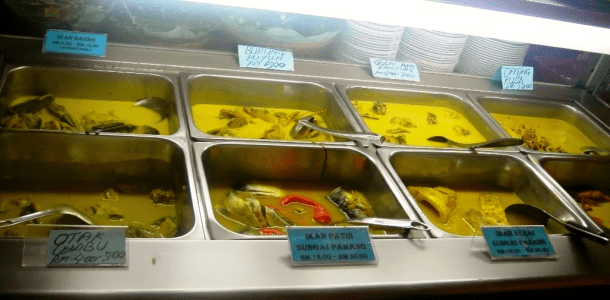
There were 30km / 18.5mi to go to Seremban.  Or more precisely, to Restoran Nelayan Seafood, which is where Danial wanted to have lunch.  That restaurant is well-known for its masak lemak dishes, which are a Negri Sembilan speciality.  A variety of meats, fowl and seafood are cooked in a coconut milk and bird’s eye chilli gravy, which is coloured a rich yellow by turmeric.

cny-2017-day-3-restoran-nelayan-seafood-warisn9world-blogspot-my

Photograph courtesy of warisn9world.blogspot.my

The guys ate well.  Luckily it was only a few hundred meters from the restaurant to the train station.

cny-2017-day-3-seremban-station-danial

Photograph courtesy of Danial Marzuki


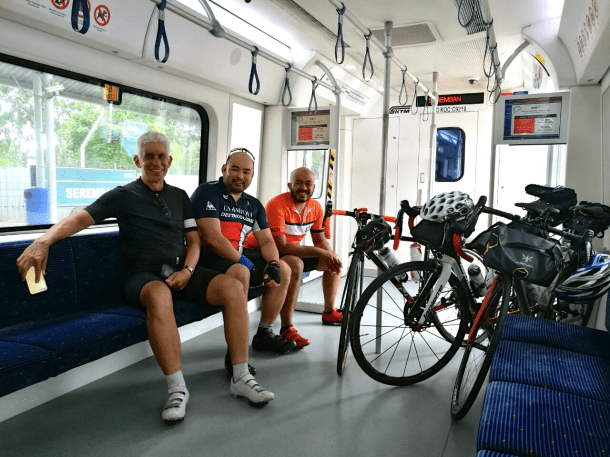
RM11 / USD2.50 each for ourselves and our bikes, and we were in air-conditioned comfort for the ninety-minute train ride to the Bank Negara station.

cny-2017-day-3-komuter-danial

Photograph courtesy of Danial Marzuki

I skipped eating at Restoran Nelayan Seafood.  I was looking forward to the Lamb Balls and Egg at Born & Bread Café.  A mere 4km / 2.5mi from the Bank Negara station.  Admittedly through some heavy traffic.  It was worth the wait and the ride!

cny-2017-day-3-lamb-balls-danial

Photograph courtesy of Danial Marzuki

Three happy guys, ready to do it all again sometime soon.

cny-2017-day-3-bb


The Eddington Number for Cycling

When I first started using VeloViewer, I focused primarily on the graph showing distance cycled by year.  My main goal in 2015 and 2016 was to cycle further than I had in any previous year.  This zoomable graph was one way to track my progress, ride by ride, against that goal.

eddington-veloviewer-annual-panel

Graph courtesy of VeloViewer

VeloViewer displays a plethora of other data, spread across eleven pages.  You can read an overview which I wrote more than two years ago here.

I occasionally browse the other pages, but I spend most of my time on only two pages.  The Update page, where you import your Strava data into VeloViewer, and the Summary page, where the graph above, and other charts and tables, are displayed.

It was many months before one item, highlighted in red in a panel titled Activity Stats on the Summary page, caught my eye.  It was a button labeled “Eddington”.

eddington-veloviewer-panel

Graphic courtesy of VeloViewer

Which I soon found out stood for “Eddington number”.

Some Googling revealed that there are two Eddington numbers, both devised by Sir Arthur Stanley Eddington.  Arthur Eddington was, among other things, an astrophysicist.  In astrophysics, the Eddington number NEdd is the number of protons in the observable universe.  Eddington was the first to propose, in 1938, a value of NEdd.

Arthur Eddington was also a cyclist.  He is credited with devising a measure of a cyclist’s long-distance riding achievements. The Eddington number (E-number) for cycling is defined as the largest number E, where you have cycled at least E kilometers / miles on at least E days.  For example an E-number of 50 kilometers means that you have ridden 50 kilometers or more on 50 or more days.

Note that the units of distance are important.  An E-number of 50 in miles means having covered at least 50 miles on 50 days.  The equivalent E-number in kilometers means having covered at least 80 kilometers on 80 days.

Achieving a high Eddington number is difficult, since moving from, say, a metric 80 to 85 will probably require more than five new long distance rides, as any rides shorter than 85km will no longer be included in the reckoning.

VeloViewer displays an informative graph when you click on the red “Eddington” button in the Activity Stats panel.

eddington-veloviewer-details-panel

Graph courtesy of VeloViewer

The blue bars show the number of times each distance (you can select kilometers or miles) has been completed.  The top of the orange bar intersects with the orange E-number line.  The orange bar shows your current E-number.

A more interesting feature pops up when you hover the cursor over a bar.

eddington-veloviewer-details-tip-panel

Graph courtesy of VeloViewer

The pop up box shows how many days you have cycled the distance denoted by that bar.  For bars to the right of the orange one, the pop up box also displays the number of days you need to cycle at least that distance for it to become your new E-number.

My current metric lifetime E-number is 104.  VeloViewer tells me that I have covered at least 104km on 113 days.

To move my E-number to 110, I need 23 days of 110km or more.  A minimum of 2,530km is a lot of riding to move my E-number up by 6.

Which is what makes the E-number an interesting, and I am sure to Type A cyclists, an addictive measure of progression.  It gets more and more difficult to increase your E-number.

Two more days of at least 105km.  Come on!

eddington-long-road


Another Udang Galah Dinner – Courtesy of the Bukit Bintang Rotary Club

rotary-112-banner

Graphic Courtesy of Bukit Bintang Rotary Club

Johny Sui, the Deputy Organizing Chairman and Immediate Past President of the Bukit Bintang Rotary Club, one of the 78 clubs that make up Rotary International District 3300, asked Mark if he would help them with a ride to Teluk Intan.

Rotary International celebrates its 112th anniversary in 2017.  In conjunction with the anniversary, the clubs in RI District 3300 are organizing a four-day charity bicycle ride, called Rotary 112 – Cycle 4 Life. Riders will cycle from Kuala Lumpur to Ipoh to Penang, and then around the island of Penang, covering a total of 500km / 311mi.

Rotary 112 – Cycle 4 Life will raise funds for the Rotary Kidney Fund to give assistance to dialysis patients from five Dialysis Centres located in the Klang Valley, Ipoh and Penang. The Rotary Kidney Fund also provides education and leads advocacy efforts to help the people of Malaysia.

rotary-112-kidney

Graphic courtesy of MIMS Pte. Ltd

Chronic kidney disease (CKD) is a major health issue in Malaysia.  The number of new dialysis patients who suffer from CKD has doubled over the last decade.  In the last four years alone, 24,000 new patients required regular dialysis.

Rotary 112 – Cycle 4 Life was initiated by Yap Fatt Lam, Organising Chairman & Past President of the Rotary Club of Bukit Bintang.  He was inspired to organise this charity ride after participating in the recent End Polio Taiwan Round Island Charity Ride from 22nd to 30th October 2016.

The charity ride is scheduled for 31st August to 3rd September, and planning is already underway.  This ride to Teluk Intan was to recce the route for Day 1 of the charity ride.

rotary-kl-to-teluk-intan-map

Map courtesy of Strava

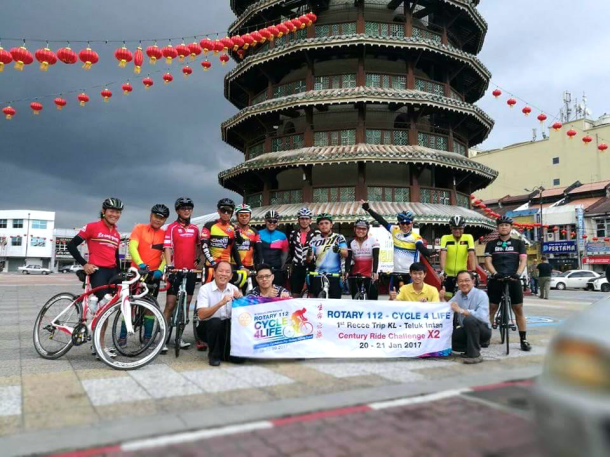
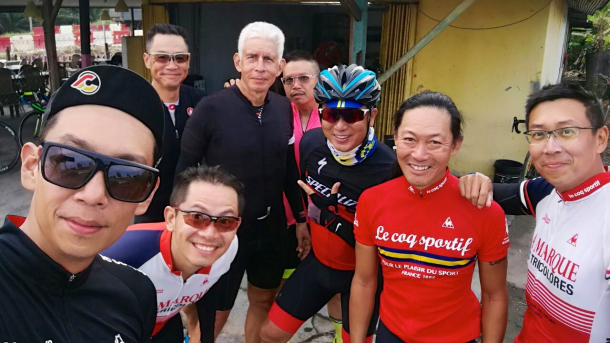
Twelve of us did the ride.  Rotarians Johny Sui and Yap Fatt Lam from the Rotary Club of Bukit Bintang, Steven, Ben, Jack, Cher, Mark, Leslie, Lay, Alvin, Liang and myself.  We were a diverse group of riders, ranging from Jack, who had never ridden more than 58km in one go before, to the likes of Alvin and Liang, who were on their fixies

rotary-kl-to-teluk-intan-start-yap-fatt-lam

Photograph courtesy of Yap Fatt Lam

We all met up at Rasik Bistro in Ara Damansara, where we had breakfast.  Then we loaded our overnight bags into the two support vehicles, driven by Javan and Ivan.

rotary-kl-to-teluk-intan-support-vehicle-ivan-wong-wai-keong

Photograph courtesy of Ivan Wong

Mark gave us a short briefing before we rolled out of the car park.  We were less than 2.5km / 1.5mi from the start point when a recurring feature of the ride made its first appearance.

rotary-kl-to-teluk-intan-first-flat-cher-weng-chun

Photograph courtesy of Cher Weng Chun

We would have half a dozen more punctures before we got back to KL.

We made our first rendezvous with the support vehicles at the junction of the LATAR Expressway and Jalan Kuala Selangor.  There we dipped into a ice chest filled with chilled Coca Cola and 100 Plus.

rotary-kl-to-teluk-intan-latar-cher-weng-chung

Photograph courtesy of Cher Weng Chun

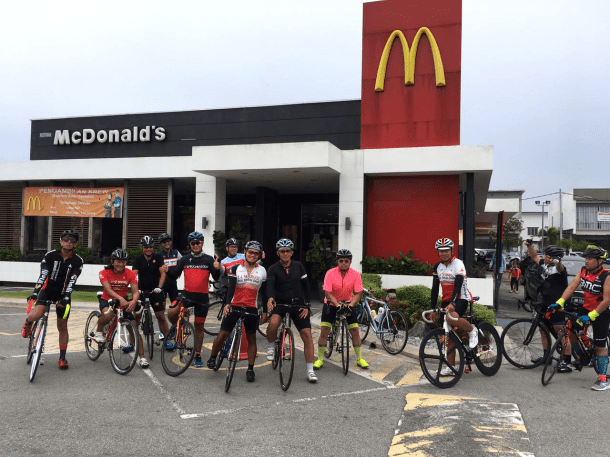
By the time we had covered 65km / 40mi it was time for a food stop.  The McDonald’s in Kuala Selangor did very nicely.  RI District 3300 should ask McDonald’s Malaysia to sponsor their charity work.  We certainly ate enough of their food over the two day ride.

The two guys in polo shirts are Javan and Ivan.  They drove the support vehicles, and were a great help to all the riders.

rotary-kl-to-teluk-intan-kuala-selangor-mcdonalds-cher-weng-chung

Photograph courtesy of Cher Weng Chun

90km /56mi into the ride we had reached Sekinchan.  It was past noon by then, sunny and hot.  The lady running this fruit stall must have felt like she had just won the lottery when twelve thirsty cyclists appeared, all demanding multiple cups of iced mango juice .

rotary-kl-to-teluk-intan-mango-juice-johny-sui

Photograph courtesy of Johny Sui

Once rehydrated, we decided to get off the main trunk road, Jalan Kuala Selangor – Teluk Intan, aka Route 5, in favour of the secondary roads that run parallel to it.  The road surface of Route 5 is damaged in a lot of places, and the speeding lorries, buses, and cars are no fun to share a road with.

We got onto Jalan Tepi Sawah, which literally means “the road beside the paddy field.”  Those smaller, traffic-free roads are so much more relaxing and pleasant to cycle on.

We rode past the Sekinchan Padi Box on the short jink between Route 5 and Jalan Tepi Sawah.  Padi Box is a homestay location made out of repurposed shipping containers.  A recent addition is N. 16, a restaurant in a converted bus, which I assume, once upon a time, was the number 16 bus.

rotary-kl-to-teluk-intan-padi-box-wc-cher

Photograph courtesy of Cher Weng Chun

At about 2pm we rolled into Sungai Besar.  We stopped at, surprise surprise, a McDonald’s.  This time just for drinks and a visit to the bathroom, although one or two hungry ones had a burger as well.

The rest of us held off eating until we got to Sabak Bernam.  Restoran Ammin Maju was a food stop on the Flipside ride to Teluk Intan, and so it was for the Rotarians as well.

Here we are, fed and watered, and after yet another inner tube change, ready for the final 40km / 25mi push to Teluk Intan.

rotary-kl-to-teluk-intan-sabak-bernam-yap-fatt-lam

Photograph courtesy of Yap Fatt Lam

We made it before the rain!

rotary-kl-to-teluk-intan-menara-chondong-wc-cher

Photograph courtesy of Cher Weng Chun

Drinks all round before picking up our room keys at the Yew Boutique Hotel next door.

rotary-kl-to-teluk-intan-finish-mark-lim

Photograph courtesy of Mark Lim

The main reason for the ride was of course to help the Rotarians to recce the route from KL to Teluk Intan for their August charity ride.

This came a close second on the list of reasons to ride once again to Teluk Intan!

rotary-kl-to-teluk-intan-dinner-mark-lim

Photograph courtesy of Mark Lim

There were twenty of us at Restoran D’Tepian Sungai.  Riders, support vehicle drivers, and distinguished guests from the Rotary Clubs of Bukit Bintang, Titiwangsa and Teluk Intan.

We went through 6kg / 13.2lb of Grade A udang galah, 1.5kg / 3.3lb of batter fried squid, plus plates of chicken, omelettes, mixed vegetables, and rice.  All washed down with twelve pitchers of watermelon juice and orange juice.

A very big thank you from all the riders to Amy Kong, President elect of the Rotary Club of Bukit Bintang and five others Rotarians: Sherman, Wilson, Elsie, Steve and Wendy, for generously picking up the dinner tab.  Very much appreciated!

The ride back to KL started just like the ride the morning before.  With a flat tire.  This time before we had even left the hotel.

rotary-teluk-intan-to-kl-hotel-flat-yap-fatt-lam

Photograph courtesy of Yap Fatt Lam

That wouldn’t be the last opportunity to stand around watching someone change an inner tube!

The Yew Boutique Hotel is a stone’s throw from a 7-Eleven.  Which was a great place to restock the ice chest in the support vehicle, and to refill bottles.  And to take an arty photograph or two.

rotary-teluk-intan-to-kl-arty-fixie-shot-alvin-lee

Photograph courtesy of Alvin Lee

We opted for an alternative to riding along Route 5 again.  That road is the only way out of Teluk Intan, but there are options once you get to Sabak Bernam.  We regrouped after riding 35km / 22mi along Route 5, at the corner where we turned right onto Jalan Gertak Tinggi.

rotary-teluk-intan-to-kl-sabak-bernam-rest-stop-alvin-lee

Photograph courtesy of Alvin Lee

We wanted to stay on the back roads all the way to Sungai Besar, but we weren’t sure of the way.  We unintentionally ended up back on Route 5 for fifteen minutes before stopping for refreshments at Restoran Rashid Fadil RM3 in Sungai Besar.

It was the network of back roads again for us as we left Sungai Besar and headed south to Sekinchan.  We stopped at Kampung Batu 23 to raid the ice chest following behind us.  This turned out to be a convenient place to stop.  We all needed something to sit on as we waited for yet another flat tire to be repaired.

rotary-teluk-intan-to-kl-rest-stop-yap-fatt-lam

Photograph courtesy of Yap Fatt Lam

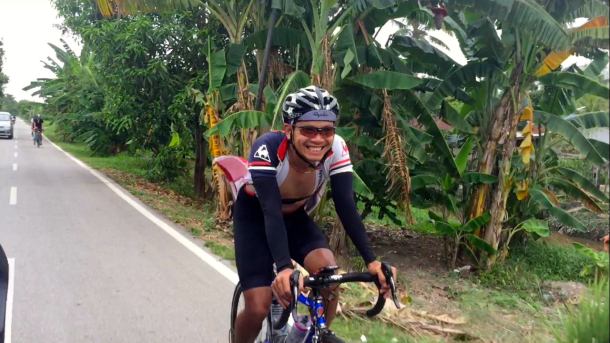
We were blessed with perfect riding weather from Kampung Batu 23 onward.  Clouds rolled in, and it stayed overcast and cool for the rest of the day.

rotary-teluk-intan-to-kl-on-the-road-4-liang

Photograph courtesy of Wong Thean Liang

rotary-teluk-intan-to-kl-on-the-road-1-liang

Photograph courtesy of Wong Thean Liang

rotary-teluk-intan-to-kl-on-the-road-2-liang

Photograph courtesy of Wong Thean Liang

rotary-teluk-intan-to-kl-on-the-road-3-liang

Photograph courtesy of Wong Thean Liang

rotary-teluk-intan-to-kl-on-the-road-5-liang

Photograph courtesy of Wong Thean Liang

By 2.30pm we had reached Sekinchan.  We had a very nice lunch at Restoran Bagan Sekinchan, and continued down the pleasant roads along the coast until we got to Tanjung Karang.  At which point staying off Route 5 was no longer realistic, especially as the bridge on Route 5 is the only way to get across Sungai Tengi.

You’ll never guess where we stopped in Kuala Selangor for drinks and to regroup.

rotary-teluk-intan-to-kl-kuala-selangor-javan-yap

Photograph courtesy of Javan Yap

About 70km / 43.5mi to go.  We took a slightly longer route to Bukit Rotan, via Kampung Kuantan, so that we could stay off Route 5, and spend less time on Jalan Kuala Selangor.

We stopped to raid the ice chest again at the entrance to the LATAR Expressway.  And stopped again at the Kundang Timur R&R, where we said our farewells to Ben, Cher, Jack and Steven, who were finishing the ride at MisiCafe in Bukit Jelutong.

Johny, Yap and we six Flipsiders ended our ride where we had started, at Rasik Bistro in Ara Damansara.

Thank you Rotarians for organizing the ride and the accommodation in Teluk Intan, and for providing the support vehicles and drivers.  And congratulations to all the cyclists for riding 350km / 217mi over the two days.

rotary-teluk-intan-to-kl-banner

Graphic courtesy of the Rotary Club Bukit Bintang

So How Much Do You Spend on Cycling?

cost-of-cycling-banner

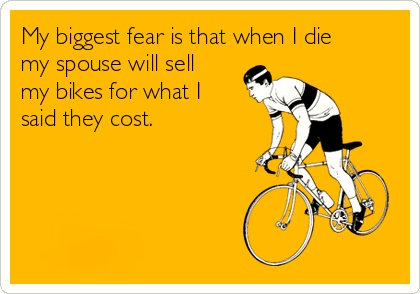
Graphic courtesy of http://www.someecards.com

This is a popular meme, available on mugs, T-shirts, hip flasks, canvas, posters and probably anything else that can be printed on.  Fortunately I don’t need to resort to creative accounting with my Biker Chick.  I can spend what I like on cycling.  And she can spend what she likes on her hobbies.  It is a good partnership.

But how much has this hobby cost me?

The biggest chunks of change went, of course, into the purchase of my bikes.  I have owned four road bikes since I started cycling in early 2010.

I think of the cost of my bicycles in terms of cents per kilometer ridden (CPK).  The more a bike is ridden, the lower its cents per kilometer figure, and the more value I am realising from that bike.

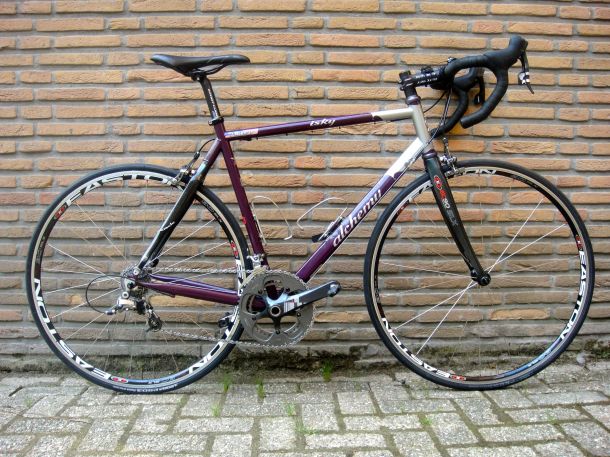
My first two bicycles have been sold.  The sale date CPK for my steel Alchemy, bought in January 2010, is USD 0.20 per kilometer.

alchemy-isky-1-1

My titanium and carbon Alchemy, bought in November 2011, ended at USD 0.38 per kilometer.

alchemy-isky-2-2

I put 32,700km into those two bikes before I sold them in August 2015.  Their CPK figures are after deducting the selling prices from the purchase prices.

Bike number three, my titanium Ritchey Break Away bought in March 2013, is currently at USD 0.53 per kilometer.

Ritchey Breakaway Ti

And my titanium Alchemy Eros, bought in July 2015, is already at USD 0.52 per kilometer.

alchemy-eros-full-side

Photograph courtesy of Alchemy Bicycle Co.

So far I have ridden a combined 23,000km on the Ritchey and the Eros.  The CPK for the Eros will go down faster than that for the Ritchey because I ride the Eros a lot more.  I already have more mileage on the Eros than I do on the Ritchey.

You could argue that defining the cost of my bikes in terms of cost per kilometer is a fudge.  Just another form of creative accounting that masks the true purchase price.  I like cost per kilometer.  It is a bit like depreciation of a fixed asset, but linked to the usage of that asset.  If I can get the CPK of my bikes down to USD 0.20, the money to buy those bicycles will be money well spent.

So that is the my fixed cost of cycling.  The bicycles themselves.

Then there is the variable cost.  The cost of everything else that goes with cycling.

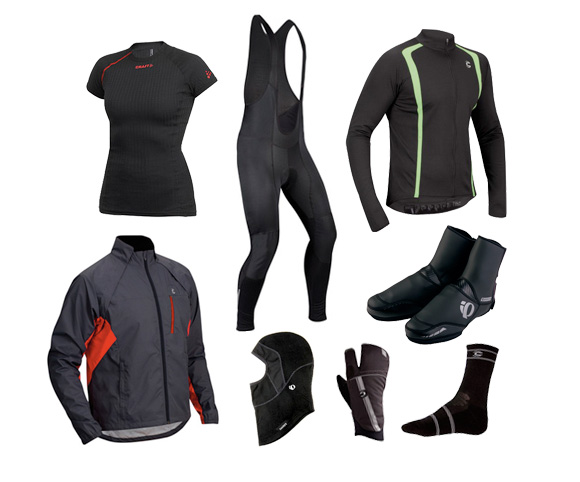
Over the years, the second largest amount of money I have spent has been on clothing and shoes.  Not helped in the least by the need to buy separate gear for winter and summer temperatures.  While I lived in Houston and Den Haag I owned cold weather versions of everything:  cycling shoes, shoe covers, socks,  bib longs, tights, long sleeved jerseys, base layers, arm warmers, jackets, gloves, hats, and even a balaclava mask.

cost-of-cycling-cold-weather-gear

Photograph courtesy of algerbikes.com

Next come accessories, gadgets and upgrades.  I’ve bought helmets, saddle bags, saddles, mini pumps, CO2 inflators, bottles and bottle cages, lights, bells, bike locks, and rear-mounted and roof-mounted bicycle car racks.  I’ve bought bike computers, and an indoor trainer. I have so far, however, resisted the gadget du jour, a power meter.  I have upgraded a set of wheels and a handle bar, and switched a standard crankset for a compact crankset.

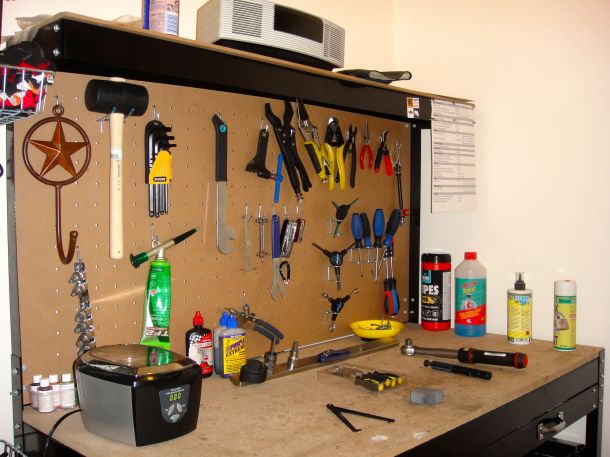
All cyclists end up owning some tools.  At the bare minimum, they have tire levers, a set of hex wrenches and a floor pump.  Those who do their own bicycle maintenance also own a selection of other tools.  These could include a cassette removal tool, a pedal wrench, a chain whip, a chain breaker, a torque wrench, spoke wrenches, cone wrenches, torx wrenches, cable cutters, a bottom bracket removal tool, and perhaps even a wheel truing stand.   I don’t have a truing stand, but I do have a work bench and a repair stand.

There is a surprising amount of money hanging on that pegboard.

tool-bench

In the maintenance vein are the costs of keeping my bicycles on the road.  I regularly spend on consumables like tires, inner tubes, chains, brake pads, cables, bar tape, and bearings.  I also had to buy new shifters to replace the ones broken in crashes, and replace a cassette that had been damaged by my riding for too long on a worn chain.  If you take your bicycle to a shop for a general service, that costs too.

Finally, riding in organised events is challenging and fun, but not free.  There are registration fees, and if the event is in another state, travel and accommodation costs come into the picture.

So it turns out that I have spent quite a bit on my hobby to date.  I estimate that over the seven years I have been a road cyclist, I have spent about USD3,000 per year on clothes, gizmos, parts and spares, etc.  And will probably continue to spend similar amounts in future years.

cost-of-cycling-spend

Photograph courtesy of http://www.imoney.my

I will be the first to admit that my fixed and variable costs are higher than they could have been.  I could still be riding that steel Alchemy, and not bought three other bicycles.  I own more jerseys and bib shorts than are really necessary.  The wheels that I upgraded from were perfectly serviceable.  I could do more bike maintenance myself, rather than sending the bikes to a shop.

However I enjoy researching all the latest and greatest gear, making a selection from the myriad of choices, and then owning and appreciating a quality jersey, or bicycle component, or tool.  It adds to the appeal of cycling.

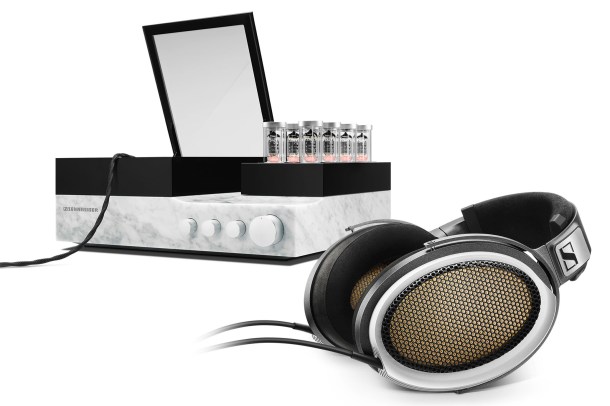
But it could be worse.  Much worse.  I could be into high-fidelity sound reproduction for instance.  A Sennheiser Reference Orpheus Headphone System, anyone?

cost-of-cycling-sennheiser

Photograph courtesy of Bloomberg


My Local Bike Shop (LBS)

Wikipedia defines local bike shop or local bicycle shop as a small business specializing in bicycle sales, maintenance and parts.

To become my local bike shop, the business has to meet a few more criteria.

  1. It has to be not more than 5km / 3mi from home.
  2. The staff are there because they love it and really want to be there.
  3. The staff are knowledgeable and keep up to date on the latest technology.
  4. The staff provides exceptional customer service.
  5. The shop provides value for money.
  6. The staff do not unnecessarily upsell, when a simple repair will suffice.
  7. Points 2 to 6 come together to create a “je ne sais quoi” that makes me want to go back there.

My first LBS was West End Bicycles in Houston, Texas.  The story of how I found West End Bicycles, in 2009, is here.

lbs-west-end-bicycles

Photograph courtesy of West End Bicycles

West End Bicycles has been in business for thirty one years now, and long may they prosper.  I moved away from Houston in 2010, but have been back a few times over the years to ride the BP MS150.  Most recently in April 2016.  Every time I visit Houston I make sure to call in at West End, which is my favourite LBS to this day.

I moved from Houston to Den Haag, The Netherlands.  It took me a year to find a group of like-minded cyclists to ride with.  By which time my bike needed a full service.  David Porritt introduced me to Tom Schouten Wielersport.

lbs-tom-schouten-wielersport

Photograph courtesy of Tom Schouten Wielersport

Like West End, Tom Schouten Wielersport is an owner-operated bike store.  Tom was always there to talk to and connect with his customers.

The personal touch matched the quality of service provided.  My bike felt like a new one when I got it back.  All the cables had been replaced.  The hubs, bottom bracket and headset had been cleaned and greased.  The wheels had been trued.  It had new bar tape.  It was cleaner than it had been since the day I took delivery of it.

The only downside?  It cost me €175 / USD187 / RM833.  Enough to convince me to attend a bicycle maintenance course!

There were a few other bike shops within a 5km radius of the Benoordenhout area where I lived.  Which would not be considered unusual in cycling-mad Holland.  Van Herwerden and Mammoet Rijwielen were two that I used on occasion when I needed an inner tube or a bicycle light.  Tom Schouten remained as my go-to LBS when my bike needed work that I couldn’t do myself, like replacing a broken spoke.

In 2012 I moved back home.  My first ride in Kuala Lumpur was with a group from Van’s Urban Bicycle Co.

lbs-vans-urban-bicycle

Photograph courtesy of BaikBike.com

It was during that ride up to Genting Sempah ride that my bike developed a nasty creak.  Read about getting that creak fixed at Van’s here.

Van’s Urban Bicycle Co. met most of my criteria for an LBS, except the “local” part.  The shop was in Petaling Jaya.  More than 15km / 9mi, through city streets, from where I lived.  Six months later the shop had moved to Kampung Tunku, which was even further away.

As time went by I gravitated to a group of road bike riders, rather than the folding bike riders that Van’s catered to.  Those roadies introduced me to Meng Thai Bicycle Centre.

lbs-meng-thai-bicycle-centre

Photograph courtesy of Meng Thai Bicycle Centre

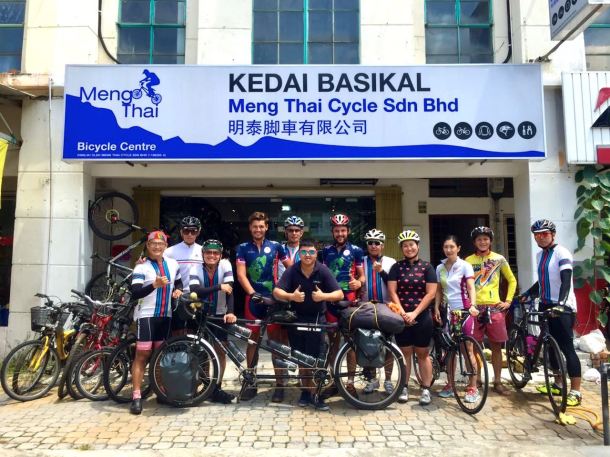
Like Van’s, Meng Thai Bicycle Centre ticked all the boxes, sadly except for the accessibility one.  The shop is in Kota Damansara, about 20km / 12.5mi away.  To make things worse, the traffic on the way there is usually terrible, and once there, parking spaces around the shop are very difficult to come by.  Which is a shame, because Husher and his team at the shop have that je ne sais quoi.

About a year ago Lee and another mechanic moved to their new branch in Kota Kemuning.

the-tandem-men-out-meng-thai-all-mark

Photograph courtesy of Mark Lim

The drive there and parking is much easier, but the Kota Kemuning shop is 40km / 25mi away.  Though I must admit that, despite the distance, that shop is relatively easy to cycle to from where I live.  Up onto the MEX Highway, and then onto the KESAS Highway to Kota Kemuning.  Nevertheless, Meng Thai Cycle is not local.

There is one bike shop that is a 6km / 4mi ride away from home.  I went there twice.  Once to address a mechanical issue, and once to buy an inner tube.  Both times I came away disappointed.  I didn’t feel that the mechanic knew what he was talking about with respect to the mechanical issue, and I was charged 30% above the market rate for the inner tube.  I will never go there again.

They say that good things come to those who wait.  A new bike store opened 2.5km / 1.5mi away in December 2016.  The Bike Artisans.

lbs-the-bike-artisans-2

Photograph courtesy of Adrian Goh

Jeff Liew has certainly given his bike shop a generous dose of je ne sais quoi.  Helped in no small measure by the drool-worthy bike frames, kit and accessories carried by The Bike Artisans.  Brands include Pegoretti, Stelbel, Look, Cervélo, Slide Away, Moulton, Black Sheep Cycling, PEdALED, Warsaw Cycling, Apidura, Kask, Tacx and MCFK Carbon.

Jeff is clearly passionate about the products in his shop, and he is happy to chat about all things cycling.  Lim is the in-house mechanic.  I am very happy with the shifting tuneups he did on both of my bikes.

And despite the high-end gear in the shop, an inner tube sells for the market rate.

I’ve found my Kuala Lumpur LBS.

lbs-support-your-local-bike-shop

Graphic courtesy of redbubble.com

Bikes on Trains in Kuala Lumpur

A rail-based rapid transit system came into being in Kuala Lumpur in 1995, with the introduction of the STAR Light Rail Transit (LRT).  This was followed by the PUTRA LRT in 1998, and the KL Monorail in 2003.  These three systems have since been placed under one administrative umbrella, and branded as RapidKL.

These privately operated commuter train systems supplemented the KTM Komuter service, which was introduced in 1995.  KTM Komuter is operated by the national rail company, Keretapi Tanah Melayu (Malayan Railways Ltd).

Bicycles were not very welcome on LRT and Komuter trains.  While folding bicycles have been allowed on LRT trains during off peak hours for many years, this quote from a 2009 online article in The Nut Graph is illustrative:

RapidKL considers bicycles, even folded ones, “potentially dangerous” to bring onboard an LRT. Hence, its policy restricting bicycles from LRT trains during peak hours.
RapidKL: Bicycles “potentially dangerous weapons”  The Nut Graph  17 September 2009

So it is not surprising that RapidKL had a long list of guidelines for commuters with folding bikes. in 2011 these guidelines were:

  1. Inform station personnel of your intention to bring a foldable bicycle onboard.
  2. Bicycles MUST be folded and once folded, dimensions must not exceed 3 x 2.5 x 1.5 feet.
  3. Bicycles must be dry and clean from oil/mud/grease. This is to ensure grime from the tires or the working parts does not contaminate the trains.
  4. Bicycles must not block the aisles and doors or impede commuter movement at ANY time.
  5. When taking the Kelana Jaya Line, cyclists with foldable bicycles must stand near the door, while on the Ampang Line cyclists must stand near the Driving Cab area.
  6. If traveling in a group, only FIVE (5) cyclists are allowed with the bicycles on board the Ampang Line, and if traveling on the Kelana Jaya Line only TWO cyclists are allowed. If traveling on the bus only ONE cyclist and foldable bicycle is allowed at one time.
  7. All folding and unfolding activities must be done outside the station area.
  8. Please use good judgement and logic whenever you travel with a foldable bicycle onboard the LRT

But things were about to change.  Cycling was becoming increasingly popular in Malaysia in general, and in Kuala Lumpur in particular.  A group of cycling activists coalesced around Jeffrey Lim, who in 2012 had the idea of creating a bicycle map for Kuala Lumpur.  2012 was also the year in which an avid cyclist, Tan Sri Ahmad Phesal Talib, took office as the mayor of Kuala Lumpur.

The Bicycle Map Project became a reality in September 2014, with the first print run of 10,000 copies of the bicycle route map.  You can view and download a copy of the map here.

The mayor of Kuala Lumpur worked with Jeffrey Lim on a number of cycling-related initiatives, including the creation, in 2015, of the first official cycling lane in the city.  Read more about the creation of the bicycle route map and related Kuala Lumpur City Council efforts here.

The mayor has continued to drive initiatives to develop a cycling culture in Kuala Lumpur.  For example, the KL Car Free Morning, introduced in 2014, is now a twice-monthly opportunity for cyclists, joggers, walkers and skaters to take over major streets of the Golden Triangle.

That cycling culture has infiltrated RapidKL and KTM Komuter.  In September 2015 RapidKL announced efforts to encourage more commuters to cycle, by reaffirming that commuters can take folding bicycles aboard LRT trains during off peak hours.  Those limitations are understandable as the LRT carriages are compact, and often very full, even during off peak.  Kuala Lumpur City Hall also announced plans to provide bicycle storage areas at all LRT stations.

Of more interest to me, as a roadie, is what KTM Komuter  announced in June 2016.  As part of a new, first-of-its-kind programme called “Ride N’ Ride”, KTM Komuter now allows all types of bicycles inside Komuter trains.  Foldable bicycles are allowed at all times, while full-sized bikes are only allowed during off peak hours.

I had my first experience on being on a KTM Komuter train with my bicycle today.  Lay, Henry, Leslie and I rode from Kuala Lumpur to Seremban in the morning.

After lunch at the Pasar Besar Seremban, we pedalled the kilometer or so to the Seremban railway station.  A ticket to take a bicycle on board the train is RM2 / USD0.45.  My fare from Seremban station to Bank Negara station was RM9.00 / USD2.00.  Not bad for a 55km / 34mi journey.

The train arrived on schedule.  Always a good start to any rail journey.

ktm-komuter-at-seremban-station

Photograph courtesy of Leslie Tong

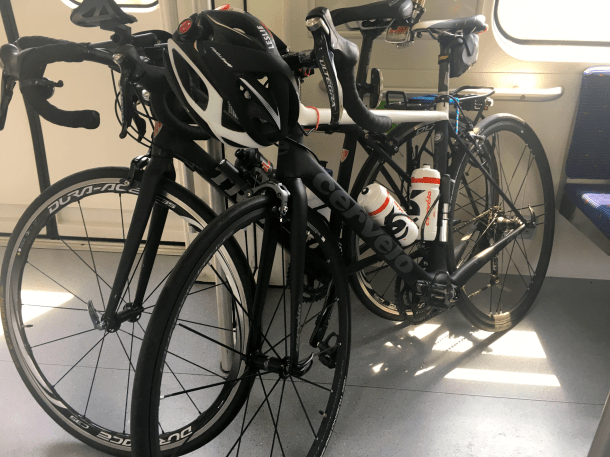
We had a very pleasant ninety minute ride, in air-conditioned comfort.  The space allocated for bikes in the first and last carriages of each Komuter train is more suited to folding bikes.  But the powers that be at KTM are clearly okay with full-sized bikes in the two designated carriages.

I brought slippers with me.  They definitely made moving around the stations and the train easier.

ktm-komuter-chilling-2

Photograph courtesy of Leslie Tong

The whole trip was such a success that we are already planning more Ride N’ Rides, to use KTM’s tagline.  There are a few possibilities to choose from amongst the stations that KTM Komuter serves.

ktm-komuter-route-map-2

Graphic courtesy of http://www.spad.gov.my


I see more of this in my future.

KTM Komuter Bikes.png