Category Archives: Cycling in Texas

2013 BP MS150 Day Two

Posted on

Riders have the choice of three official starting points for Day One:  Tully Stadium in Houston, Rhodes Stadium in Katy, and Waller Stadium in Waller.  Who knows how many unofficial starting points there are.  The Omni Houston at Westside was where we started.  The advantage of multiple starting points is that all 13,000 riders aren’t crowded into one location.  Which is the case at the Day Two start at La Grange.

If you join the pack toward the rear it can take forty five minutes or more to cross the start line once riders are released from La Grange.  It was immediately clear that we had left it a bit late to wheel our bikes toward the start line.  Dane reckoned he had never waited behind as many people for a Day Two start before.
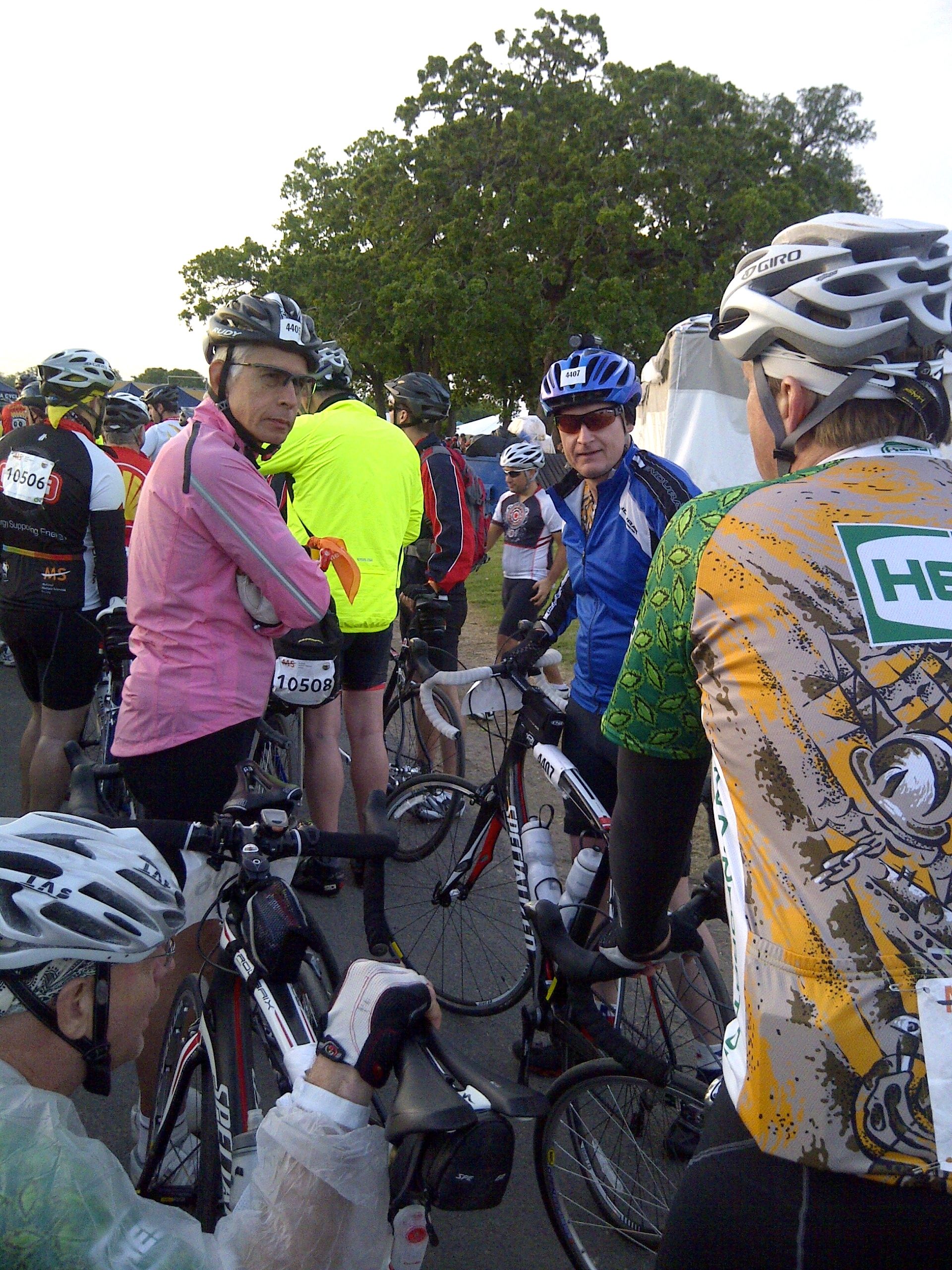
BP MS150 2013 Waiting to leave La Grange Johan, MOT, Skip and Dane

Photo courtesy of Barbara Luksch

Our collective relief that is was not as cold as it had been twenty four hours earlier faded as the stationary wait stretched toward the hour mark.  Our core temperatures steadily dropped  along with the ambient temperature as it cooled to 10°C / 50° F just before dawn.  I may have been in the pink, but I was turning blue.
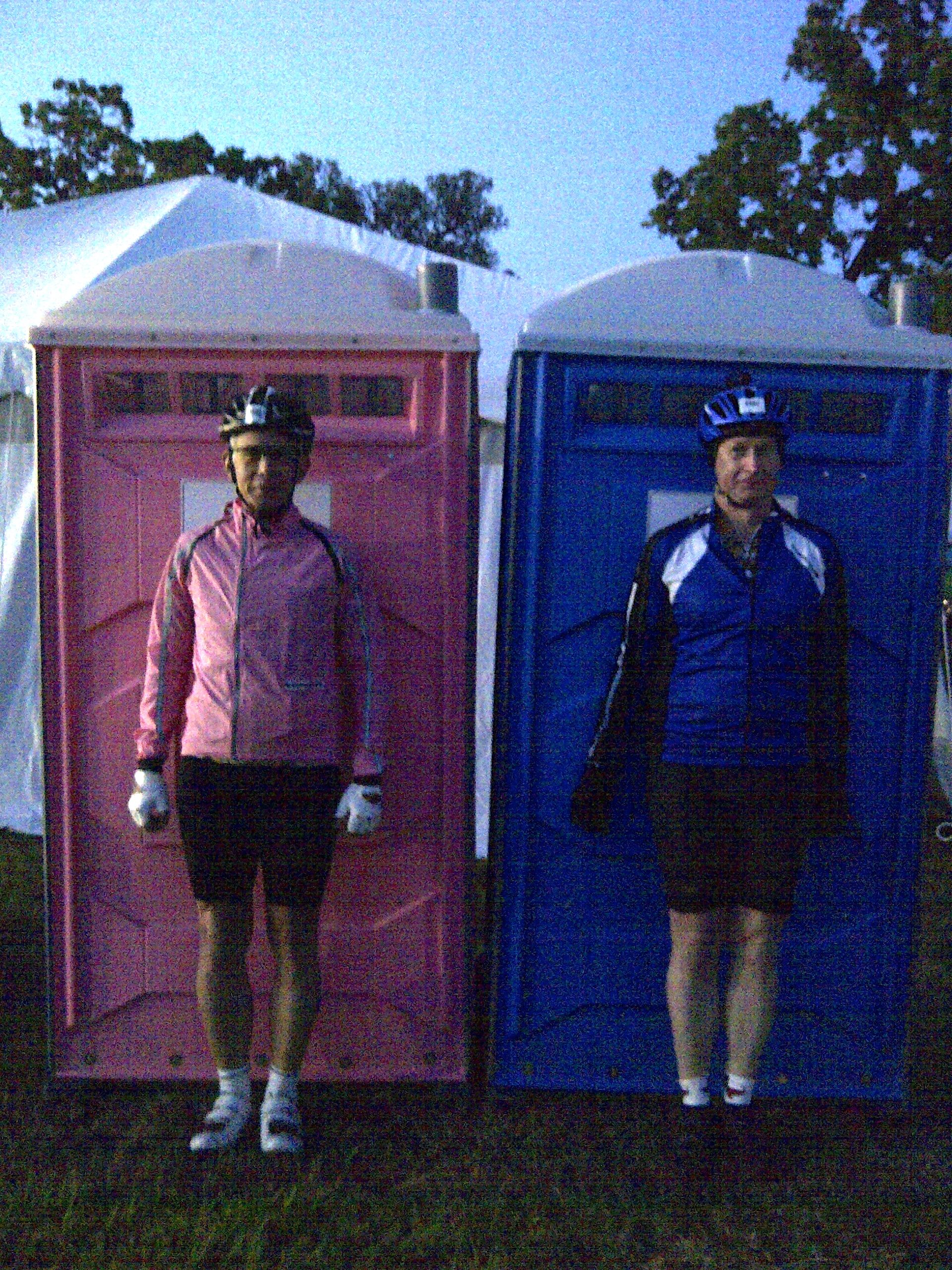
Photo courtesy of Barbara Luksch

Photo courtesy of Barbara Luksch

By the time we rolled over the start line I was shivering so badly that my bike was wobbling around.  Once again I rued my choice of bike clothing, and was desperate for the sun to come up.  This gentleman never fails to lift the spirits.  He occupies the same spot every year, about 12 km / 7.5 mi from La Grange.  It is worth the time to stop to listen to him play for a while.  And to soak up some sunshine!

BP MS150 2013 Bagpiper

We had elected to do the Bechtel Challenge Route through Buescher State Park and Bastrop State Park.  The parks had been devastated by a wildfire that swept through Bastrop County in September and October 2011.  The fire damage was so significant that the Challenge route was closed in 2012.  I was interested to see how different the park was compared to what I rode through in 2011.  Barbara was excited and nervous about riding through the park for the first time.  Tom, Skip and I did our best to convince her that she would have no problems with the hills in the park.
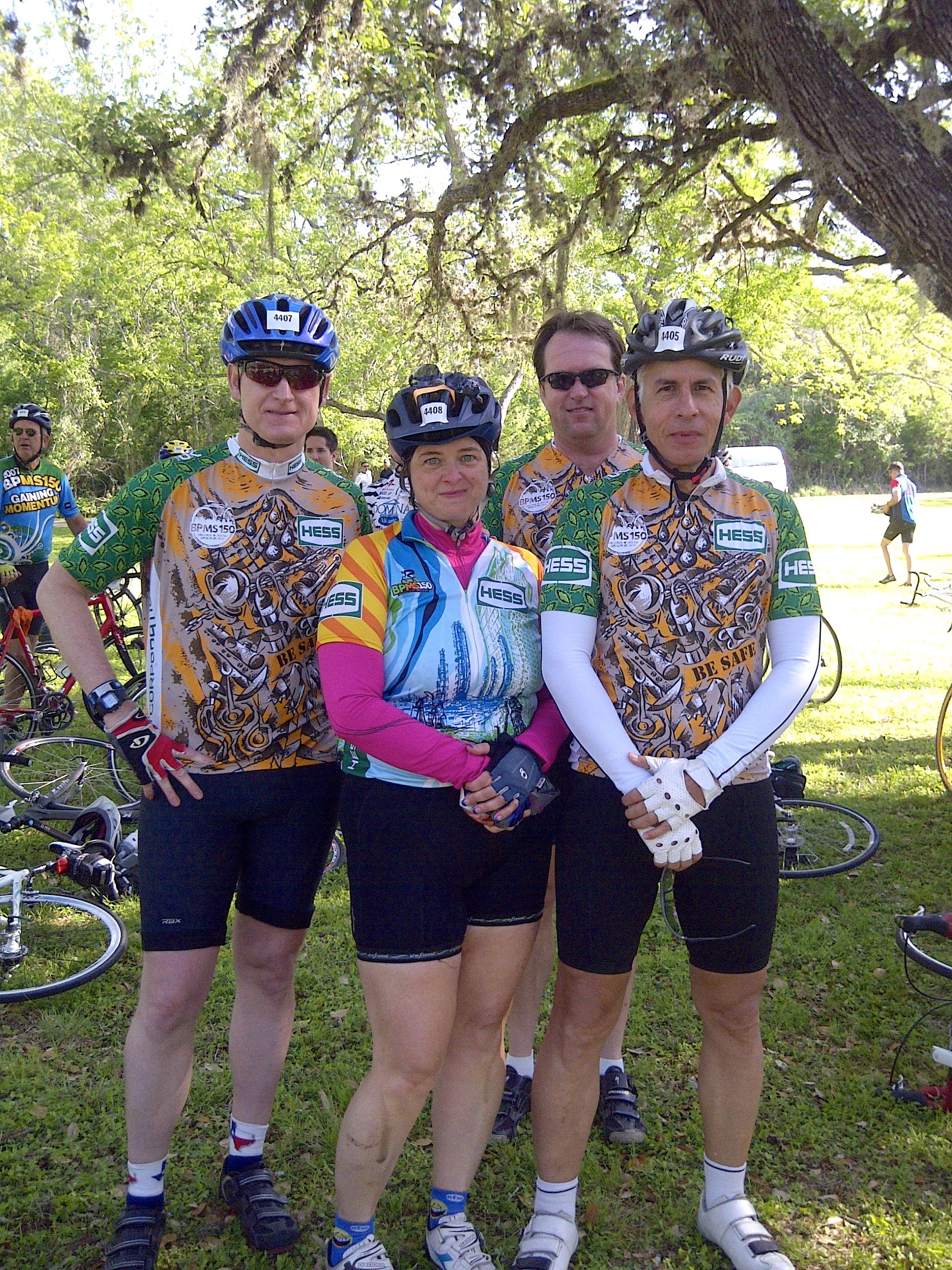
Photo courtesy of Barbara Luksch

Photo courtesy of Barbara Luksch

Naturally there is a huge amount of damage to the loblolly pines and other trees and vegetation in the parks.  These scars will remain for years to come.

BP MS150 2013 Bastrop State Park Fire Damage

In return the fire has created some beautiful vistas and opened up the visibility of the terrain. Tom and I commented that we weren’t able to see the topography the last time we rode through Bastrop State Park.  At one point we found ourselves on a ridge overlooking a view that we didn’t even know existed.  The park has a very different, and to my mind a better look to it.  I enjoyed being able to see the road ahead winding through the trees,

BP MS150 2013 Bastrop State Park Road

We made our traditional lunch stop at Whataburger in Bastrop.  Barbara was so excited at having ridden the park that she announced the fact to all at the restaurant.  She was given a flower to commemorate her achievement.
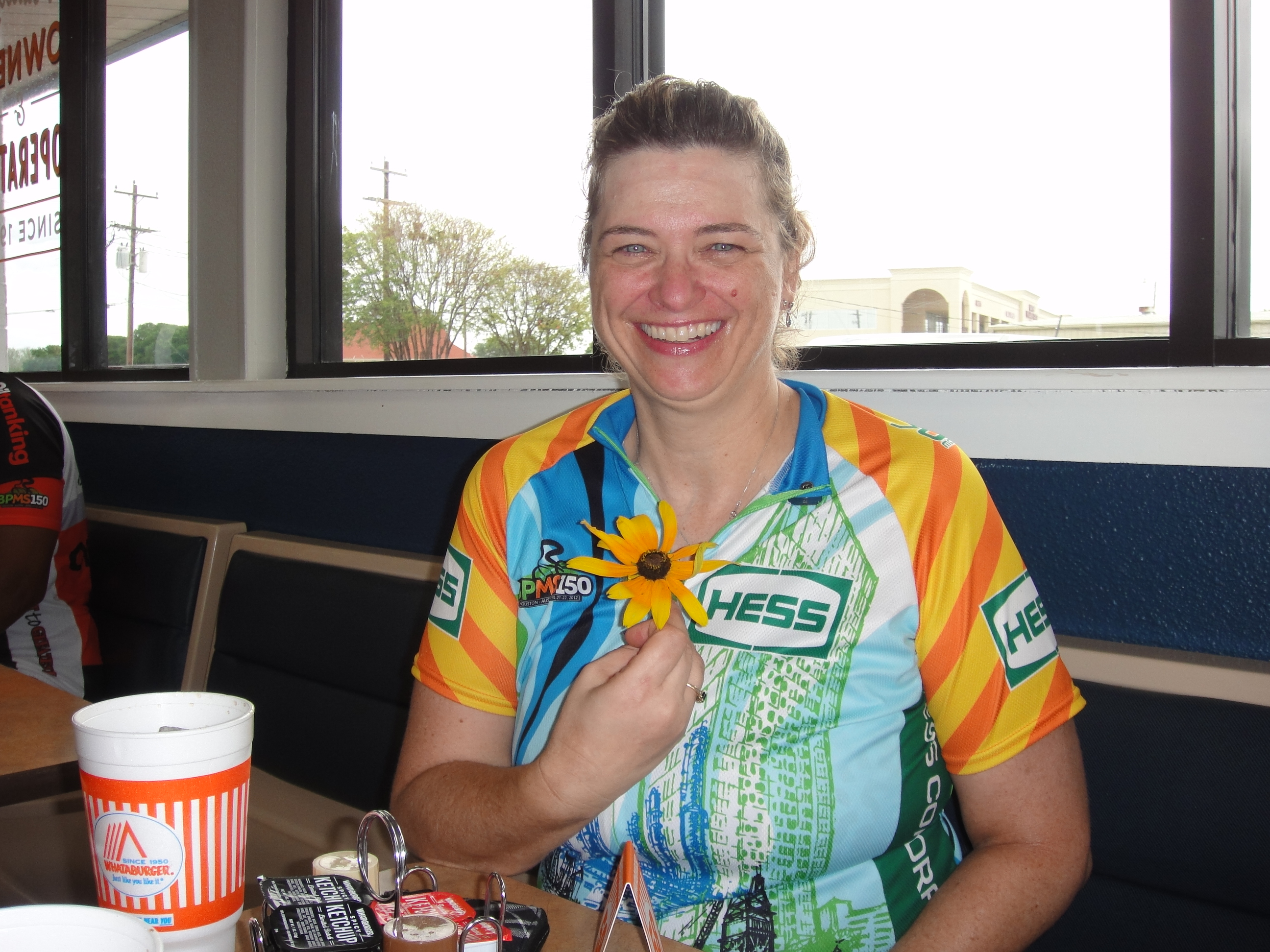
BP MS150 2013 Barbara Flower

The plan after the parks and Whataburger was to meet up at The Moose Lodge so we could ride the final 5km / 3mi as a group.  As it turned out we regrouped at the two rest stops before Austin as well.  There is always lots to see at the rest stops – besides the lines for the toilets..

BP MS150 2013 Mohawk

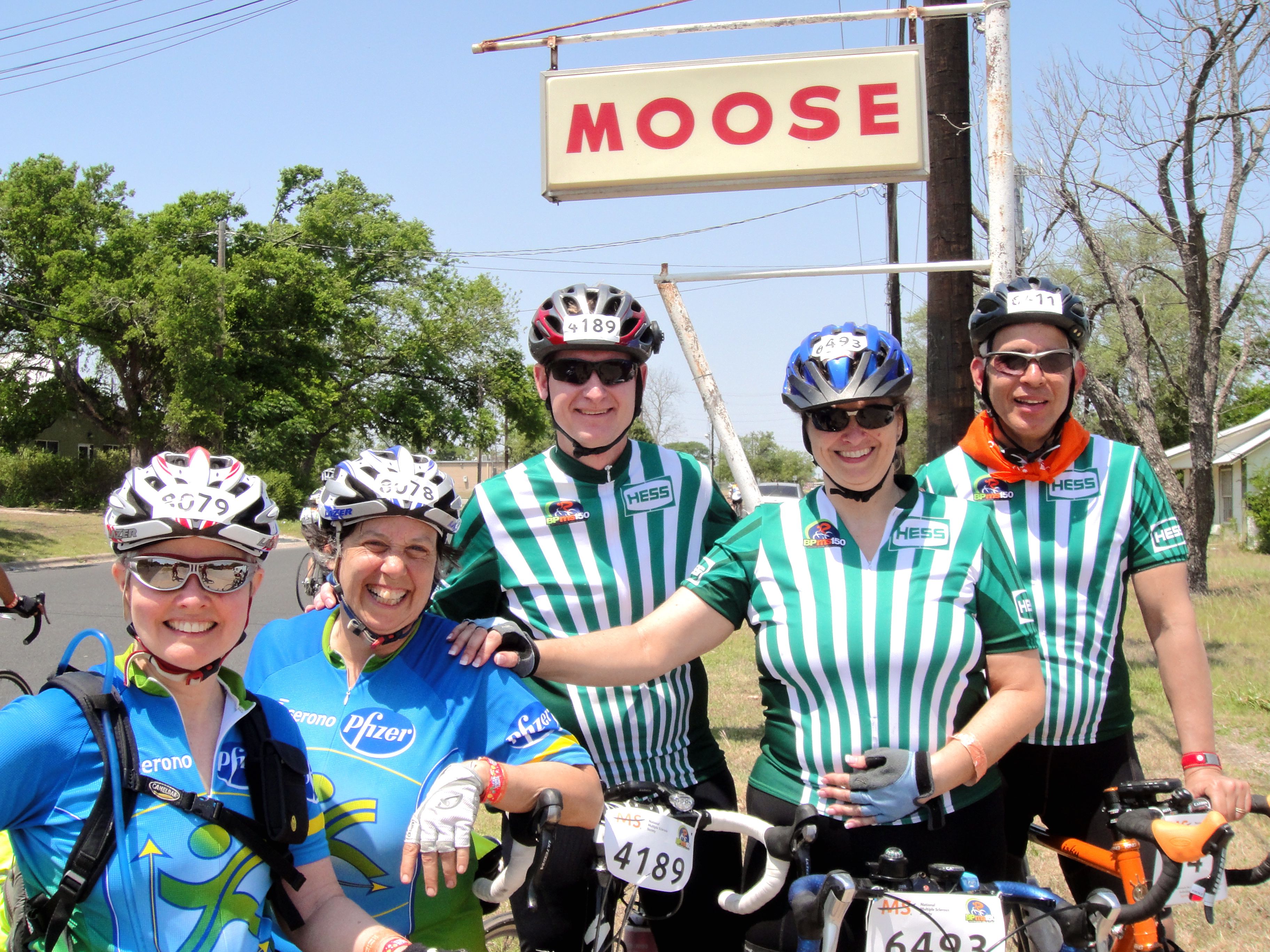
We took a “Non-Hess members of Team Hess” photo at the last official rest stop before Austin.
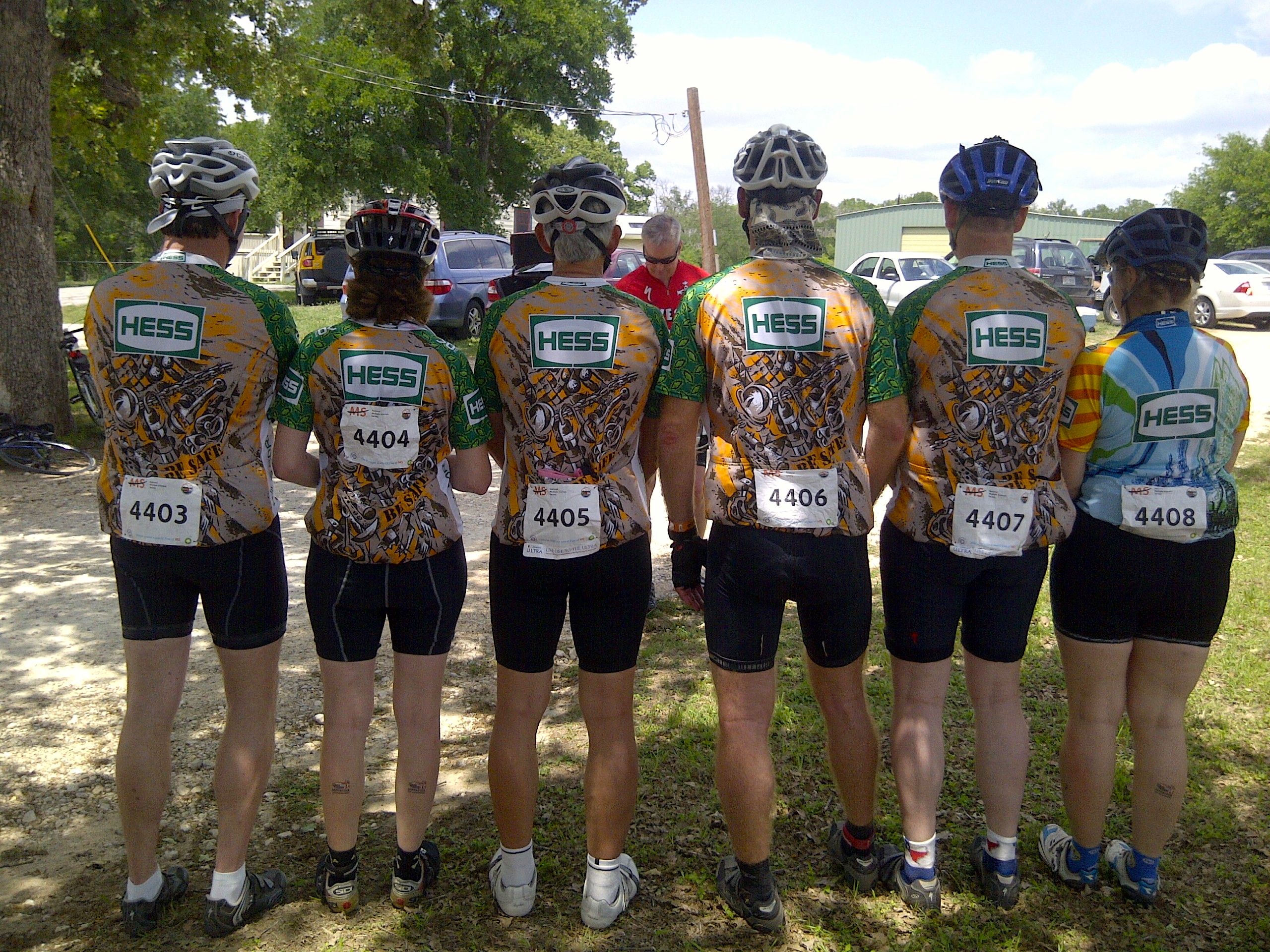
Photo courtesy of Barbara Luksch

Photo courtesy of Barbara Luksch

We met up at The Moose Lodge as planned.  We missed The King though.

BP MS150 2013 The Moose Elvis

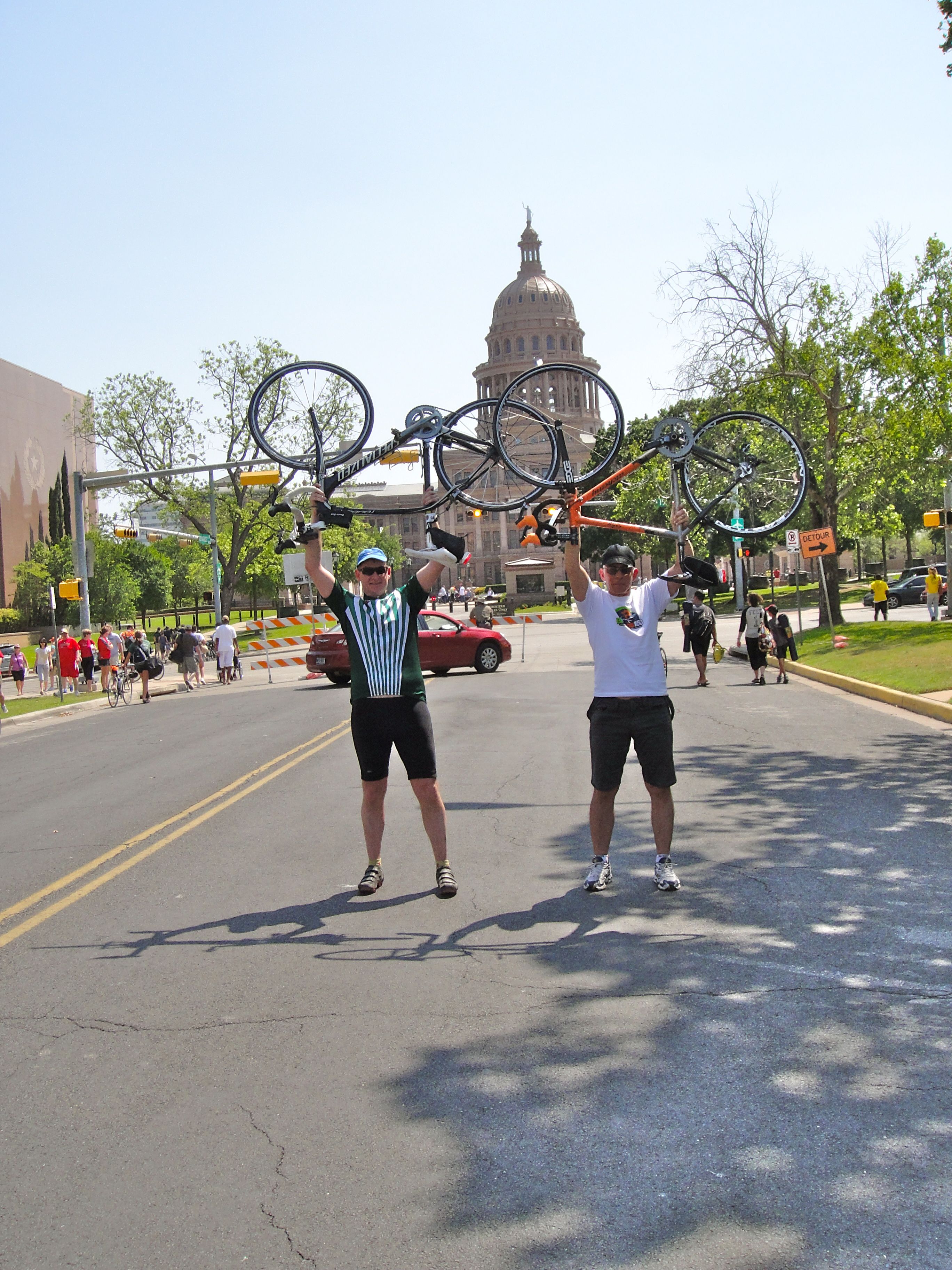
Everyone made it safely to the finish in Austin.  Our group suffered no flat tires or falls over the two days and  280 km / 174 mi.  Everyone thoroughly enjoyed the ride.  It was another brilliant BP MS150.  I wouldn’t want to say that this was my last.  After all I have a travel bike now.

BP MS150 2013 Glory Shot 02

The National MS Society is still accepting donations linked to this ride.  The society is depending upon your generosity to raise as much as possible to put toward the search for a cure for multiple sclerosis.  Please click on the link below to make a donation to this worthy cause.

Donate to Multiple Sclerosis Research and Treatment

2013 BP MS150 Day One

Posted on

BP MS150 2013

The lead up to this year’s BP MS150 ride from Houston to Austin was faultless.  Barbara collected my rider pack and Hess jersey for me.  Malaysian Airlines and KLM got me to George Bush Intercontinental Airport as scheduled.  Tom and Donna were waiting outside Arrivals for me.  The Omni Houston Hotel at Westside had my room ready.  Most importantly Fedex had delivered my Ritchey Break-Away bicycle to the hotel.

The first thing to do was to put the bicycle together.  My bike came with a Ritchey torque key that fits the 4mm bolts on their bars and stems, as well as the bolt on the hinged clamp that anchors the flanged joint on the down tube.  Steve Dodds at Bicycle Doctor USA had told me to pack an 8mm Allen key to install the crank with.  I also packed 6mm and 5mm Allen keys for the seat post and saddle mounting bolts.  Four Allen keys and a pump were all I needed to get the Break-Away ready to ride.

The plan was to do the Thursday evening ride with the West End 6.30 group.  That would have been the perfect shakedown ride for my brand-new bike, if not for the rain that afternoon.  Instead Tom and I made do with a quick 8km / 5mi loop around Memorial Park on Friday.  If that short spin was anything to go by, the Ritchey Break-Away was going to serve me very well.  The ride quality was everything I expected from a titanium frame.  The SRAM Force group set shifted precisely.  The brakes had good modulation and stopping power.  I didn’t expect problems during the ride to Austin but we stopped at West End Bicycles to get the bike inspected anyway.  It is worth getting an official inspection sticker.  If I did have a problem during the ride I would receive free labor for repairs.

The weather when I arrived on Thursday was unusually cool.  When we started the ride from the hotel at 6.30am on Saturday morning it was unseasonably cold.  It was 4°C / 39°F.  That was a record low temperature for April 20th.  The previous low was 6°C /44°F set in 1901.

Needless to say in my group I was probably the least appropriately dressed for the temperature.  I was riding with Barbara, Laura, Dane, Joe, Skip and Tom.  Everyone was cold, but I was chilled.  It had warmed up by the time we got to the lunch stop at Belleville, but not enough for me to take my jacket off.  Barbara and Dane kept their arm warmers on, unlike  Laura and Skip.

BP MS150 2013 Bellville Group

Relatively normal temperatures for the time of year were restored by the time we got to the stop at Industry.  West End Bicycles was operating their customary service stand there.  Complete with yummy snacks.  There was time for a post-cookie fist bump with Tom before we hit the road again.

BP MS150 2013 Industry West End 02

Fayetteville is always a treat to ride through.  The residents come out in force to cheer the riders on.  And ring bells and blow whistles and generally carry on.

BP MS150 2013 Fayetteville Welcome 01

We had an additional treat in store for us at Fayetteville this year.  Skip knows a lady who runs an antique store out of a converted gas station.

BP MS150 2013 Antique Shop

For MS150 day she bakes all sorts of cakes and cookies which she lays out for anyone who wants some.  Not everyone knows about this though.  So hooray for Skip and his insider knowledge!

BP MS150 2013 Fayetteville Munchies

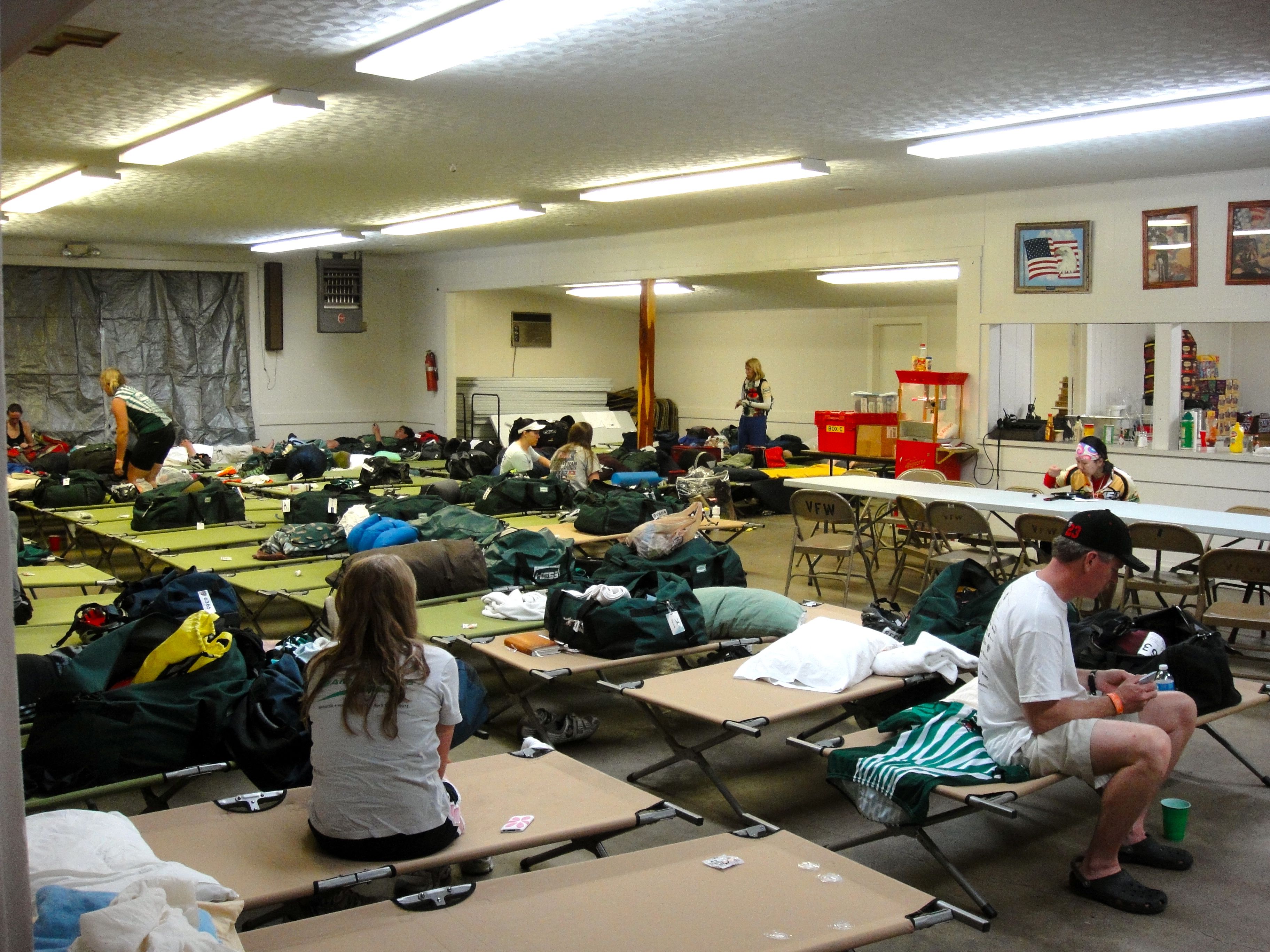
We had about 30 km / 18.5 mi to go to La Grange.  Dane headed out ahead of the rest of us.  His plan was to get to the VFW Hall early enough to reserve prime sleeping spots for us all.  We wanted a row of six camp beds near a wall socket.  We all had electronics that needed recharging.  We didn’t get the row we had hoped for, but we were near a coveted wall socket.  This is Tom watching Dane get sorted out after their turns in the private shower truck that Hess provides for its team.

BP MS150 2013 VFW Hall

This year the Hess bar featured recovery drinks made to order.  Just the ticket after a hot shower and before a massage.

BP MS150 2013 La Grange Recovery Drinks

We are all spoiled by the excellent support that Hess provides to its riders.  Air-conditioning, private showers, indoor toilets, an open bar, ear plugs in case the snoring gets too loud.  I’m not sure how we managed when we rode with other teams and had to endure conditions like this.

BP MS150 2013 Life on the other side of the tracks

Tom, Skip, “Sideshow” Dane and I went for a wander around the Fayette County Fairgrounds to stretch our legs before dinner.

BP MS150 2013 Dane 'Sideshow Bob' Schiller

We had ridden 160 km / 100 mi.  That made it my longest Day One in the three times I have ridden the BP MS150.  I was still a bit jet-lagged and very ready to call it a day as soon as I had finished my dinner.  Day Two wasn’t far away.

The National MS Society is still accepting donations linked to this ride.  The society is depending upon your generosity to raise as much as possible to put toward the search for a cure for multiple sclerosis.  Please click on the link below to make a donation to this worthy cause.

Donate to Multiple Sclerosis Research and Treatment

Now There Are Three

Posted on

What is the correct number of bikes to own?

Courtesy of Kickstand Comics by Rick Smith and Brian Griggs

Courtesy of Rick Smith and Brian Griggs at yehudamoon.com

I’ve seen a third variation:  S – 1, where S is the number of bikes owned that would result in separation from your partner.

While I do not intend to discover the value of S where my biker chick is concerned, I can report that in her case S > 3.  I took delivery of bicycle number 3 last month. And my biker chick and I are still a happy unit.

Thoughts of a new bike started percolating in my mind as I planned a trip to the USA to ride in the BP MS150 from Houston to Austin, and the TD 5 Boro Bike Tour in New York City.  My friend Keat and I had discussed the travails of flying with a bicycle.  Airlines charge between USD 100 and USD 150 to transport bicycles.  Despite the additional fee, there is the ever-present danger of damage in transit – see United Breaks Guitars.

One way to avoid the additional fee and to mitigate the risk of damage in transit is to have a bike that can be disassembled and packed securely in a case which meets airline size restrictions.  Keat owns such a bike.  A Ritchey Break-Away travel bike.  He showed me the bike in its case, then assembled the bike and let me try it out.

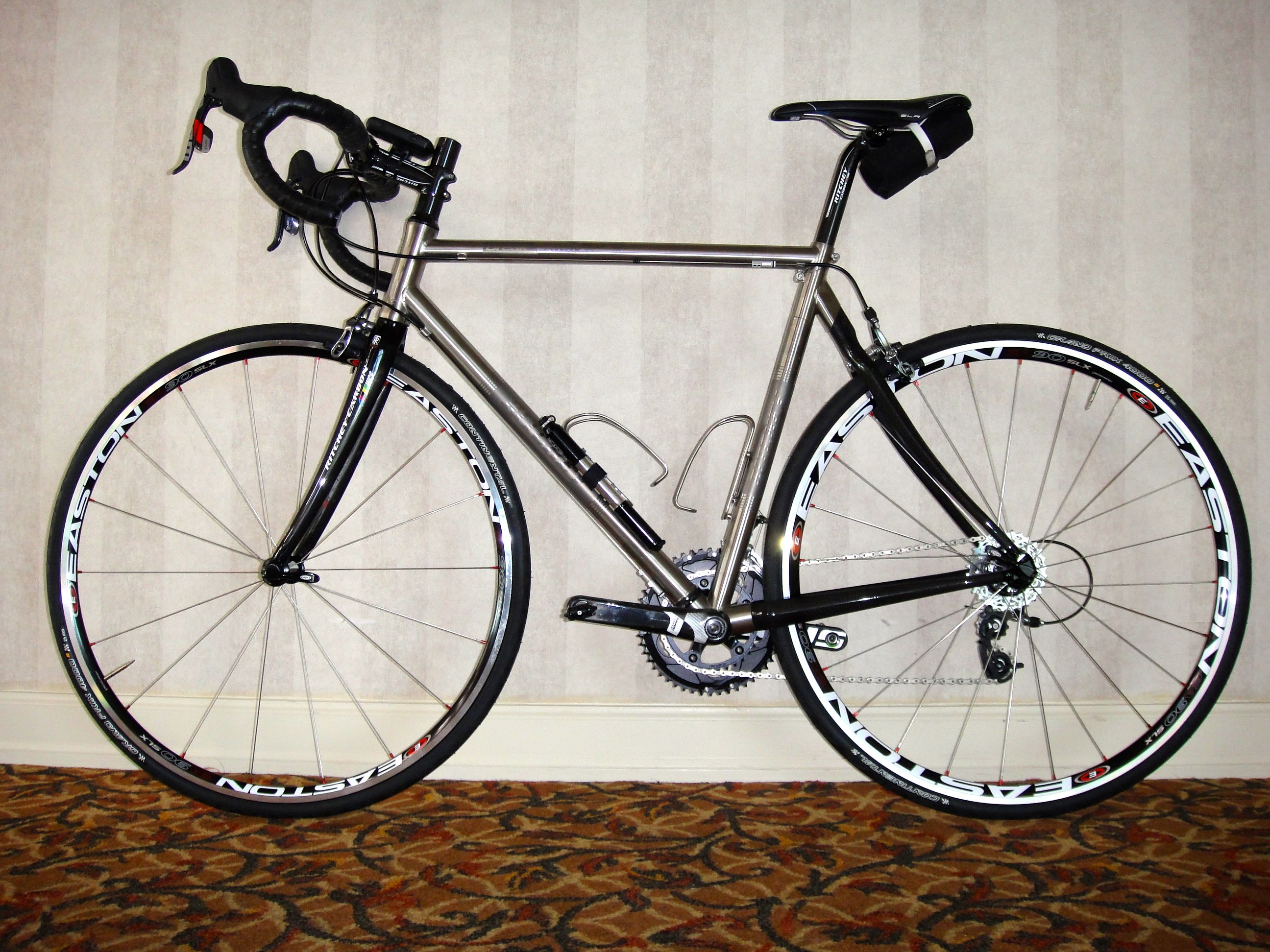
I now own a Ritchey Break-Away Road Ti / Carbon travel bike.

Ritchey Breakaway Ti

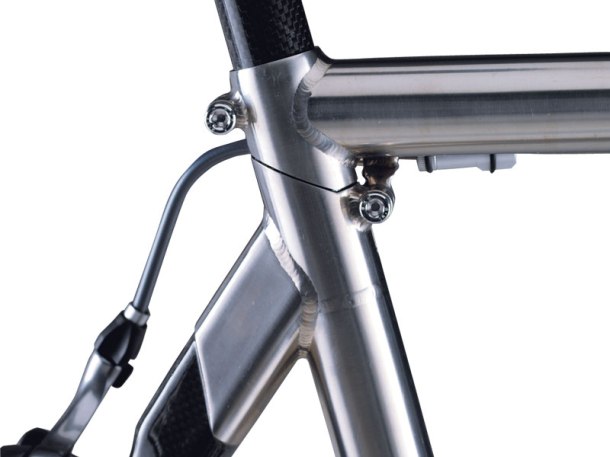
Ritchey has designed an elegant coupling system for their travel bikes.  The two halves of the frame are held together by three bolts and a hinged clamp.  Two bolts secure the top tube and the seat tube to the seat post.  The seam between the top tube and the seat tube is visible below.  Also visible below the top tube is a cable splitter.  In this case for the rear brake cable.  The two halves of the splitter screw together to join the cable.

Photo courtesy of Jon Sharp at www.gearreview.com

Photo courtesy of Jon Sharp at http://www.gearreview.com

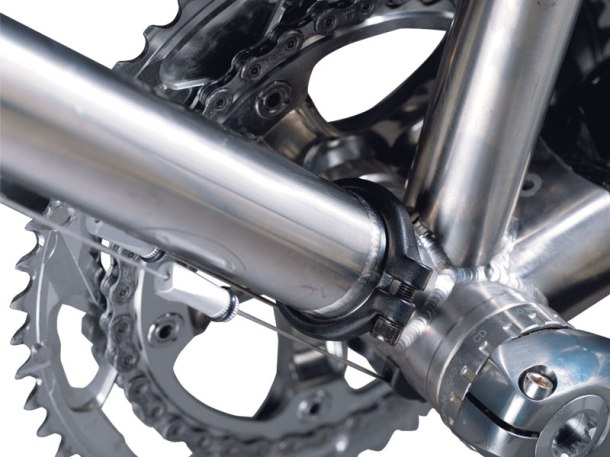
A flanged interface between the bottom bracket and the down tube is secured by a hinged clamp.  One bolt holds the clamp in place.

Photo courtesy of Jon Sharp at www.gearreview.com

Photo courtesy of Jon Sharp at http://www.gearreview.com

Also visible in the photograph above are the two other cable splitters.  The frame can be broken down into two halves in a matter of a minute.  Admittedly it does take more than loosening three bolts and three cable splitters to get the bike into its case.  I opted for an S&S Butterfly Latch hard case rather than the Ritchey soft case.  The dimensions of the case are 66cm x 66cm x 25cm / 26″ x 26″ x 10″.  The total length plus width plus height equals the airline standard maximum size for checked luggage.
In practical terms the case is just large enough to fit a 700c wheel.  It doesn’t look possible in this photograph, but with no air in the tire the wheel squeezes in.

S&S Hard Case

The first time I tried to get all the bike parts into the case it took me about forty five minutes.  With the help of ‘how-to’ videos and PDFs.  I have packed the bike three times now.  The third time was no faster, but I don’t need the visual aids anymore.

The easy step is separating the bars from the stem, removing the front brake from the fork, releasing the wheels, taking off the pedals and cranks, and unbolting the rear derailleur from the derailleur hanger.

The next step is to prepare everything for packing.  All the tubes and the fork go into the supplied wraparound covers.  There is an elastic strap that goes over the large chainring teeth, and a cover  for the chainrings.  Hub axle caps for the wheels and dropout spacers are also included.  The rear derailleur gets bubble wrapped.  I bought velcro cable ties to secure cables to the bars and the chain to the chain stay.

The final step is to fit everything into the case.  I prefer the S&S method to the Ritchey method.  The front triangle and fork go in to the case first.  The rear wheel is next.  Then comes the rear triangle.  The saddle, bars and crankset slide through and between the triangles and wheels.  Finally the front wheel goes on top.  There is enough space around and between the parts of the bike for shoes, tools, bottles and clothes.  It took a few attempts to position everything so that the case would close.  Here I am tightening everything down, ready for my first trip with the bike, from Houston to Denver.

The white disks and upright pipes are compression members.  Pressure is kept away from the packed bicycle by transferring loads from one side of the case to the other side through the plastic pipes which are held in place by plastic disks on either end.  The compression members work so well that I can stand on the case without deforming the sides of the case.

Photo courtesy of Azie Azizuddin

Photo courtesy of Azie Azizuddin

I ordered my Ritchey frame online from Bicycle Doctor USA.  This shop came up on Google as one of the larger Ritchey dealers around.  I emailed an enquiry about the availability of a Break-Away to Bicycle Doctor USA and two other shops.  Steve Dodds of Bicycle Doctor responded within three hours.  I didn’t hear from the other two places.

Steve and his son Eric have received many positive reviews and comments.  Those allayed some of my concerns about conducting what to me was a large transaction over the internet.  A telephone conversation with Steve put any other worries I had to rest.  Steve is easy to work with.  I get the feeling that Eric and he run a busy shop.  Despite that I always received prompt replies to my queries.  So it didn’t take long to decide to on the build kit for my chosen frame.  Steve kept me updated on the progress of the build, and sent me some photos as well.

As planned the built-up bike was delivered to my hotel in Houston a few days before I arrived there for the BP MS150.  Everything was as discussed and ordered.  Steve even emailed some hints and tips for assembling and packing the bike.  The first thing I did after checking in to the hotel was to put the bike together.  While taking photos of each step of the unpacking process (one of Steve’s great tips).

I couldn’t wait to go on a test ride.  Which is the subject of a post to come.

Share the Road

I have a “Share the Road” sticker on my car.  It reminds other drivers to do their bit to help make our roads safer for cyclists.

During last Sunday’s ride up Genting Peres I was reminded that cyclists share roads and bike paths with more than just vehicles.  I have encountered enough birds and animals while on my bike to stock a small zoo.

Dogs are of course everywhere.  Fortunately I haven’t been chased by any.  Though I do recall a particularly ornery dog that used to lie in wait on Sylvan Road in Houston for us to ride by.  Our Taco Rides would be enlivened by this dog barking furiously as it burst onto the street.  I keep a wary eye on the feral dogs that roam the back roads of Hulu Langat and Genting Sempah, though I have yet to hear even a whimper out of any of them.

I expected to see more cats than I did in the Netherlands.  A lot of our riding was through villages and towns, but I guess the majority were house cats and therefore weren’t out and about.

Ducks, geese and swans were another matter.  Water birds are everywhere in the Netherlands.  I had to stop frequently for various birds as they ambled across the bike path.  More infrequent were pheasant bolting across the bike paths when we passed too close to their nests.

In Malaysia we come across the occasional chicken trying to cross the road.  The challenge with chickens is that they often change their minds about the direction they want to head in.  I haven’t seen anyone hit a chicken yet, but there have been some near misses.

I’ve had a few near misses with rabbits.  The dunes along the coast north and south of Den Haag teem with baby rabbits in the spring.  The best tasting greenery always seemed to be on the other side of the bike path.  Like chickens, baby rabbits often don’t have the courage of their convictions, and turn around mid-path.  Much to the alarm of cyclists.

The dunes are also home to foxes, which don’t like to be out in the open and move very quickly when exposed.  I saw very few foxes, and when I did it was late in the evening.

The same is true of hedgehogs.  Out late in the evening I mean.  Not moving very quickly.

It was broad daylight when the Not Possibles got the shock of our lives.  A large deer  appeared out of nowhere and ran beside us for a good fifty meters or so before veering off into the bushes and trees of the dunes.

Many bike paths in the Netherlands are shared with people on horseback.  Although to be honest we spent much more time dodging piles of manure than we did skirting around horses and ponies.

I’ve mentioned the monkeys on the roads in Malaysia in previous posts.  Monkeys feature on this sign at the summit of Genting Peres.  It warns road users that this is an area where wild animals cross the road, and lists what drivers should do when animals are on the road..

IMG_1222

I’ve yet to encounter the other two species on this sign.  It would be quite something to share the road with a tapir.

2011 BP MS150

BP MS150 2013

I will be riding in the 2013 BP MS150 from Houston to Austin.  This is a charity ride  in aid of multiple sclerosis research and treatment.  If you would like to donate to this worthy cause on my behalf please click on this link:

Donate to Multiple Sclerosis Research and Treatment

My first BP MS150 ride was in 2010.  I wrote about that ride in Austin or Bust.  I registered late for that ride and had to scramble to get onto a team.  One outcome was that Tom and I didn’t get space in the team tent for the overnight stop at the Fayette County Fair Grounds in La Grange.  Instead we stayed in a motel that was a 40 minute van trip away from the fair grounds.  I am sure we were more comfortable on proper beds in our air-conditioned motel room than we would have been on camp beds in the team tent.  Especially as it rained hard that night.  However we paid for it by having to be up and ready to leave the motel at 5am to get back to the fair grounds in time to start with everyone else.

I signed up early for the 2011 BP MS150.  By then I had moved to The Netherlands, and was no longer working for Hess Corporation.  The team captains were kind enough to let me join the Hess team anyway.  They were even nicer to allow friends of an ex-employee onto the team.  So Barbara, Dane, Laura and Tom would be in Hess colors with me.

I flew into Houston a few days before the start of the ride.  I visited the new Hess office at Discovery Green and called in on Patrick Cummings, one of the team captains.  The first indication that this experience would be quite different from the previous year’s came when I heard that we would spend the night in the VFW Hall at the Fayette County Fair Grounds in La Grange.  No tent pitched on grass for us!

The ride started as it did the year before.  My West End friends and I rode out at dawn from the Jack Rhodes Memorial Stadium in Katy.  Tom and I chose not to wear jackets so we shivered for an hour or so.  By the time we got to the first rest stop it was warming up in the patches of sunlight.  There were still some jackets and arm warmers in use though.

MS150 2011 Rest Stop 01

Our lunch stop was in Bellville.  That was when I got the the second indication that the Hess team did the MS150 a little differently.  There were Hess volunteers and a Hess tent at the lunch stop.  We had an alternative to the sandwich lunch on offer for everyone else.  The wonderful Hess volunteers were handing out chicken and spicy chicken sandwiches from Chick-A-Fil.  And Snickers bars and iced drinks.

This is Tom, Laura, Dane and I at the Bellville stop.  The patch on Laura’s jersey signifies that this was her tenth consecutive BP MS150.  Fantastic!

MS150 2011 Bellville 08

One of the other stops before La Grange was at Industry.  The guys from West End Bicycles were manning a bike service tent there.  We hung out with Daniel and the team while we ate our bananas before continuing west.

MS150 2011 West End Industry Stop

One of the most appealing things about this ride is the encouragement all the riders get from the communities along the route.  It seems like entire towns turn out to cheer us on.  And some do more than simply clap and wave.

MS150 Band

Laura, Barbara and the rest of the West end crew rode into the Fayette County Fair Grounds at La Grange at about 2pm.

MS150 2011 Laura and Barbara

It was pretty hot by then, so we were grateful for the Hess volunteers who were on hand with cold water and iced towels as we got to the VFW Hall.

That was, dare I say it,  just the start of the pampering that we received at the overnight stop.

In 2010 we queued for thirty minutes with everyone else for the communal shower trucks.  In 2011 we lounged in folding chairs with a cold drink in hand while waiting for our turn in the Team Hess shower truck.  After which we handed our sweaty cycling gear to a friendly volunteer to be laundered.  Note the jerseys drying on the line behind Laura and Barbara.

MS150 2011 VFW Hall Showers 02

Feeling a bit tight and sore despite the hot shower?  Get a massage!

MS150 2011 VFW Hall Massage

We spent the rest of the afternoon waiting for our turn to be kneaded, and chilling with drinks and munchies on the patio behind the VFW Hall.

MS150 2011 VFW Hall Patio

We were eventually roused from our seats and coaxed into our freshly laundered jerseys for the obligatory group photo.

MS150 2011 Hess Group 02

Then it was dinner time.  Courtesy of the crew manning this beast.

MS150 2011 VFW Hall Barbecue

The barbecues come big in Texas!  And the food that came out of this one was delicious.

Well-watered and fed, we started thinking about sleep.  As I mentioned earlier, no tent pitched on the grass for us.

MS150 2011 VFW Hall Main Room

Air-conditioning and indoor toilets if you please.

There was no excuse if you didn’t get a good night’s sleep.  And there was no excuse if you weren’t well-fed by the time you got on your bike in the morning.  The Hess volunteers served up a delicious breakfast from the kitchen next to our sleeping area.

The BP balloon lit up the pre-dawn sky as we waited for it to get bright enough to continue on our way.

MS150 2011 La Grange Start Balloon

The decision to be made at the start of Day Two was whether to take the Bechtel Challenge Route or the Pfizer Lunch Express.  The Bechtel Challenge takes riders through Buescher State Park and Bastrop State Park.  We chose not to take the Bechtel Challenge Route in 2010 because the hilly roads were wet and potentially dangerous.  There were no such concerns this time.  The Challenge adds about 17 km / 11 mi to the ride but it was well worth doing.  The road wound through scenic loblolly pine woodland that is 18,000 years old.

Sadly Bastrop State Park and the surrounding pine forest were the scene of a devastating wildfire in September and October 2011.  This was one of the most destructive single wildfires in Texas history.  Bastrop State Park suffered significant damage affecting 96% of the park.  The Challenge route was not an option during the 2012 BP MS150.  However I am happy to say that the road through the park has reopened, and weather permitting, we will ride the Challenge route again this year.  Albeit through an altered landscape.

We skipped the opportunity for even more pampering from the Hess volunteers at the lunch stop in Bastrop.  We did the usual for the West End crew.  No matter what team we were riding with, we congregated at the Whataburger for a burger, fries and a milkshake.

It was about 55 km / 34 mi from Bastrop to the finish line at the Bob Bullock Texas State History Museum.  We made one last stop at the Moose Family Center of Austin.  The Moose Lodge is about 5 km / 3 mi from the Texas State History Museum.  A perfect place for the West End gang to regroup so we could roll through the finish together.  Sophie and Alisa joined, Tom, Barbara and I.  We missed connecting with Laura and Dane.  They thought they were late getting to the Moose and had ridden on.

MS150 2011 Moose 01

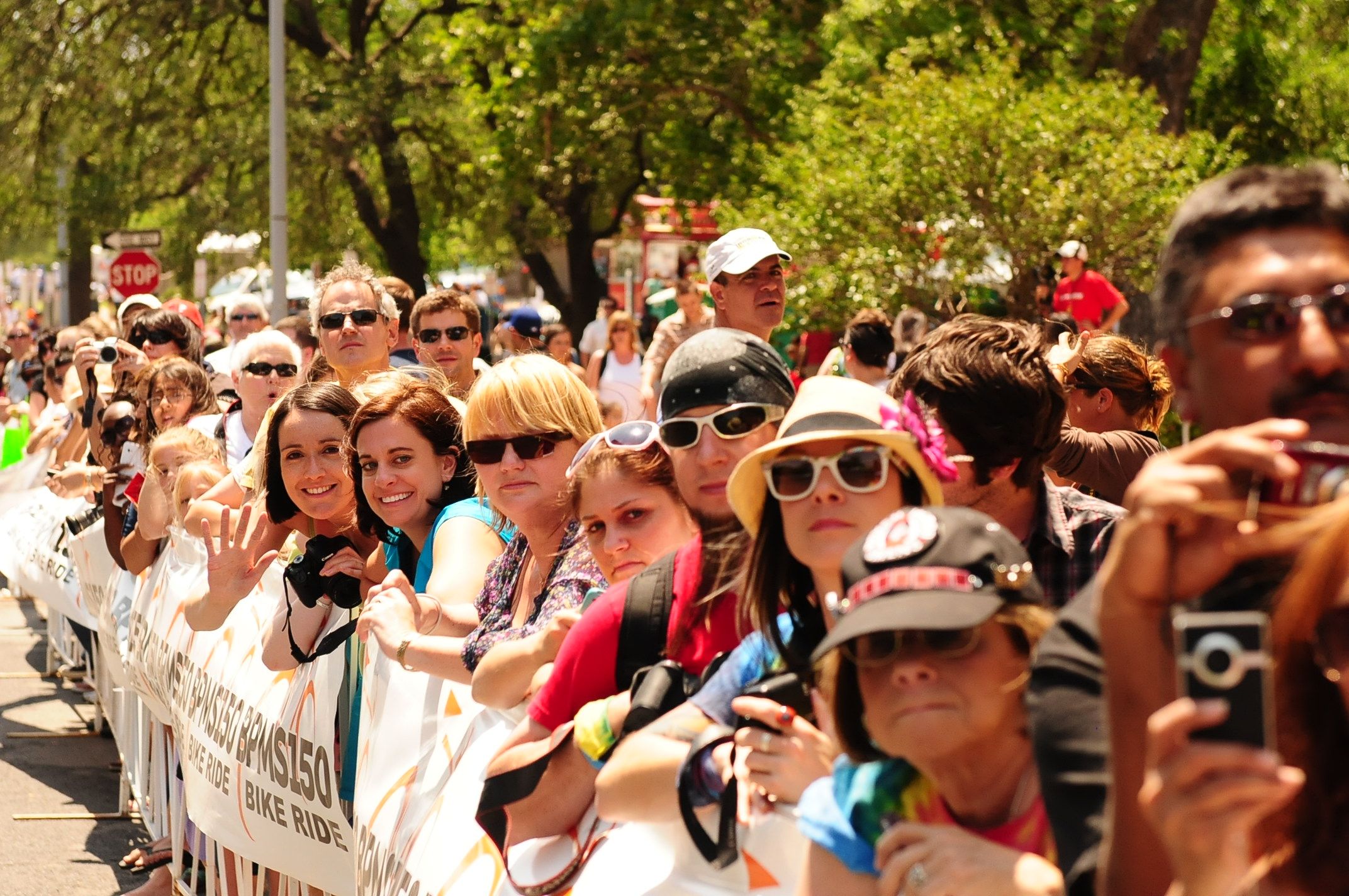
It is quite a thrill to ride that last kilometer or so through spectators three and four deep on both sides of the road.

79051-1745-004f

We took advantage one last time of the superb care – read cold drinks and snacks – provided by the Hess volunteers at the finish.  Then Tom and I headed toward the State Capitol.

MS150 2011 Glory Shot

I am looking forward very much to my third BP MS150.  It is going to be a treat to reconnect with my West End friends.  Who like me have been spoiled by the Team Hess treatment in the past.  Who like me can’t imagine riding the BP MS150 with any other team.  And who like me are depending upon your generosity to raise as much as we can to put toward the search for a cure for multiple sclerosis.

Donate to Multiple Sclerosis Research and Treatment

Culture Shock

I did my first organised ride in the Netherlands in early March 2011.  The Witte Kruis (White Cross) Classic was a 100 km clockwise loop through South Holland.  Much of the route covered new ground for me.  I had ridden to Kijkduin and Meijendel but my wheels had yet to traverse points further east like Benthuizen and south like Oud Verlaat and Schipluiden.  I had yet to find any cycling buddies in Den Haag so I rolled up to the start by myself.  I had done a number of organised rides in Texas so I had a preconceived idea of what this ride would be like.

Things were different right from the get-go.  We were all given timing chips to mount on our front forks.  For many participants this wasn’t just a jaunt through the countryside.

WKC 2011 Transponder

The Dutch idea of a supported ride turned out to be a bit different from what I had experienced in Texas.  I had come to expect lots of people giving directions along the route, or at the very least, large signs.  This is what we had to guide us during the Witte Kruis Classic.

WKC 2011 Direction

All was well until I had a puncture after about 60 km.  Everyone else in the group I had tagged onto kept riding.  Once back in the saddle I could see one rider ahead of me in the distance.  I put my head down and started chasing.  5 km later I caught up to a group of five riders.  We were at a T-junction in Terbregge.  With nary a tiny painted arrow on the road in sight.

We knew that we were about 6 km from the rest stop.  Between us we managed to figure out which way to head and after a couple of kilometers we picked up the white arrows pointing us toward the rest stop at the RWC Ahoy.

Which brings me to my next supported ride, Dutch style, surprise.  I don’t recall having ridden more than about 35 km / 20 mi before coming upon a rest stop on my Texan rides.  The one and only rest stop during the Witte Kruis Classic was at the 55 km / 34 mi point.

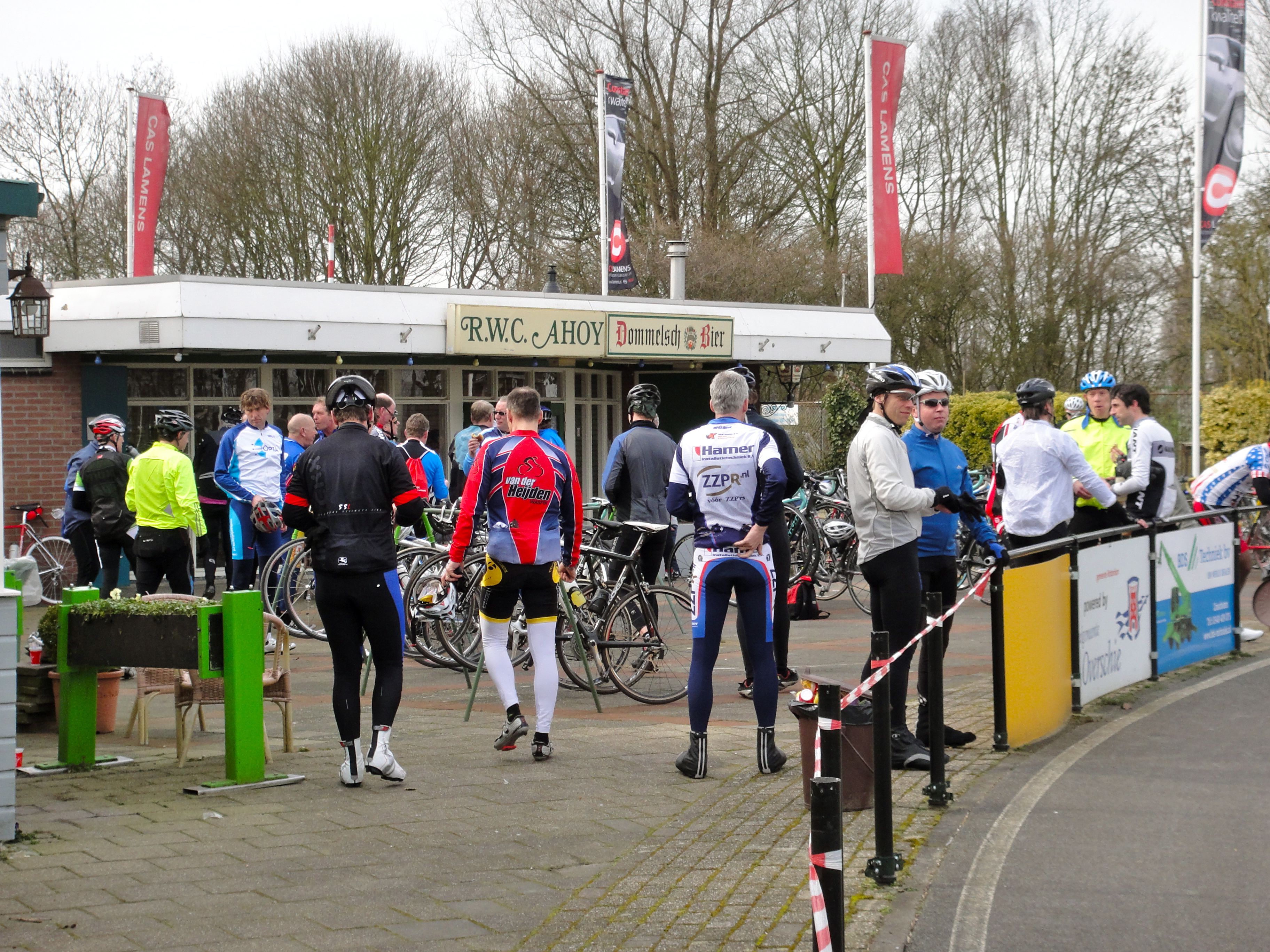
The location of the rest stop was an eye opener in itself.  We were on the premises of the Rotterdam Wielrennen Club Ahoy.  Not only does the RWC Ahoy have a nice clubhouse . . .

WKC 2011 RWC Club House

but it also has its own racetrack.

WKC 2011 RWC Ahow Racetrack

There was a race in progress, complete with electronic timing board and race announcer.  This was my first glimpse of the serious side of Dutch amateur cycling.

After a much-needed drink, some food and a comfort break I set out off again to the roar of aircraft landing and taking off from the adjacent Rotterdam The Hague Airport.

At the 85 km mark there was a three kilometer timed sprint.  I had forgotten about that little feature of the ride.  Not that I was in any state to ride any faster at that point.  All I wanted to do by then was to just finish.

This photograph was taken in the dunes south of Kijkduin.  Before I realised that the ride was 10 km longer than advertised.

WKC 2011

I did not enjoy the last 10 km to the finish.  Especially knowing that I had a further 8 km to get home, having cycled to the start.

I felt a lot better after a shower and lunch.  I did like the ride, despite being on my own and those extra kilometers.  I now knew what to expect on my next organised ride, which was the Joop Zoetemelk Classic the following weekend.  In addition to windmills that is!

WitteKruis

No Chip Seal Here

I bought my first bike in Houston.  My early solo rides were on the few bike trails along the Columbia Tap to Trail and Brays Bayou.  Then I met the Six Thirty group.  The majority of our group riding was done on city streets.  In most cases there were no bike lanes.  Where there were bike lanes you tended to stay out of them.  I remember Washington Avenue having a bike lane in name only.  What had been designated as a bike lane was badly rutted filled and with debris.  So we took our chances toward the center of the lane.

We also rode on the farm-to-market roads outside Houston.  There was less traffic on them, which was a plus.  They tended to be chip sealed, which was a minus.  Chip seal has a layer of aggregate embedded in the bitumen or asphalt.  On that surface we were were modern-day Rough Riders.

The Dutch cyclist has the good fortune to have 29,000 km of bike paths.   The Dutch cyclist is truly blessed to have 29,000 km of bike paths that are almost without exception well-maintained.  The majority of the paths are asphalt.  Those are generally the smoothest.  Some paths are made of concrete slabs or pavers.  Those sometimes have cracks and bumps in them.  Then come the brick bike paths, which run the range from smooth to bumpy.

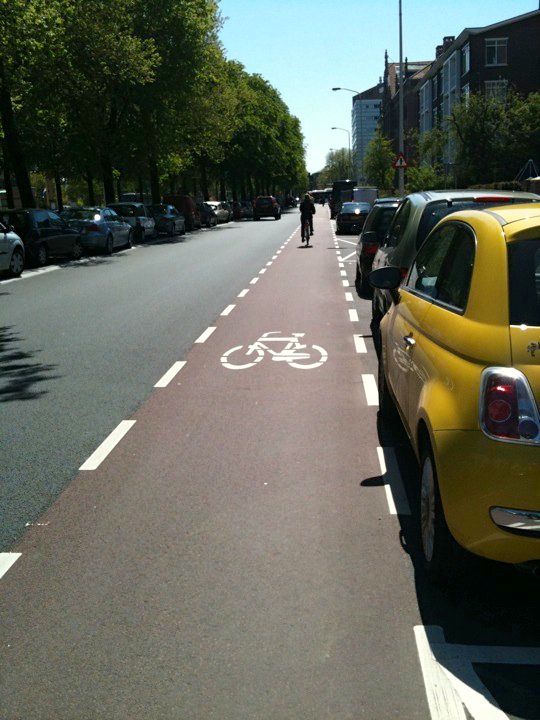
Bike paths in towns and cities are usually red.  This differentiates the bike paths from the road where bicycles and motor traffic share the same road-space.  This one is asphalt.

Bike path

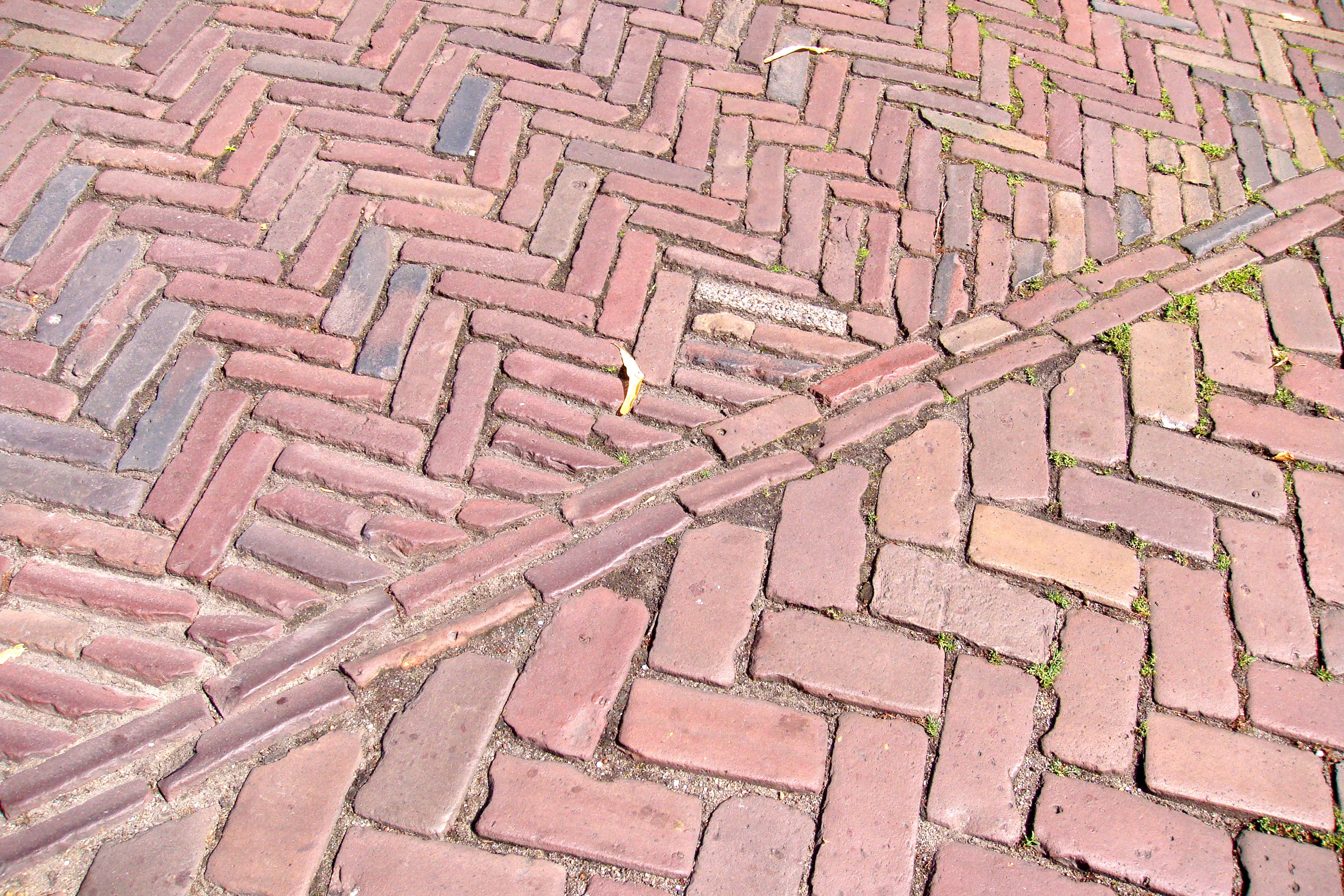
In the center of towns and villages the surface is occasionally brick.  Ideally the bricks form a smooth surface.  Sometimes though you are in for a rough ride.

Kinderdijk Ride Brick Road

Concrete pavers often appear around the edges of towns.  This a section of the new bike path on the beach south of Kijkduin.  The dashed center line indicates that this is a two-way path.  The surface is good enough for the Not Possibles to hit 45 kph / 28 mph or more when the wind is right.

Katwijk Pavers

Outside towns the paths are almost always asphalt.  Usually smooth and fast, although this section of the LF 1 near Monster is due for resurfacing.

Hoek Van Holland 02

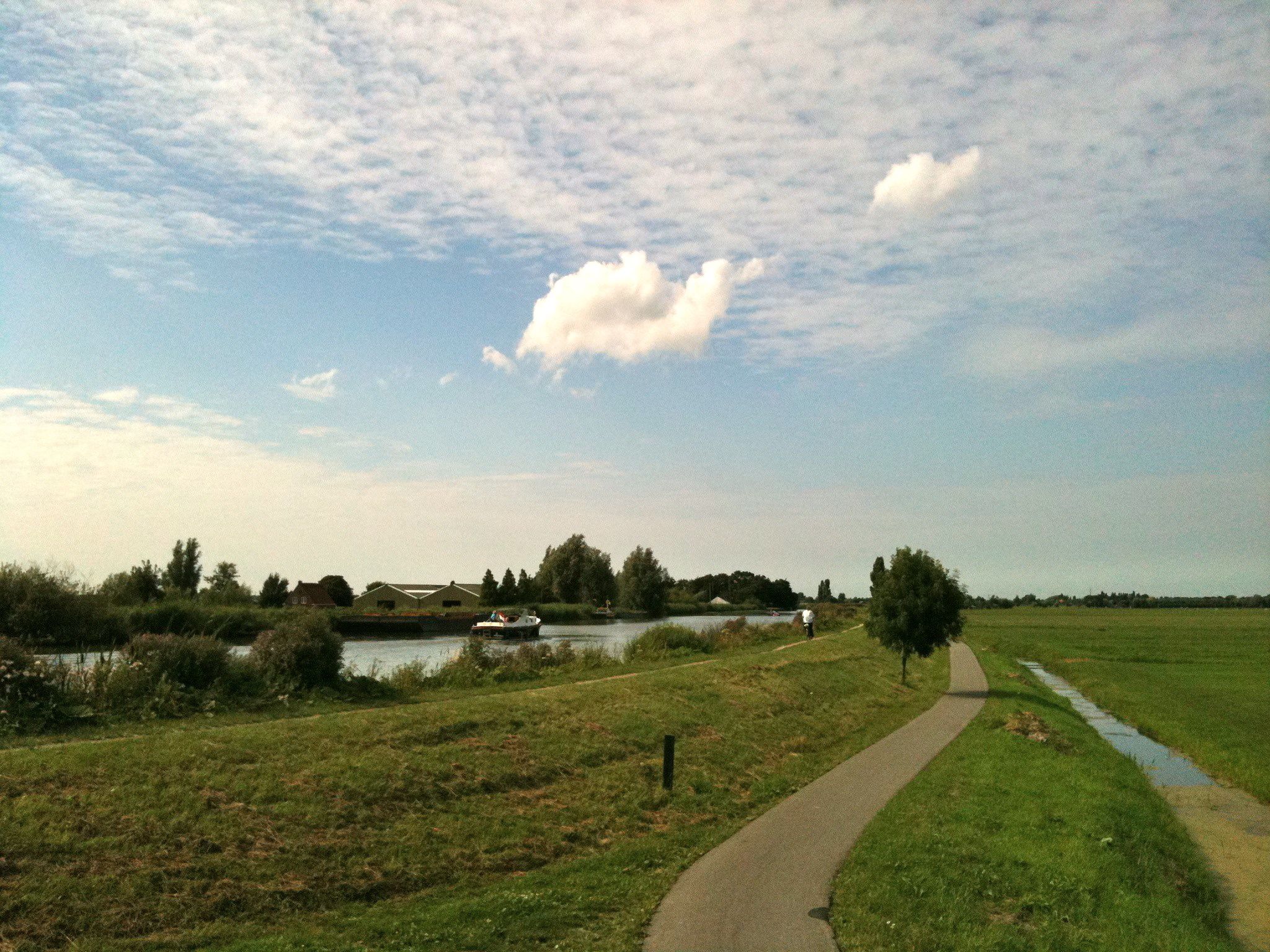
This smooth asphalt path is in Midden Delfland.

Kinderdijk Ride Seat View 1

Where the paths follow roads the two are usually separated.  Like this one in Noordwijk.

IJmuiden aan Zee Nordwijk Trees

Now that I am in Kuala Lumpur I am back to riding on city streets and sharing the roads with other traffic.  Riding in Kuala Lumpur is a lot like riding in Houston.  Except there is no chip seal here.

Where Do I Go From Here?

The Netherlands is criss-crossed with a network of dedicated bike paths.  Every part of the country is accessible by bicycle.  If your bucket list includes riding every path, you would have to cycle about 29,000 km.  There isn’t anywhere that you can’t cycle to.  It was clear from my “Bicycling 101” class that all I had to do was wheel my bike outside the front door, choose a direction and start pedalling.  And be sure to avoid the 53 ways to pick up a road rules fine.

I used a Garmin Edge 705 GPS cycle computer in Houston.  It came with a detailed road map and points of interest.  So I could use the unit to navigate with exact, turn-by-turn directions to any address or intersection.  I used my Edge more for tracking where I had been rather than for planning routes.  Nevertheless I installed a map of the Netherlands.  If nothing else I would be able to see on the screen exactly where I was hopelessly lost.

The best thing about the unit is that when maps and sign posts fail, it will get me back to where I began my ride.

Garmin Edge 705

I quickly discovered that I would have little use for the navigation functions on my Edge 705 in the Netherlands.  The 29,000 km of bike paths are sign posted.  And since the Dutch are nothing if not meticulous, they didn’t stop at just one sign post system.  They have four that I know of.

The first type of sign post is much like what you would see on normal roads.  Signs point in the direction of cities and towns, listing the distance to each.  A more distant major destination is listed on the bottom of each ‘finger’, and the closer, minor destination is shown on the top.  Once a destination is listed, every subsequent sign along the route will list that destination until you reach it.

The sign posts for cyclists feature red or green lettering on a white background.  The options shown in green are less-direct alternatives that offer scenic routes through the Dutch countryside.

Maassluis to Hoek van Holland Ride 02

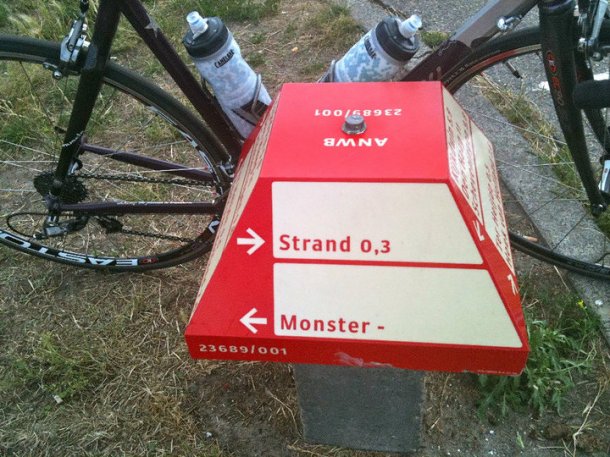
The second type of sign post for cyclists sits low to the ground and is mushroom-shaped.  These signs are located in more rural areas where the bike paths intersect away from roads.  Each of the four sides has direction and distance information for destinations nearby.  The sign below with the red lettering on a white background is a newer one.  The older style has the same shape but features black lettering on a white background.

Mushroom

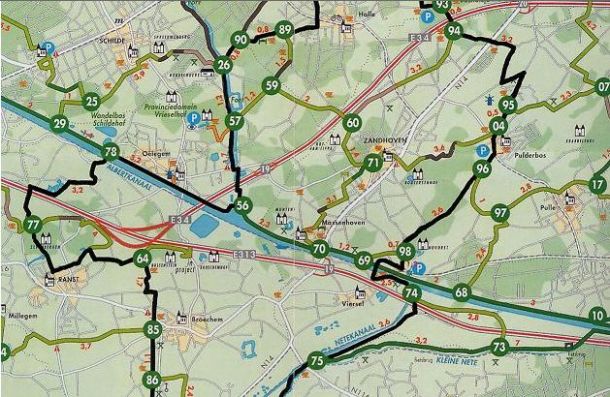
The third system of providing directions for cyclists is the Bicycle Node Network (Fietsknooppuntennetwerk).  Each junction on the cycling path network has been given a unique one or two-digit number.  You need a map showing all the ‘knooppunten’ or nodes.  These maps also list the distance between nodes so you can work out how far away your destination is.

Planning a route from the starting node to the ending node is a simple matter of making a list of all the intermediate nodes that you want to cycle through.  There is a list of online route planners at fietsen.123.nl to help with this.

Knoppunkt Map 2

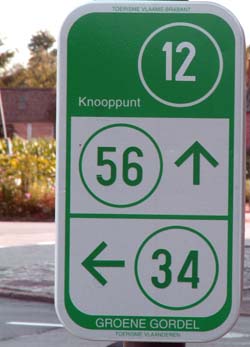
Each junction or node is marked with a sign showing the node number and a map of the immediate area.

Knoppunkt Map

Signs like this show you which way to go to the next closest nodes.

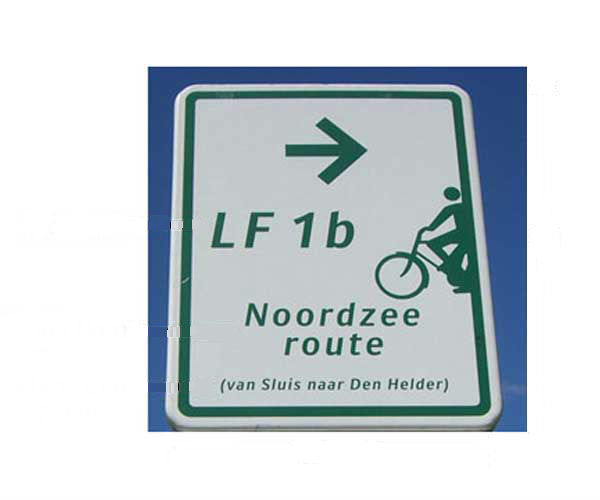
The fourth system is a network of long-distance, or LF (Lange afstands Fietsnetwerk) routes.  There are currently 30 LF routes covering some 4,500 km in total.  These routes include the LF 1 North Sea Route, which starts in the south near Sluis at the Belgian border, and continues up the coast to Den Helder in the north.  The Not Possibles often cover sections of this route between Hoek van Holland and Zandvoort during their Saturday morning rides.

The LF routes are marked in both directions with rectangular white signs with green lettering.  In this case the sign pointing in the opposite direction reads “LF 1a”.

LF1

With few exceptions the various wayfinding systems on the bike paths served me well.  I would pick a destination and let the signs show me the way.  Confident that if I did get lost, which happened on a few occasions, I could always access the menu on my Edge 705 and select “Back to Start”.

Welkom in Nederland

On Tuesday 20th April 2010 I did a last Tuesday ride around the streets of Houston with the West End Six Thirty group.  Our bikes (my road and hybrid bikes, and the biker chick’s cruiser bike), along with the rest of our belongings, had long since departed Houston bound for  Rotterdam.  I had Tom B. to thank for loaning me a bike for the Tuesday ride.  On Thursday I joined the group at Jax for the post-ride meal.  On Friday I collected my passport and visa at the Netherlands consulate, dropped our car off at the freight company, and took a taxi to George Bush Intercontinental Airport to catch my 3.30pm flight.

On Saturday morning I flew into a damp and chilly Amsterdam Schiphol airport.  Den Haag, our home for the next few years, was no drier nor warmer.  I had arrived with a suitcase full of what I had been wearing the week before in Houston.  I had shorts, t-shirts and sandals.  What I should have packed were sweaters, scarves and boots.  My first purchase in the Netherlands was a Nike sweatshirt.  I would have bought gloves too, but the shop assistant told me that winter was over!

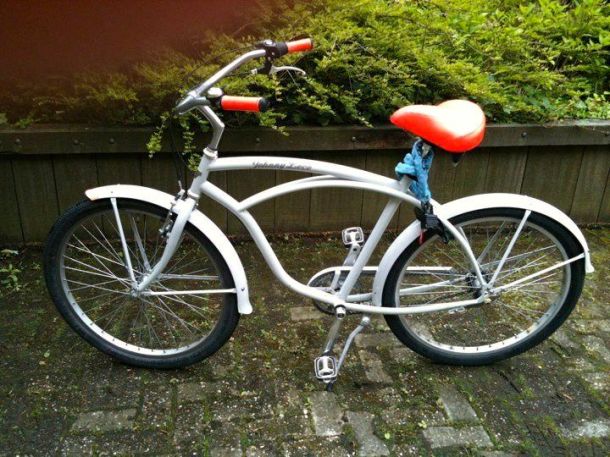
The weather stayed pretty ugly for the next few weeks.  Usual Dutch spring weather in other words.  It was five or six weeks before it warmed up enough for me to consider a bike ride.  By then I had found Bikes For Rent.  I reserved a bike for the weekend.  Then I crossed fingers and toes hoping that the weather would not revert to wet and windy.  Fortunately Saturday dawned dry and reasonably warm.  Warm enough for my tropical blood at least.  I rode away from Bikes For Rent on a three-speed Johnny Loco.

Johnny Loco Three Speed

I had a map of the bike route to the beach.  The map was helpful but I soon found that the bike paths in the Netherlands are very well signposted.  The cycling infrastructure is really very good.  The bike paths are very well marked and maintained.  “Yes” everyone checks for bicycles before opening car doors.

Bike path

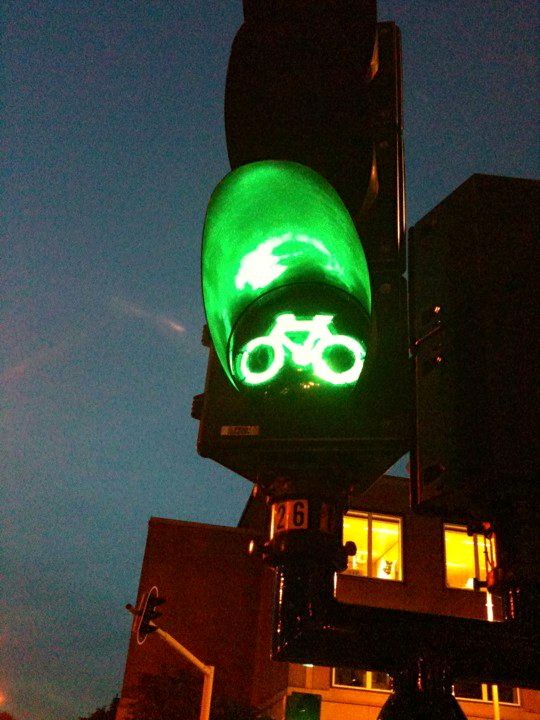
Cyclists even have their own traffic lights.

Bike light

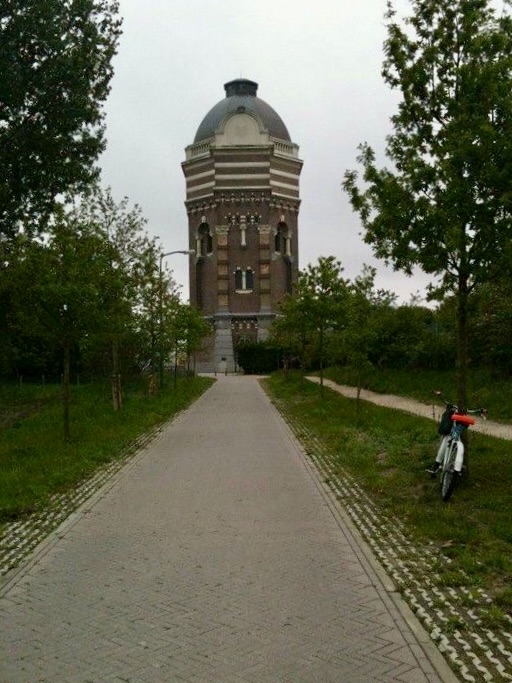
The path to the dunes and the beach took me past the Scheveningen water tower.  Built in 1874, the tower contains 1 million litres of drinking water and has the largest storage capacity of all the water towers in the Province of Zuid-Holland.  It is still in use today.

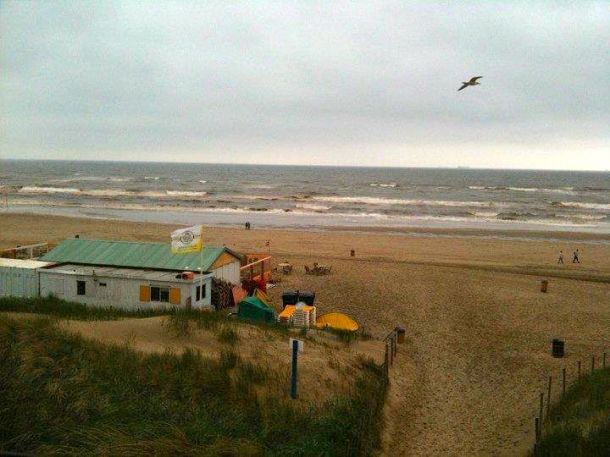
It wasn’t the brightest of days so the North Sea looked pretty raw.

The North Sea

I didn’t expect to see World War Two gun emplacements facing out to sea along the dunes.

Eastward view

On the way home through Scheveningen I saw a few more signs of just how much the bicycle is the go-to mode of transportation for many in the Netherlands.  I’ve seen bike racks before, but these two boys on the right took racks to another level.

Surfboard racks

You can leave your bike in a guarded bike parking areas like this one for less than €1.

Guarded bicycle parking

The route back home took me past the Vredespaleis or Peace Palace.  Andrew Carnegie donated USD1.5 million in 1903 (the equivalent of USD40 million today) to fund the construction of the Vredespaleis.  Today the building houses the International Court of Justice (which is the principal judicial body of the United Nations), the Permanent Court of Arbitration, the Hague Academy of International Law, and the extensive Peace Palace Library.

The Peace Palace

This was a very nice welcome to riding in the Netherlands.  I couldn’t wait for my road bike to arrive.

Austin or Bust

As the Houston winter turned to spring conversations turned to the MS 150.  The main event of the year for many in the Six Thirty group.  There was an expectation that you were riding the MS150.  What could possibly stop you?

The MS 150 is a two-day ride of between 150 mi / 240 km and 180 mi / 290 km, depending on which of the three starting points you choose in Houston.  Day One ends at the Fayette County Fairgrounds in La Grange.  The final destination is next to the Texas State Capitol in Austin.  The purpose of the ride is to raise money for multiple sclerosis research and other services supported by the National MS Society.

75 mi / 120 km was well beyond my longest ever ride.  My first challenge was to convince myself that I could ride that far.  So I rode the events that were billed as MS 150 training rides, like the Humble Lions Bike Ride in March.  I huffed up the climbs at Cat Spring, Chappell Hill and Bellville, hoping that I would be adequately prepared for the mythic hills of Austin.  By March I felt I probably had enough miles and climbs in my legs to sign up for the event.

I was a very late entrant and was lucky to get a place.  The MS 150 is a very popular ride and the 13,000 places get snapped up very quickly every year.  I was, it seemed, a beneficiary of the appalling weather that plagued the 2009 ride.  Day One had been cancelled and the rain, wind and cold made Day Two miserable for the riders.  Some of whom had decided not to sign up for the 2010 event.  Leaving spots available for latecomers like myself.

Once I had my place in the event there were two things to do.  One was to raise the minimum fundraising pledge.  I had left myself very little time to hit up my friends for donations.  Most of whom were looking for their own donors anyway.  The solution was simple.  My biker chick and I split the required amount between us.

The second task was to find a team to ride with.  The obvious choice was my employer, but the Hess Corporation team was full.  Tom B. came through for me, again, and managed to get me a last-minute spot on the Exxon Mobil team with him.  I was so late that I had missed the deadline for ordering a team jersey.  Not such a bad thing in hindsight.  I don’t think it would have done me much good to be seen in an Exxon Mobil jersey by the great and the good of Hess Corporation.

As the big day drew closer I continued to worry about never having ridden 75 mi / 120 km before.  So the weekend before the MS 150 I rode in The Space Race.  A loop from Gulf Greyhound Park in La Marque through the Brazoria National Wildlife Refuge to the west, then north to the outskirts of Angleton before heading eastward toward Alvin and back to La Marque.  I felt good at the halfway point.  I felt really terrible with 20 mi / 32 km to go.  I was hot and tired and hungry and barely maintaining forward progress into a constant headwind.  The event was billed as a 100 mi / 160 km ride.  I was so thankful that the finish came sooner than advertised.  I didn’t get my first century ride under my belt that day.  But more importantly I did come away convinced that I could finish the MS 150.  Even if it almost killed me!

A group of Six Thirtyers rolled out of Jack Rhodes Memorial Stadium in Katy at dawn.  It would take far too many words to describe the energy, the excitement, the exuberance, the entertainment and the exhilaration of the next two days.  This is one of those events where you truly had to be there.


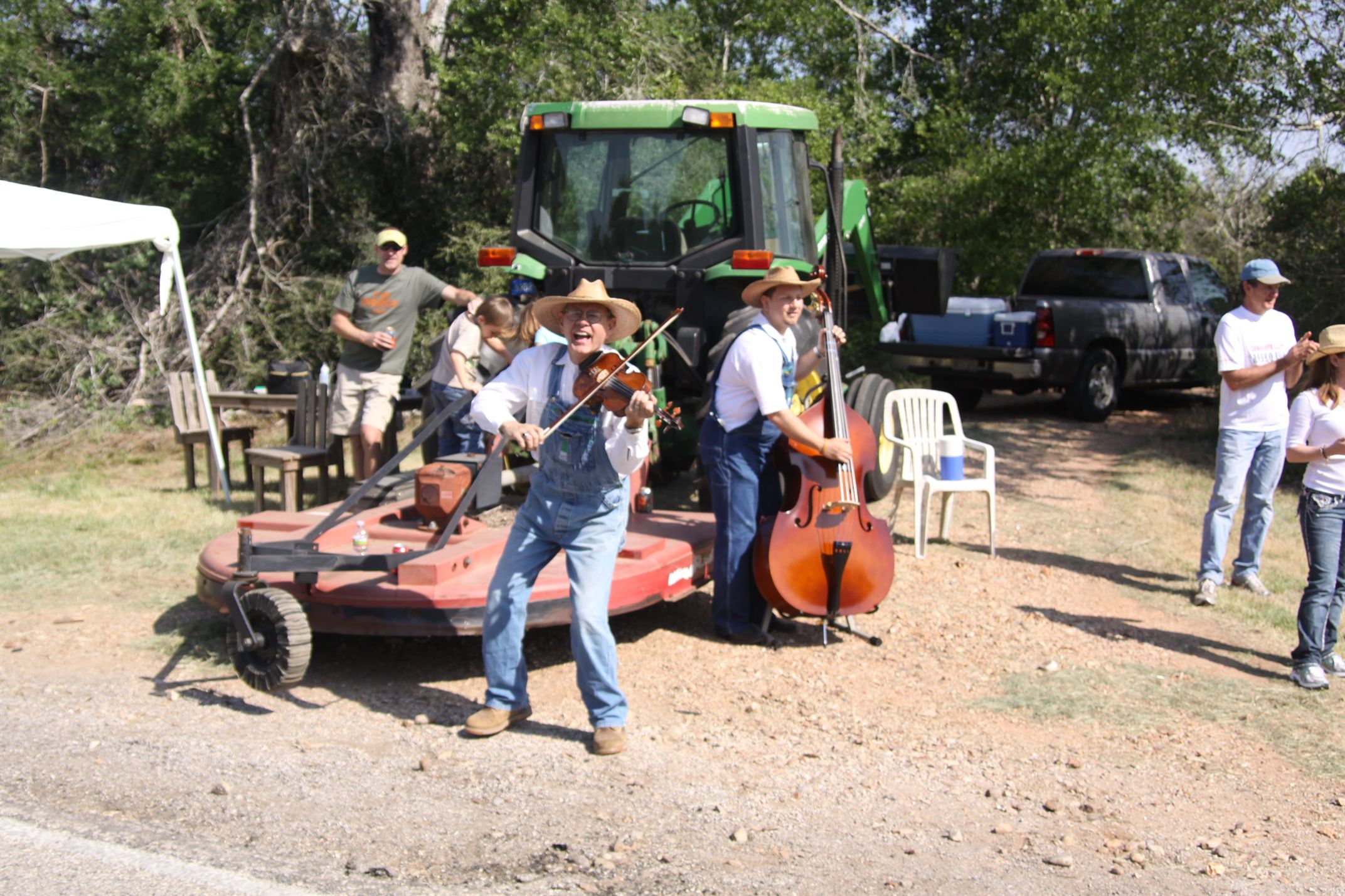
In Bellville and Fayetteville  and La Grange and Bastrop and Austin there were crowds lining the streets ringing cowbells, blowing bubbles, waving signs, cheering, tooting horns, shouting “thank you.”  We even had live music.  A fiddle band at one point.  A bagpiper in full regalia at another.  There were brigades of cheerful volunteers at every rest stop.  The familiar faces of the West End Bicycle guys at their bike service tent in Industry.  Everyone encouraging us on with a friendly wave and a smile.

This is some of the Six Thirty group at the lunch stop at Bellville on Day One.  There were five of us in Exxon Mobil jerseys.  Only one of us was actually an employee of that company.

On Day Two we all put on our Six Thirty jerseys.  It has become a tradition that the group foregoes the Bastrop lunch stop sandwiches provided by the MS 150 organizers for the much tastier fare at Whataburger.  Texas’ own burger chain.

This was the first time I had been to a Whataburger.  I shouldn’t have waited so long.  As Whataburger say in their commercials, “It’s shut your mouth good.”

After our burgers, fries and shakes it was 32 mi / 51 km to the finish line in Austin.  Where Tom and I naturally had to pose in front of the Texas State Capitol building for the signature glory shot.

I knew right there that I would do this ride again in 2011.  What I didn’t know right there was that the experience in 2011 would be even better.