Category Archives: Cycling in Malaysia

Your Country Very Hot

My biker chick ZAZ and I have moved a number of times from our tropical home to more temperate climes.  Each time we struggled initially with the cold but we did get used to it.  Almost without noticing our increasing tolerance for low temperatures.  Until we got home again.

We have a catchphrase that we use with each other a lot in the first few months back home.  “Your country very hot.”  I shouldn’t be surprised that we have to reacclimatize to the heat and humidity.   It does take a few months before I don’t feel the need to take four or five showers a day.

Yesterday’s ride confirmed that I am not yet used to being back in a hot and humid country.  I was invited to ride the Broga 116.  I had expected to be part of a group ride.  What I hadn’t expected was that I would be part of a highly organized group ride.  A group ride with two SAG support vehicles, three water stops, photographers along the route, lunch at the finish, a t-shirt, and in a first for me at any organized ride, a route ‘tulip‘ sticker for my top tube.

All put together by a cycling club, without commercial sponsorship, for anyone who was willing to pay RM 30 / USD 10 to participate.  At least fifty of us stumped up the cash and were ready to roll from the car park at the Sungai Tekala Recreation area at 7.30 am.
I had three 25 ounce bottles of Nuun-treated water, a layer of sunscreen on every bit of exposed skin, and a cap under my helmet to soak up sweat.  In other words I was unprepared for the heat and humidity.

On previous rides I had noticed that my average pulse rate was 10 to 15 bpm higher than it had been in the Netherlands.  I knew that was because of the higher ambient temperature in Kuala Lumpur.  It was about 28C / 82F with a relative humidity over 80% at the start.  It would get considerably warmer as the sun rose in the sky.  That fact should have been my first warning that I would have a tough day.

Graph courtesy of The National Weather Service at http://www.nws.noaa.gov/om/heat/index.shtml

The second warning came 35 km into the ride, in the form of the first climb of the day.  The Bukit Mandom 1 climb is only 1 km but it has grades of up to 10.2%.  By the time I had crested that climb sweat was dripping onto my top tube and I was already into my second bottle.  The descent at 60 kph plus cooled me off a little but that was scant respite.  After 1 km the road tipped upward again as Bukit Mandom 2 presented itself.  By the time I completed the 1.8 km to the crest of that hill I knew for certain that it would just get tougher as the ride progressed.

As indeed it did.  Bukit Tangga (literally Stairway Hill) was bigger and badder than the previous two hills.  I started cramping in both quadriceps on the lower slopes and had to stop 3 km into the climb to stretch.  If nothing else that gave me the opportunity to take this photo of my fellow cyclists grinding up the hill.

The spasms from heat cramps in my quadriceps were my constant and faithful companion for the rest of the ride.  Whenever the grade kicked up above 6% I had to slow down to below 10 kph.  I found that if I rode in my inner ring /  largest cog combination (why oh why didn’t I have my compact crank?) and maintained a very slow cadence I could continue to pedal without completely cramping up.  The observant among you, dear readers, will have noticed from the route tulip that the planners had saved the biggest climb of the day for the end.  13 km long and a total of 470 meters upwards.  I have never been so glad to to see the back side of a hill.

Nevertheless I took several positives from this ride.  The organisation was excellent.  Which was a very good thing.  The water stops saved me from becoming severely dehydrated.  I had 75 ounces / 2.2 liters of fluid in my bottles at the start of the ride, which turned out to be woefully insufficient.  I picked up at least another 2 liters of water at the stops, along with, pardon the pun, a bunch of bananas.

The views, when I wasn’t staring fixedly at my front wheel so that I wouldn’t have to look up at the never-ending slope ahead of me, were lush and verdant.

I learned that Aesop knew what he was talking about.  My slow and steady 6 to 8 kph up Genting Peres meant that I caught and passed a number of other riders who had started the climb at speed but then had to stop for a breather before the top.  And I finished the ride on my bike and not in a SAG support vehicle.  Not that I am competitive or anything!

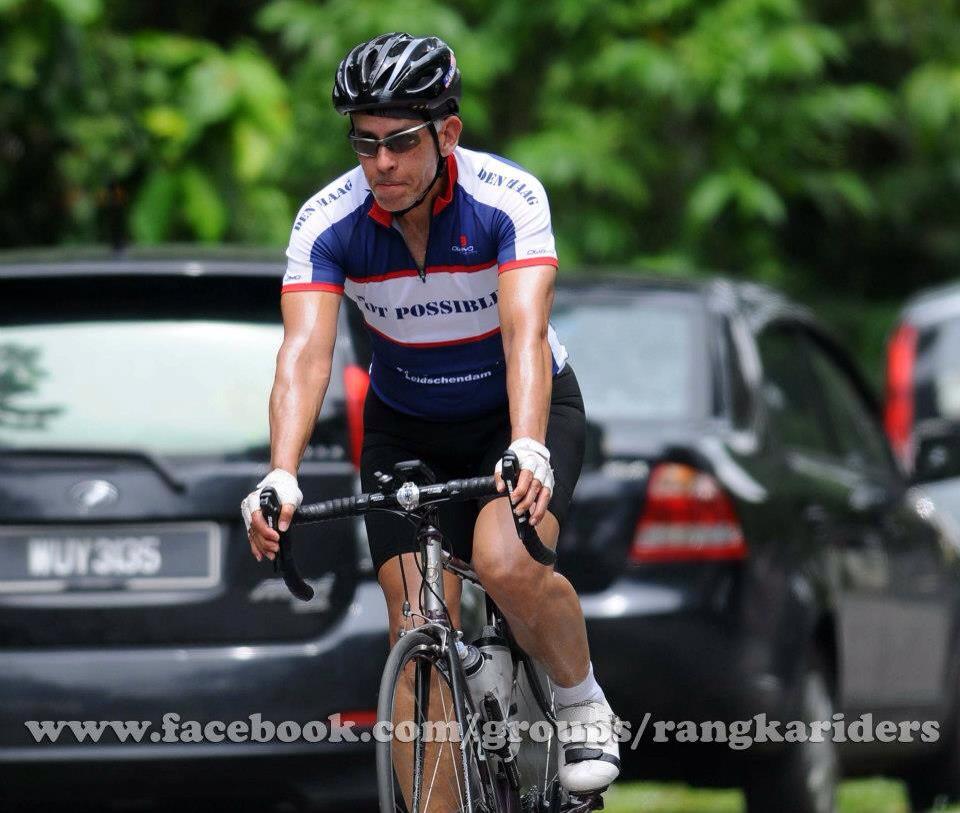
Our sea freight had been delivered so I was able to do the ride in my Not Possibles jersey.

Best of all I made new friends, courtesy of Syihan Nik, who invited me to do the Broga 116.  By the way I still haven’t decided if I should thank him or thump him.  Here are Syihan and I early in the day, looking and feeling considerably better than we did at the end.  As you will soon see.

I finished the 114 km soaked in sweat but my cooling mechanism hadn’t coped very well with the conditions.
Despite cold showers and iced drinks my core temperature stayed elevated for the rest of the day.  So there is no doubt about it ZAZ.  Your country very hot.

Ride and Shine

I did an organized sightseeing ride around Shah Alam today with the Cyclistis.  “Ride and Shine” is the best translation of the Bahasa Malaysia name for this ride that I can come up with.

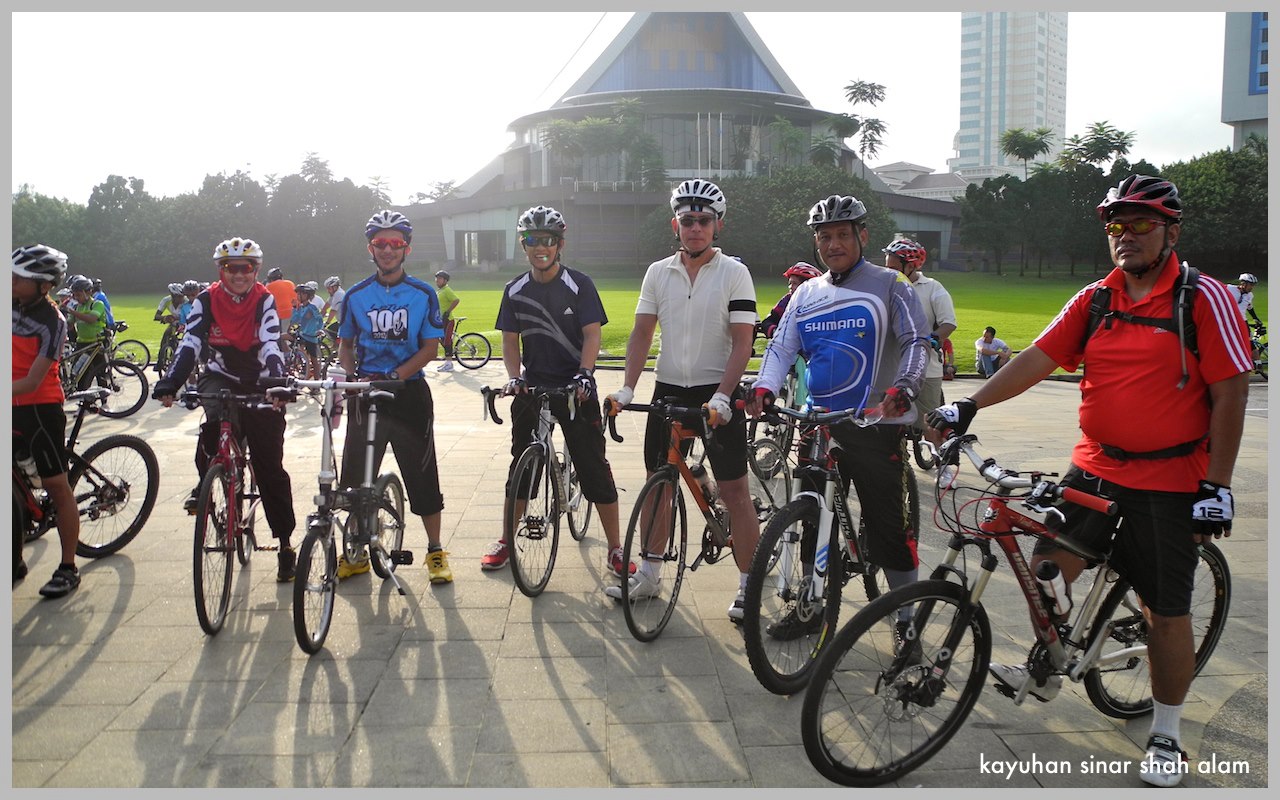
This was a family-oriented event.  There were 100 or so men, women and children on the start line at 7.30am, including the Cyclistis group.

Photo courtesy of Mohd Farid Abu Bakar

The majority were on mountain bikes, with the rest on a mix of road bikes, fixies and foldies, including a few Moultons with their frames made up of a lattice of small-diameter tubes.  This Moulton TSR 30 has a Campagnolo Veloce groupset and a colour-matched Brooks B17 saddle to boot.

Photo courtesy of Mohd Farid Abu Bakar

Full marks to the Shah Alam City Council for their excellent organization.  There was no entry fee to participate in this ride.  Despite this there were police personnel who ensured we had the right-of-way at all intersections, a lead vehicle with flashing lights to clear the lane for us, six motorcycle outriders to keep us separated from other traffic on the roads, a minibus and lorry to provide SAG support, and three rest stops with water and food.

I worked in Shah Alam from 1985 to 1990.  Apart from being the state capital of Selangor, Shah Alam was best known then for the main campus of the MARA Institute of Technology.  The campus was surrounded by homes and there was a small commercial centre.  Shah Alam has grown by leaps and bounds since I worked there.  It gained city status in 2000.  The 42 km route took us north of the Shah Alam city center into what was jungle twenty five years ago.  Now the wilderness has been replaced by a series of residential neighborhoods:  Bukit Jelutong, Sunway Kayangan, Kayangan Heights, Desa Subang Permai, Denai Alam and others.

The weather was thankfully overcast so we stayed as cool as is possible in the tropics.  The pace was gentle so there was no need to work too hard on the climbs.  There was plenty of time to enjoy the views and, in these connected times, to get caught up at the rest stops.

It was noon when we finished the ride.  Adzuan, Farid and I decided to have a nasi kandar lunch.  The name derives from the time when hawkers would carry rice (nasi) and a variety of curries and side dishes in two large containers hanging from opposite ends of a long pole or yoke (kandar).

Photo courtesy of Buruhanudeen at http://bdeen.blogspot.com/

Hawkers walking the streets balancing a pole on one shoulder have been replaced by nasi kandar restaurants.  There is a Nasi Kandar Pelita restaurant within a kilometer of where the ride ended.  My lunch was a plate of steaming rice, chicken, cabbage, green beans, curry gravy and, naturally, a teh tarik.  I think I replaced the calories I burned on this morning’s ride.

“The Hills Are Alive . . .” *

When I found out that I was moving back to Kuala Lumpur, Farid was one of the first people I contacted about riding.  He and I were colleagues at Hess Corporation.  At the time he rode motorbikes.  I assume he still has his motorbike.  These days he also hits the roads on his red and white Colnago Ace.

This morning was the first opportunity we had to ride together.  Farid rides with the Cyclistis.  A group afflicted with the love of cycling.  Early starts are essential if you want to avoid the midday heat.  I was in the car at 6.45am for the twenty eight kilometers to the meeting point.  Adzuan, Asyraf, Farid, Syihan and I met around the corner from the police station at Pekan Batu 18, a village at the 18th mile on the Hulu Langat road.

Kuala Lumpur sits in a basin and is surrounded by hills.  My compact crankset will get a lot of use here.  Our route took us steadily upward from the start.  We turned onto Jalan Sungai Lui and rode through rolling countryside for the first 10 kms.  The approach to Kampung Gemi marked the first true climb of the day.  60 meters / 200 ft in 1.4 km.

The payoff was the 2.5 km descent to Tasik Semenyih.  This is a man-made lake.   It is one of the reservoirs that provides fresh water to Kuala Lumpur and other towns and cities in the Klang Valley.  The dam holding back the lake is visible in the distance.

We rode through more rolling terrain along the western shore of the lake.  In the Netherlands you have to be alert for ducks, geese and rabbits crossing the bike paths.  Here we have to watch out for a different animal.

In the Netherlands all the water is horizontal; in canals and lakes.  The heavy rain we have had here over the past couple of weeks is feeding lots of these alongside the roads.

At the far end of the lake we hit a 500 meter stretch that dropped at better than 6.5°.  No problem with ‘riding’ my age there.  The problem came just a few minutes later when we turned around to retrace our route.  Going up that 500 meter stretch wasn’t as much fun.

I took a short detour at the 30 km point.  They guys had told me about a steep climb up Jalan Sungai Tekali.  I thought I would take a look at it.  It certainly was steep with a grade of better than 9°.  A taste was all I wanted so I stopped after 500 meters and waited for a car to go past before turning around.  I forgot that I was in a very small gear.  As I turned my bike I pushed down hard on my pedal and my front wheel lifted off the ground.  In a dejà vu moment, considering the topic of my last post, I tumbled to the ground.  In typical roadie fashion I first checked to see if my bike was okay.  It was.  I on the other hand had a bloodied elbow and a bruised hip.

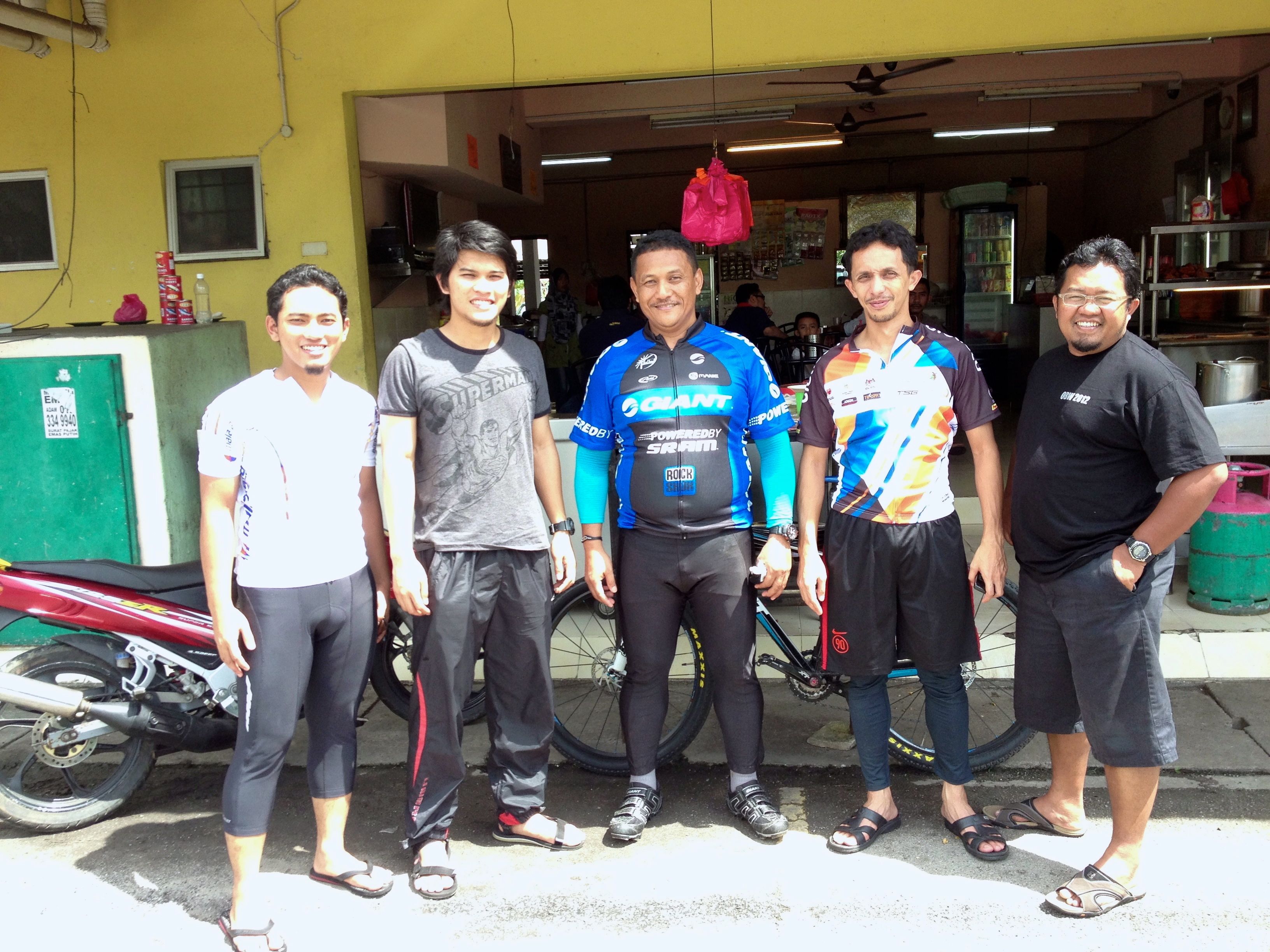
I have learned a few tricks since I started riding here.  One is to add a towel and a bottle of water to my riding kit bag.  Essential for wiping oneself down after a hot and sweaty ride if you want to be presentable post-ride.  Here are my very presentable fellow Cyclistis; Asyraf, Adzuan, Hairi (who started late on his mountain bike and caught up with us at the end of the ride) , Syihan and Farid, after the mandatory teh tarik and roti canai.


* Title courtesy of The Sound of Music.

Alternative Reality

I have been driving on the Federal Highway since the 1980s.  It is Malaysia’s first expressway, and it runs for 45 km from Kuala Lumpur to Klang on the west coast.  During the four years before I left Kuala Lumpur for Houston I lived just off the Federal Highway in Pantai Hill Park.  I drove along the Federal Highway almost daily.  The Mid-Valley Megamall was a frequent destination.  I took my mother for regular medical checkups at the University Malaya Medical Centre.  I ate many meals at the restaurants in the Petaling Jaya Hilton.  A corollary to all those car journeys on the Federal Highway was the number of hours I wasted whilst inching along in the traffic jams for which the highway has become infamous.

I didn’t think it was possible to cycle along the Federal Highway.  But that is exactly what I found myself doing last Saturday morning.  I had agreed to help out with a cycling safety class being run by YC and Albert K. at Van’s Urban Bicycle Co.  So after a brief talk about the do’s and don’ts of riding on city streets  Albert led us from the shop to the motorcycle lane running alongside the Federal Highway headed toward Kuala Lumpur.

Photo courtesy of Albert Koo

Before long we were cycling under the Kota Darul Ehsan arch, which marks the border between the state of Selangor and the Federal Territory of Kuala Lumpur.  From the vantage point of a bicycle saddle it certainly looks like the the biggest arch in Malaysia.

Photo courtesy of Albert Koo

Apparently the motorcycle lanes were originally intended for bicycles.  We cyclists were definitely in the minority though.  Riding single file was essential as we were continually being passed by motorcycles.  You can see them in the distance in these photos.  That motorcyclist on the right in the picture below should be on the motorcycle lane by the way.  The skyscraper is the Menara Telekom.

Photo courtesy of Albert Koo

Less than ten minutes later we were at the Mid-Valley Megamall.  It has often taken me at least three times that long to drive from the Menara Telekom to the Mid-Valley Megamall.  Now I know there is an alternative I’m going to see if there is a place to safely park a bicycle at the mall.

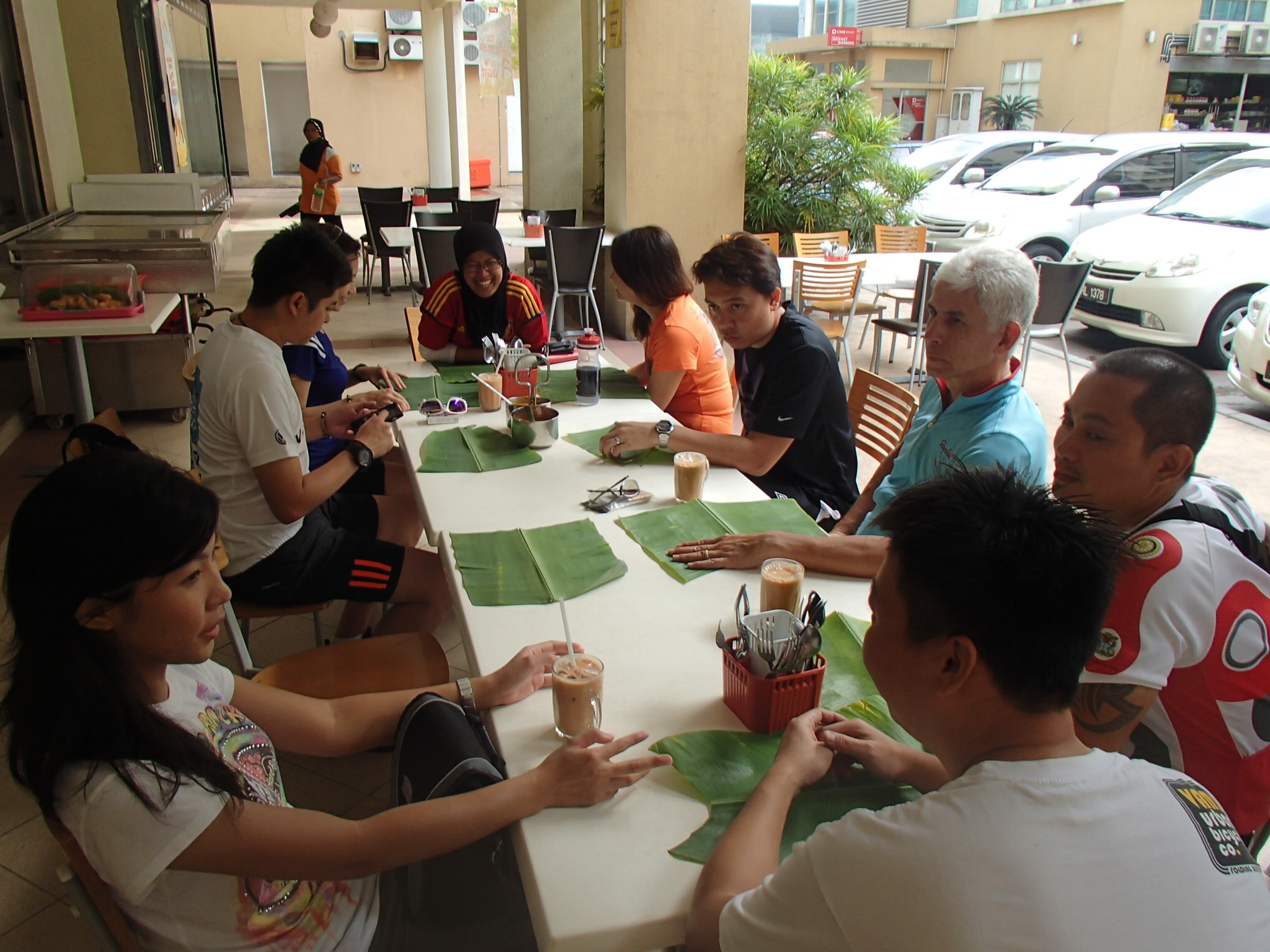
We turned around at the mall and headed back on the opposite side of the Federal Highway.  We took a different route from the highway back to Van’s Urban Bicycle Co.  Conveniently there is a mamak restaurant below Van’s.  Ravi’s Banana Leaf, which as the name suggests, uses banana leaves as plates.  If you read my post about the ride from Bukit Jelutong you already know what we had at Ravi’s.  Teh tarik and roti canai of course!

Photo courtesy of Albert Koo

Reverse Dragon’s Back

I was so excited to finally do my first long ride in Kuala Lumpur today that I could hardly sleep last night.  So it was no hardship to be up at 5.30am for breakfast.  That gave me time to drive the 27 km to Bukit Jelutong.  I got to the rendezvous point at 6.50am.  Mark L. arrived shortly thereafter, followed by Wan A.  By 7.30am we were a Racun Cycling Gang of four roadies and three foldies, ready to get on the road.  We weren’t the only ones heading out for a ride this morning.  The car park quickly filled up with all sorts of vehicles that disgorged all sorts of bikes and riders.

Mark led us on what he described as a Reverse Dragon’s Back ride.  Which meant tackling the six hills that make up the Dragon’s Back at the start of the ride rather than at the end.  A wise choice in my book given the potential for roasting sunshine by midmorning.

As it turned out we were lucky with the sun.  It was humid and fairly warm, but it stayed overcast for most of the morning.  I was glad that I had sunscreen on though.  I picked up some color in spite of the cloud cover.

Riding in Kuala Lumpur reminds me of riding in Houston.  The Houston weather, at least in the summer, rivals Kuala Lumpur’s for heat and humidity.  More to the point, riding in Kuala Lumpur requires cycling alongside all manner of motorized vehicles.  Fortunately I had a gentle reintroduction to sharing the road.  The Sunday traffic was relatively light.  This is Mark coasting down one of the humps on the Dragon’s Back with just the occasional car for company.

Some of the major tollroads have separate motorcycle lanes.  Which of course make excellent bike paths.  Almost like the ones in the Netherlands.  After the Dragon’s Back and a stop for a drink we rode for 30 km on the motorcycle lanes alongside the Guthrie Corridor Highway.  The road surface is excellent and as it was a Sunday there were very few motorbikes out.

What is different here as compared to Houston and Den Haag is the lush and verdant foliage that covers everything beyond the shoulders of the roads.  Vegetation quickly reclaims any cleared land.  In just a few years secondary jungle takes hold.

The route that Mark chose was one that few other riders were on today.  We had long stretches to ourselves, including one 5 km section where Mark and and I were able to cruise along at better than 40 kph.  We stopped at regular intervals to regroup, including at the point where we would leave the highway.  Once back together again we returned to the urban roads.  From there we gently pedaled the last 2 km to where we had parked our cars.  Which just coincidentally was right in front of a ‘restoran mamak.’

These are very popular restaurants run by Indian Muslims.  These restaurants grew out of the roadside stall equivalent known as ‘gerai mamak.’  Some gerai and restoran mamak are open 24 hours a day.  All serve a variety of food and drink, including the ubiquitous roti canai and teh tarik.  Those make up the standard order at the end of a ride in Kuala Lumpur, in the same way a koffie verkeerd and an appelgebak met slagroom put the finishing touch to a ride in Den Haag.

Do You Have That Purple One in a 57?

A recreational cyclist friend asked me for a quick way to gauge if a bike frame is the right size.  Few topics provoke more debate amongst cyclists than how to determine the correct bike fit.  A Google search for “bike fit” generated about 73,900,000 results.  Almost seventy four million items devoted to comfort and efficiency while riding a bicycle!

There seems to be a direct correlation between how serious cyclists are about their riding and the complexity of their bike fit process.  At the complex end of the spectrum are tools like goniometers, forefoot measuring devices and plumb bobs, and a variety of systems that include complete bike fitting rigs and 3D motion capture.  I would have been very happy to know just the following basics when I bought my Trek hybrid.

There are two related things to consider.  The first is the size of the bike’s frame.  The second is to get the five connection points between you and your bike:  pelvis, hands and feet, in the ideal places.

Photo courtesy of bikerowave.org

Having the correct size frame is a good start, although it is not essential to getting a reasonable bike fit.  Witness my too-small hybrid bike that Daniel M. adjusted to fit me quite well.  The simplest measure of a bike frame is the standover height.  For road, mountain and hybrid bikes just step over the top tube (the usually horizontal tube that runs from the seat to the handlebars) and stand with both feet flat on the ground.  Ideally you want 2.5 cm / 1 in clearance between your body and the top tube for a road bike.  If you have a hybrid or mountain bike expect to have 5 cm / 2 in of clearance.  If your road bike has a sloping top tube you will have a clearance similar to that of a hybrid bike.  If the top tube touches your body the frame is too big.  Conversely if you have more than 5 cm / 2 in clearance the frame is too small.

You can also use your height to determine the correct frame size for you.  There are many bicycle sizing tables available online to help you translate height into frame sizes.  For example I am 180 cm / 5’11” tall.  That translates to a large hybrid bike frame size of of 55 or 57 cm and a large road bike frame size of 56 cm, 57 cm or 58 cm.  The mountain bike frame size for my height is a large frame of either 19 in or 20 in.  Why are mountain bike frames measured in inches while road bike frames are measured in centimeters?  Apparently because mountain bikes were invented in America where imperial units still rule.  Road bikes have more of a European heritage, hence the metric units.

Note that a slightly too-small frame is preferable to one that is too big.  Adjustments can be made to the five connection points – see below – to make a too-small frame fit reasonably well.  This cannot be done with a too-big frame.

The second step is to adjust the saddle and handlebars so that you are comfortable on the bike and can pedal it efficiently.  Again you can get very technical about, for example, saddle position.  I would again suggest a more basic approach for the casual cyclist.

Here are some simple steps to set a saddle height that is comfortable and allows you to pedal efficiently.  Turn the pedals backwards until the cranks are vertical with one pedal at it highest point (12 o’clock) and the other at its lowest point (6 o’clock).  Ask someone to hold the bike while you sit on the saddle.  Keep your pelvis level, so no tilting one hip higher than the other.  Hang your leg free on the side where the pedal is at its lowest point (6 o’clock).  Your heel should just touch that pedal.

If this is not the case adjust the saddle height until your heel just touches the pedal as described above.  For most people this provides a saddle height that gives a slight bend in the knee (see picture above) when you move the ball of your foot to the center of the pedal.  Your legs should not straighten out completely at the bottom of the pedal stroke and your hips should not rock from side to side while you are riding.  Note that setting your saddle height this way means that you will not be able to remain seated and easily touch the ground with your feet when you come to a stop.  You should always dismount when you come to a stop.

As for the tilt of the saddle, generally speaking level is best.  However you may feel more comfortable with a slightly downward or slightly upward tilt.  Ride with what feels best to you.

Once you have set your saddle height you can check if you can comfortably reach your handlebars.  Again ask someone to hold the bike while you sit in the saddle.  You should be able to easily reach the brakes and gear shifters.  You should be able to rest your hands lightly on the handlebars.  Your back and neck should be at a comfortable angle.  If you have to lean forward and lock your elbows to reach the handlebars then the handlebars are too low and / or the stem is too long.  The stem is the component that connects the handlebars to the front fork of the bike.  Unfortunately raising handlebars and changing stems is a job for a bicycle shop.

This is just about the full extent of my bike fitting knowledge.  But have no fear.  Seventy four million hits are just a Google search away.

R R Go Away, Come Again Another Day

The weather had looked threatening all afternoon.  The heavens finally opened in spectacular fashion at 6.30pm.  Thunder, lightning, and lots of water.  This was the view from our hotel room at 7.00pm.  Droplets still running down the window, but the main show was over.

Emails about the weather were a common feature of ride days in Houston.  A number of online weather sites were consulted.  Screen shots of radar images went out.  Six Thirty riders looked out of their office windows and reported about the state of the roads along the ride route.  If the roads were going to be wet at 6.30pm the ride would be canceled.  The Six Thirty group never rode in the wet if it could be avoided.  I remember just one occasion where we got caught in a deluge about halfway through the ride.  Somewhere in the vicinity of the old Masonic Lodge on the corner of Brompton Road and North Braeswood Boulevard.  Whatever the weather there was one constant.  The words “rain” and “wind” were never used.  It was always just R and W.  One of those cyclists’ superstitions.  Which I will disregard for the rest of this post.

The weather featured large in Den Haag too.  Saturday morning Not Possibles rides and all other rides were preceded by a look at various weather forecasts.  The concern was less about the rain though.  It rains much less in Den Haag – 25 cm / 10 in annually than in Houston at 122 cm / 48 in per year.  Plus everyone in the Netherlands seems to be very comfortable with riding in the wet.  We often rode on wet bike paths and in the rain.  A waterproof jacket and SKS Raceblade Long fenders were essential items.

For The Not Possibles it was more about the direction of the wind.  The average windspeed in Den Haag is 28.6 kph / 17.8 mph compared to 13.3 kph / 8.3 mph in Houston.  The decision to be made prior to the start of every ride was which way to head out so that there would be a tail wind on the return leg.  The wind in Den Haag is a fickle beast though.  We had many rides where the wind seemed to be in our faces no matter which heading we were on.  On some particularly windy days we chose to sail along with the wind, spinning at an effortless 50 kph for an hour or more.  Then we would ride the train back home.

The amount of rain in Kuala Lumpur is double that in Houston.  We get 240 cm / 94.5 in a year here.  This evening’s downpour dumped a significant amount of water onto the streets.  Enough water for Albert K to call at 7.15pm to say that the Racun Cycling Gang evening ride had been called off.  The fall during last week’s ride is still fresh in the memory.  That no doubt contributed to the decision to cancel this evening.  I shall have to get used to the R getting in the way of riding here.

“Toto, I Have a Feeling We’re Not in Kansas Anymore.” *

My last urban night ride was in Houston in April 2010.  The Six Thirty West End group still does a Tuesday evening and a Thursday evening ride through downtown Houston.  I can still hear Juan R’s “Two Minutes” call at 6.28pm.  And I can still taste the Tex-Mex at Jax Grill where we had regular post-Thursday ride meals.

I was delighted to hear that Van’s hosts urban night rides in KL.  They start at 9pm so lights are essential.  Of course when I was packing up my riding stuff in Den Haag I didn’t think I would need lights right away.  My Niterider MiNewt Mini and Planet Bike Super Flash are in the sea freight, not to be seen until November sometime.  So if I was going to ride on Tuesday evening I needed lights.  When I was at Van’s on Monday, creak hunting with YC, I bought a Cateye Rapid 5 tail light.  Raymond T at Van’s kindly lent me a headlamp.  Good to go!

The Racun Cycling Gang met at the Decanter restaurant on Jalan Setiabakti in Bukit Damansara at 8.45pm for a 9pm start.  We were a mixed group of nine riders.  As was the case with the Genting Sempah ride the majority were on folding bikes, although Wan A was on a rather tasty looking yellow Specialized  S Works Tarmac SL3.  We headed out onto quiet residential streets with YC following behind in a car.  The roads were still a bit damp from the afternoon rain.  And my bike was still creaking!

Those were the least of my concerns though.  Here is the elevation profile for the first twelve kilometres from my last ride in Den Haag:

Here is the elevation profile for the first twelve kilometers from the Tuesday night ride:

We weren’t even two kilometres into the ride and my heart rate was pushing 150 bpm.  Which is not far short of my maximum heart rate.  The rest of the ride was more of the same.  A series of  7% to 9% gradients packed fairly together.  Those low-geared folding bikes were starting to look good.

We were fortunate to have YC in a car following behind us.  At the 4km mark we were all descending at some speed.  I heard the unmistakeable sound of a bike hitting the pavement behind me.  The damp road surface, wet leaves and speed had brought down one of our group.  Fortunately he came away with only scrapes and bruises.  YC took our unlucky rider to get his road rash cleaned up.  The rest of us looked around for my headlight, which had fallen out of its handlebar mount at about the same time the accident happened behind me.  We found the batteries and the light, less the battery cover and lens cover.  The LED was still working so I stuck it back in its mount and rode on.

We made it safely up and down the rest of the climbs that made up this ride.  We regrouped at the Decanter, loaded our bikes into our cars and drove down to a roadside stall for a lime juice and cycling chat.  Which stretched to another lime juice and more chat.  And a third lime juice and yet more chat.  I’m not sure that “I was just out for a bike ride” worked as an excuse for why I got home at almost 1am.

* Title courtesy of The Wizard of Oz.

Creak (verb): To Make a Harsh, Grating Sound When Pressure or Weight is Applied

To quote the late, great Sheldon Brown:

Aside from the whoosh of the tires on the road, and the clicking of the freewheel, a bicycle should be silent.

I subjected YC to a continuous cacaphony as I rode beside him toward Genting Sempah.  A rasping noise accompanied each and every pedal stroke.  YC was the guy I called from the McDonald’s parking lot for directions to the meeting point for this, my maiden ride in KL.  More pertinently given the noise my drivetrain was making, he is also is the technical expert at Van’s Urban Bicycle Co.

We chatted about what the cause or causes could be.  In the back of my mind I worried that my bike had taken a hard knock during shipping.  We did what little diagnosing by eye was possible whilst spinning up a 6 degree slope.  My wheels looked true.  My chainrings weren’t bent.  There wasn’t any play in my cranks.  All the while the creaking seemed to get worse.  Perhaps the boost in volume was just in my mind but I was getting increasingly embarrassed by all the racket my bike was making.

I stopped and looked over my bike.  I had to at least give the impression that I was doing something about the noise.  I checked my chain ring bolts.  I loosened and retightened the quick release skewers on my wheels.  I gave my saddle a twist.  I ran through the gears.  I poked at my cleats.  Then I remounted my bike and grated the rest of the way up the hill.  At the top of the climb YC and I, hex wrenches in hand, made another attempt to find the source of the creak.  Unsuccessfully.

The next morning my bike was on the work stand at Van’s.  YC and I took the cranks off the bike, disassembled the chain rings and cleaned all the parts.  We checked the torque on the bottom bracket cups.  We put Loctite on the bolts when we reassembled the chain rings.  We reinstalled the cranks.  I went for a spin outside the shop.

My bike went back onto the work stand.  This time we removed the rear wheel and checked the hub for play.  We lubed the spoke heads where they exited the hub flange.  We checked the spoke tension.  We greased the dropouts and axle.  I went for another spin outside the shop.

There was an improvement.  However not enough to have impressed.  But was time for lunch.  Everything stops for lunch in Malaysia.  So with the hope that lubricant would continue to work its silencing way between the various parts on my bike, YC and I went to the cafeteria next door for a rice and curry feast.

Step One: Find the Meeting Point

The instructions for the Sunday morning ride with the Racun Cycling Gang seemed simple enough:

Meet at the McDonald’s – Middle Ring Road 2 @ 7.45am

I was familiar with the road if not that particular McDonald’s outlet.  I fired up the Tom Tom and selected my destination.  I pulled into the McDonald’s parking lot on the MRR2 at 7.40am, pleased that I was right on time.  I walked into the restaurant and looked around for anyone clad in stretchy fabrics.  The first warning bell rang in my head.  I was the only one sporting bib shorts.  Fortunately I wasn’t fluorescent as well.  I looked outside.  The second warning bell rang.  There were no bikes to be seen.

A hurried phone call revealed that there is more than one McDonald’s on that section of the MRR2.  I wasn’t on time after all.  But not to worry.  This was Malaysia; the land of the never-on-time,  and not the Netherlands; the land of the fastidiously punctual.  Ten minutes later I was amidst a group of new-found fellow Lycra-wearers.

I hadn’t hauled my bike out of the back of the car upon my arrival.  Which was a good thing as the ride didn’t start there.  We all piled back into our cars and drove for another six kilometers or so to Kampung Batu Dua Belas, Gombak.  That translates literally as Twelfth Mile Village, in Gombak.  Naturally enough the village is at mile 12 on the Gombak Road.  And it wasn’t renamed after the country went metric.

The Gombak road used to be part of the main route from KL up over the spine of the Malaysian peninsula and down again to towns and cities on the east coast.  It has been superseded by the Karak Highway.  Which means that there is now hardly any motorised traffic on the old road.  Bicycles were another matter entirely.  I hadn’t expected so many and such a variety of bikes on the road.  I saw between eighty and one hundred cyclists during my ride that morning.

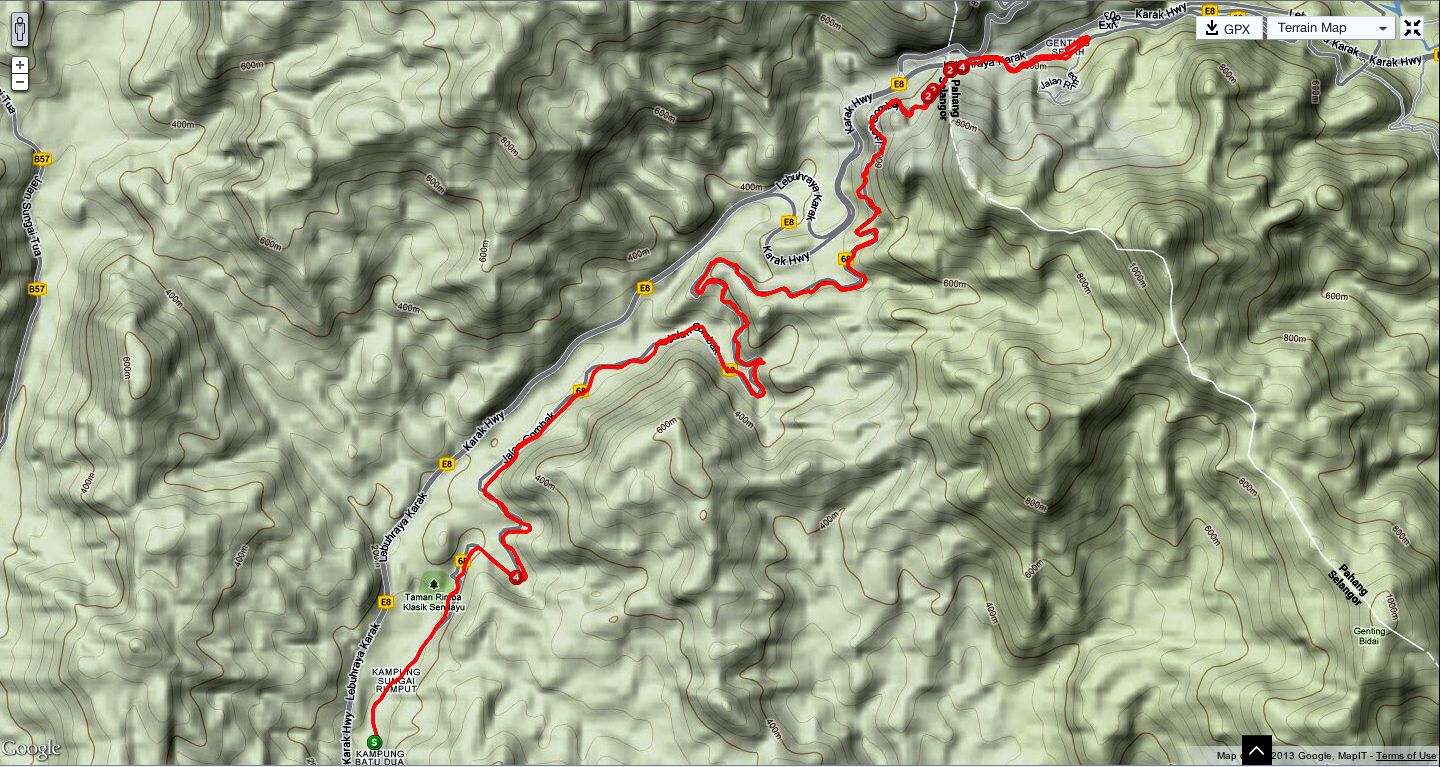
We found parking spots and got our bikes ready.  Three of us had road bikes; I had my purple steel bike, but the rest of the guys in the group pulled folding bikes out of their cars.  I quickly learned that folding bikes are very popular here.  At least for the distance we planned to ride that morning.  Which was about sixteen kilometers – straight up.  I did say that the road goes up over the spine of the peninsula.  Here’s the route:

Genting Sempah

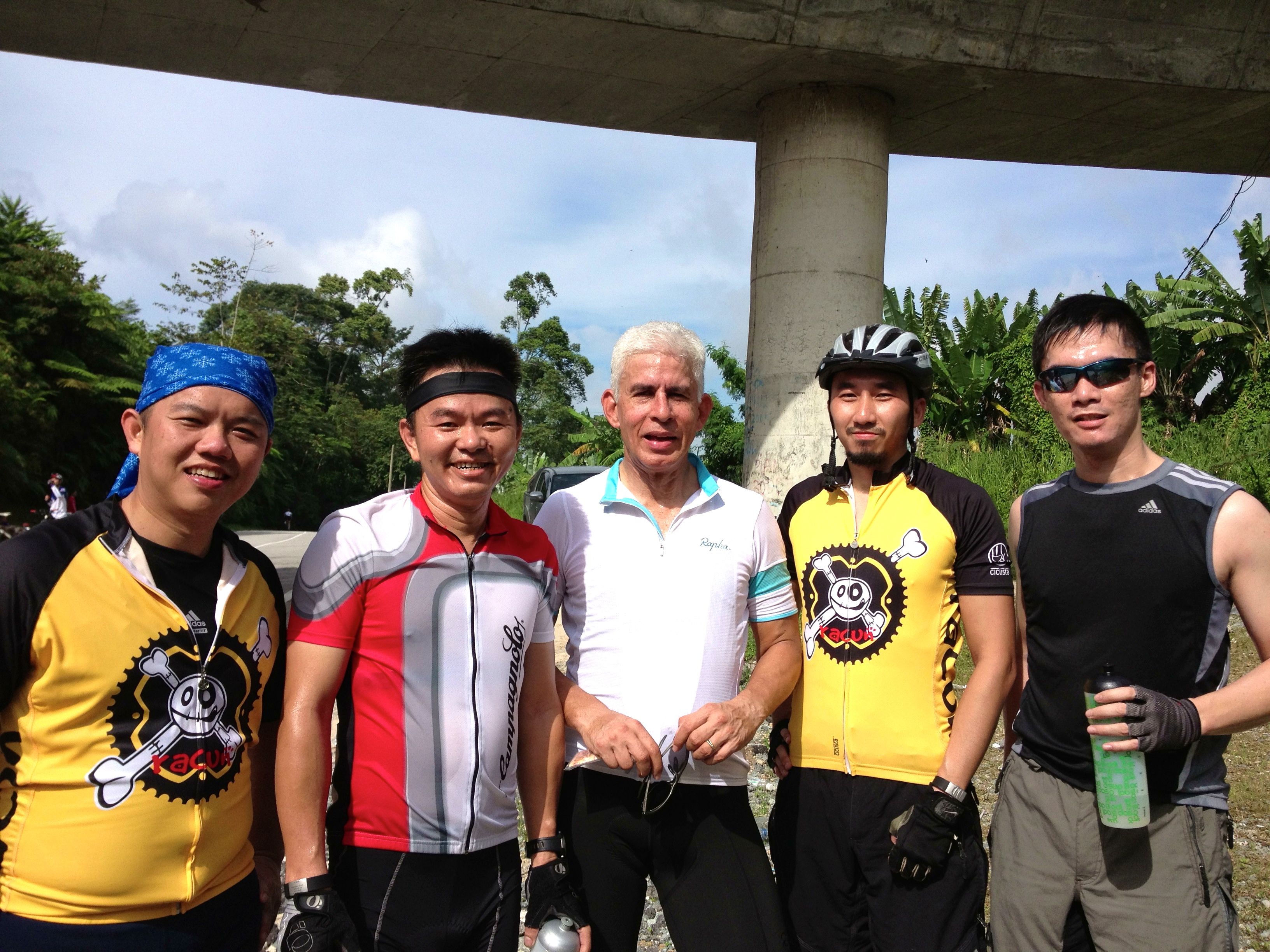
We regrouped at the top of the climb to catch our breath, and in my case to also wipe the sweat out of my eyes and off my face.  Here are some of the Racun Cycling Gang:

Christine D saw this photo and sent me the following sweat control advice – which I definitely needed:

Using unflavored, uncoloured (no mint!) lip balm, draw a line on your skin, above your eyebrow, extending down past the side of your eye, to make a “hydro barrier” – do this over each eye. don’t put it on too thick or smear it. this channels the sweat away from your eyes.

Here’s some of the competition we had for the shade at the top of the climb.

Once our pulse rates stopped hammering in our ears we rolled down the other side of this slope to the McDonald’s that is a rest stop on the Karak Highway for coffee and Cokes.  Then it was a sharp one kilometer climb back up to the point in the photo above, followed by a long sweeping descent back to our cars.

What a fabulous first ride!  The road runs through the rain forest that covers much of the country.  So while it was rabbits, ducks and geese on the bike paths in Den Haag, here I had to watch out for monkeys on the road, in this case long-tailed macaques.  The road surface is generally very good and there was very little traffic to contend with.  On my way down I passed perhaps three cars coming the other way, all driven by learner-drivers with instructors at their sides.  Presumably practicing hill stops and starts.  So I was able to descend with some speed.

The only niggle in my morning was a creak that developed at the start of the climb.  All creaks seem to emanate from the bottom bracket, but I am fairly sure that wasn’t the source.  A bit of a mystery to solve in the next few days.