Category Archives: Gear and Tools

“Hey, I Put Some New Wheels On, And Suddenly Everything Is Right” **

Ride regularly with a large enough group and you can count on seeing something new on a weekly basis.  A pristine pair of shoes, a shiny helmet, sometimes a new bike (I’m looking at you Chris).

Lately it has been new wheels.  First Mark showed up with a pair of 50mm deep Sonic carbon wheels.  Admittedly a borrowed pair, but still.  Then Marco bought a pair of 38mm Sonic carbon wheels.  A week or two later Shahfiq rolled up on a set of carbon Sonics.  Ken was next.  It seems that the group has managed to buy up the entire stock of Sonic carbon clinchers in Kuala Lumpur.

Our conversations became centered on the difference that those Sonics made.  Rides became “effortless.”  “Sonic boom” entered our shared vocabulary as a way to describe the impact the new wheels had on average speeds.

I have only ever ridden on Easton EA90 SLX wheels.  My steel Alchemy came with those wheels.  I like them.  So I stuck with them for my other bikes.

The appearance of all those new wheel sets on my friends’ bikes made me think about getting some new wheels too.  I wanted to stay with alloy wheels.  I’ve seen a number of broken carbon wheels but have yet to see a broken alloy wheel.  I was keen to get something that was more aerodynamic that the Eastons.  And I was sold on the advantages of running 25 mm wide tires on a wider rim rather than the 23 mm tires I was using with the Eastons.

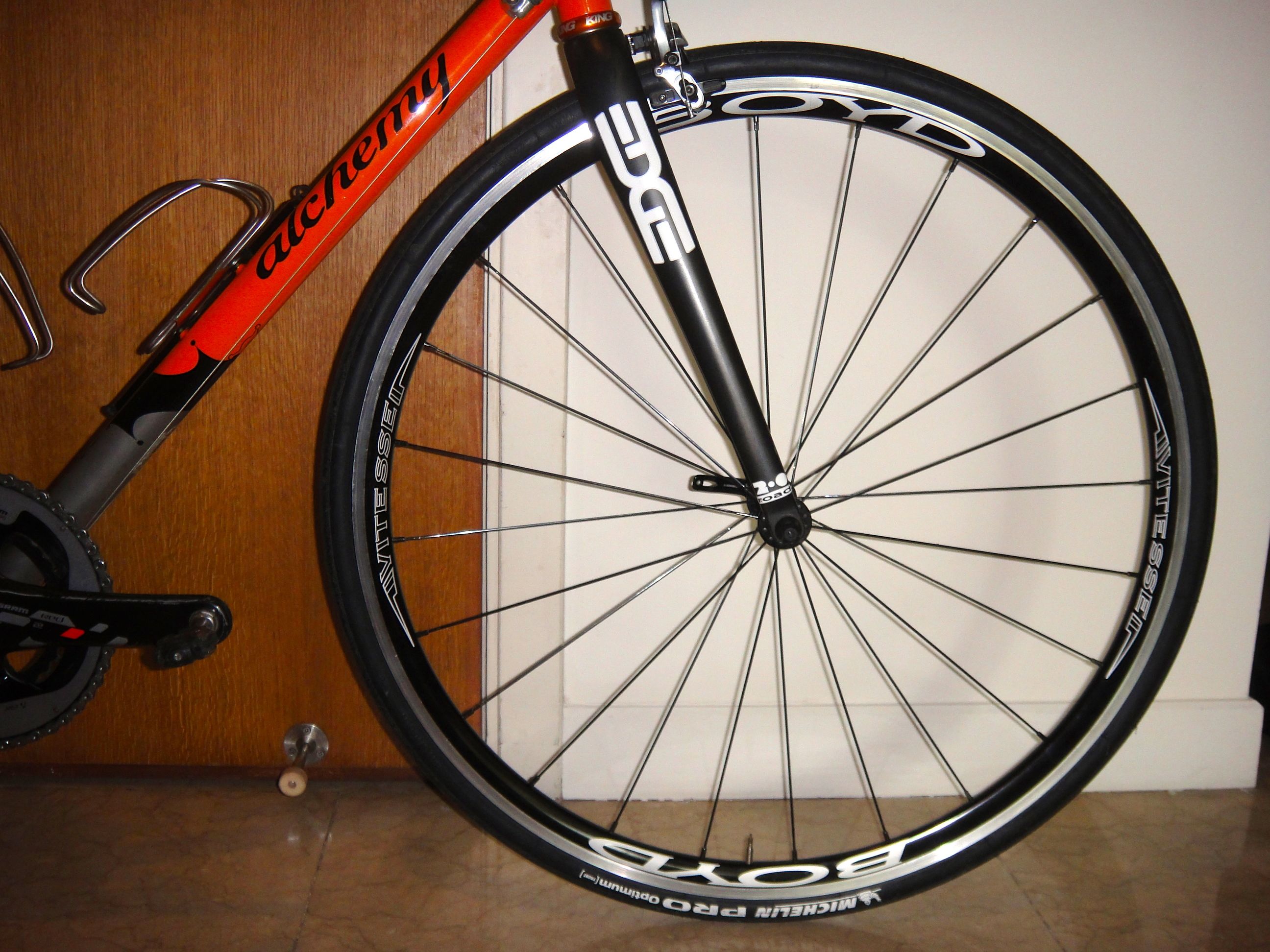
Lots of online product reviews and some e-mail conversations with Boyd Johnson later, I placed an order for a set of Boyd Vitesse alloy clinchers.  The Vitesse wheels met the requirements I was interested in.  Additionally they are hand-built, and come at a reasonable price.  I ordered the version with 24 spokes on the front and 28 spokes on the rear.  The standard spoke count of 20 front / 24 rear is recommended for riders below 81 kg / 180 lb.  I hover right around 81 kg, so I took Boyd Johnson’s advice to go with the more durable higher spoke count.

On the day I placed my order, Nicole Johnson confirmed that the order had shipped, and gave me a shipment tracking number.  Greenville, North Carolina, the home of Boyd Cycling, is 15,800 km / 9,800 mi from Kuala Lumpur.  So I was a bit nervous about how well my wheels would stand up to the trip.  The United States Postal Service did a good job.  The carton arrived in very good shape.  Just a crease on one corner to show for the journey from Greenville to Miami, Florida and onward to Kuala Lumpur.
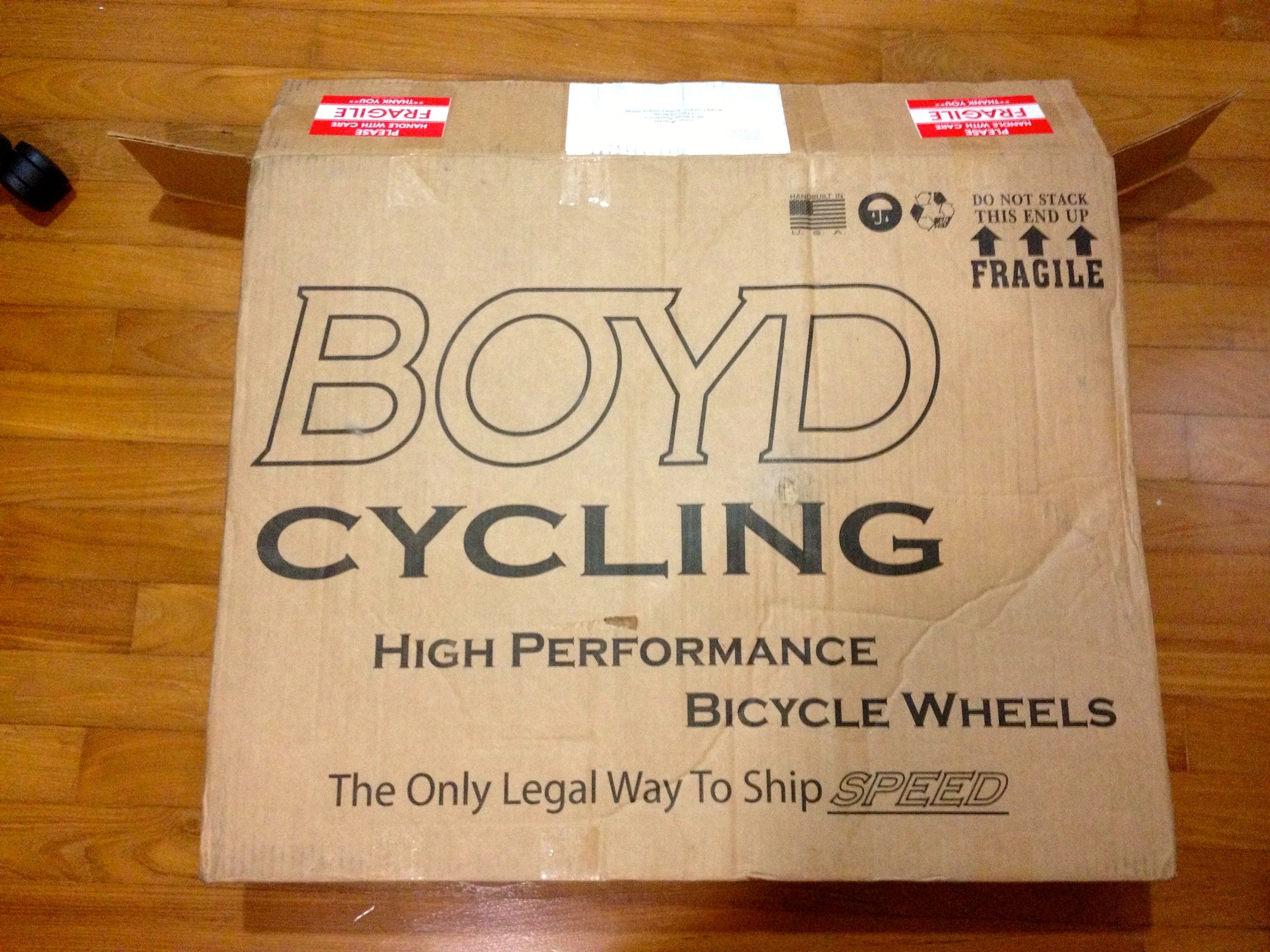
Image2

The contents were safely cradled within braces inside the carton.  The wheels arrived undamaged and as true as the day they left the Boyd facility.

Photograph courtesy of Boyd Cycling

Photograph courtesy of Boyd Cycling

I tried the Vitesse wheels out with new 700 x 23 Michelin Pro4 Service Course tires on a ride to the Chamang waterfall.  The wheels rolled smoothly and silently (more to come on the sound of the freewheel).  There were no creaks or pings from the spokes.  One sign of a well-trued, well-tensioned and well-stress relieved wheel set.

These wheels felt stiffer and seemed to hold their speed better than my Eastons.  However I needed more than 75 km / 47 mi on the Boyds before I could form a definitive view on stiffness and speed.

What I can say is that I under-inflated the Pro4 tires.  The 23 mm wide rim meant that the tires have a lower profile than they do on the narrower Easton rims.  So they are even more prone to pinch flats if under-inflated.  I had two pinch flats on my maiden ride on the Vitesse wheels.

The next outing on the Boyd Vitesse wheels was on the Samila Century.  I wanted to try the wheels with a wider tire.  I had a pair of rarely-used 700 x 25 Bontrager Race All Weather tires that I bought in 2011 for a ride on the cobbles of Flanders.

The wire-beaded Bontragers aren’t the lightest tires at 400 grams each, but they were the only 25 mm tires I had.  As it turned out they were a good tire to have for a very very wet Samila Century.  The wheels felt just as stiff, and were just as silent.  The ride quality on the 25 mm tires was much improved over that on the 23 mm Pro4s.  There was a lot less harsh road surface feedback with the wider tires.

I am tempted to say that it took less effort to get the Boyd Vitesse wheels up to speed, and then to hold that speed.   I did after all get up to and exceed 60 kph / 37 mph for 8 km / 5 mi or so, albeit drafting behind a lorry.  It may be just wishful thinking, but these wheels did feel ‘faster’ that my Eastons over the 145 km / 90 mi course.

Since the Samila Century I have taken delivery of a new pair of tires.  My wheels are now shod with 700 x 25 Michelin Pro Optimum tires.  I rode the 74 km / 46 mi Shimano Challenge on the Pro Optimums.  These Michelins are considerably lighter than the Bontragers, at 215 grams on the front and 240 grams on the rear.

“Effortless” may be pushing it, but the Boyd Vitesse wheels do seem to take less effort while climbing.  They continue to impress me with their stiffness.  Somewhat surprisingly for wheels that are 28 mm deep, they feel less twitchy at speed than the 25 mm deep Easton EA90 SLX wheels do.

Now about the sound of the freewheel.  Some reviewers feel that the Boyd freewheel is too loud.  The 2013 Boyd hubs have four oversized pawls, versus three pawls in my Easton hubs.  Perhaps that is why the Boyd freewheel is louder than the Easton freewheel.  Not excessively so in my view.  Experience with my Easton hubs tells me that putting some grease in the hub will quieten it if necessary.  I will leave my Boyd hub alone.  I like the sound it makes.

Photograph courtesy of Boyd Cycling

Photograph courtesy of Boyd Cycling

I also like the look of these wheels.  The black Sapim CX Ray spokes make a nice change from silver spokes.  To my eye the single-color logos are an understated touch.

Rear.

DSC02449

Front.

DSC02450

The full view.

DSC02448

I give the Boyd Vitesse alloy clincher wheels a “Thumbs Up” rating.  My customer experience with Boyd Cycling was outstanding.  I would buy from Boyd Cycling again, and I would certainly recommend Boyd Cycling to my friends.

** Thank you Paolo Nutini for the slightly amended lyric to “New Shoes.”

Saddle Up

A rider touches a bicycle at three points.  At the pedals, the saddle, and the handlebar.  When I got my first road bike the components at these three contact points were chosen for me by James Flatman, the bike builder.  Thank goodness, because the choices of pedals, saddles and handlebars are seemingly endless.

My steel Alchemy came with Speedplay Zero pedals, a Selle Italia SL Flow saddle, and a Ritchey Comp Road Logic handlebar.  I was happy with all those contact points, so a year later when I got my next road bike I was happy to stick with what I was used to.

Welcome to the concept of product updates in the cycling components world.

My titanium Alchemy came with Speedplay Zero pedals, a Selle Italia SLR Flow saddle (the SL Flow having been discontinued), and a Ritchey WCS Carbon Evolution handlebar (the Road Logic having been discontinued).  The saddle and handlebars were not very different from the models which they had replaced, but they were different enough for the change to be noticeable.

So it was that I contracted that affliction that affects so many cyclists.  The desire to fiddle.  In my case with saddles.

Fortunately the itch to fiddle has not extended to my pedals and handlebars.  The scope for mucking around with my pedals is limited anyway.  I like the dual-sided entry of the Speedplays.  Other makes of road pedals are single-sided.  So my only option is getting lighter Speedplays; chrome-moly or titanium.  I haven’t yet been cursed with the ultimate cyclist’s affliction, the desire for the lightest components on earth.  So my stainless steel Speedplays remain my pedals of choice.

I must admit that I like the Carbon Evolution handlebar more than I like the Comp Road Logic handlebar.  The Carbon Evolution has an oval top with a 4 degree sweep, which makes it more comfortable  than the Comp Road Logic.  So about a year ago I put a Carbon Evolution handlebar on the steel Alchemy.

Back to fiddling with saddles.  Of the three contact points I notice the saddle the most while I am riding.  Not that the SL Flow or the SLR Flow are uncomfortable saddles.  They both have a central cutout, which I like.  This is the SL Flow.

Selle Italia SL Flow

This is the SLR Flow.

Selle Italia SLR Flow

The SLR Flow has a slightly larger cutout than the SL Flow, but they are essentially the same saddle.  Equally comfortable.  But as I learned more about saddle shapes and the different materials used to make them, I kept wondering if there may be a more comfortable saddle out there for me.

Then in the latter half of 2011 I read about the Fi’zi:k Kurve range of saddles.

Fizik Kurve

There was enough new technology in the Kurve saddles to appeal to the geek in me.  Spine Concept designs, Re:flex construction, a Tuner interchangeable tension system, a Moebius one-piece saddle rail.  Add positive reviews about outstanding comfort to the mix, and I wanted one.

The Fi’zi:k Kurves appeared in a few London bike shops some time before they turned up in Dutch bike shops.  At the very first opportunity I popped into Condor Cycles in London.  I had every intention of leaving with either a Kurve Snake or a Kurve Chameleon saddle, depending upon what a Spine Concept test showed I was best suited to.

The sales person asked me if I had any problems or discomfort with the Selle Italia saddles.  I said “no.”

I left empty-handed.  She refused to sell me a saddle.  She told me not to try to fix something that wasn’t broken.

That cured my saddle fiddling itch.

That is until I started seeing Michelle again.  Michelle is a Rolf Method Structural Integration Practitioner.   She does myofascial release therapy.  In plain language, she manipulates deep tissue to correct postural imbalances and restrictions.   I saw her regularly in the years before I moved to Houston.  As soon as I got back to Kuala Lumpur I signed up for a course of therapy.  I had lots of things that needed fixing.  Some brought on by cycling.

After Michele had worked on my hip muscles: adductors, glutes, illiopsoas, piriformis, sartorius, etc., my saddles felt less comfortable.  They felt too narrow.

I had learned that bicycle saddles come in different widths.  Perhaps Michelle had loosened up my pelvis such that my sit bones had moved further apart. So I went to a Specialized Concept store to have my sit bones measured.  The resulting number showed that my 130mm wide Selle Italia saddles were indeed to narrow for my sit bones.

Specialized makes saddles in three widths: 130mm, 143mm, and 155mm.  My sit bone measurement showed that I needed a saddle wider than 143mm.  So I left the shop with a 155mm wide Romin Comp Gel saddle under my arm.

Specialized Romin Comp Gel

I replaced the SL Flow saddle on my steel bike with the Romin saddle.   The Romin felt very comfortable at first.  As time went by it felt less and less comfortable.  At the same time the SLR Flow saddle on my titanium bike became increasingly comfortable.  My sit bones must have slowly migrated closer together again.  The Romin saddle started feeling too wide for me.

So when I had to choose a saddle for my Ritchey Breakaway I picked the latest iteration of the Selle Italia SLR saddle.  The SLR Superflow.  A 130mm wide one.

Selle Italia SLR Superflow

The SLR Superflow has a monster cutout.  Which must work as designed because this a very comfortable saddle.

Since April this year I have rotated between the 130mm wide SLR Flow, the 130mm wide SLR Superflow, and the 155mm wide Romin Comp Gel saddles.  The Romin was a mistake.  Certainly in the 155mm width.

Last week I replaced the Romin Comp Gel with another 130mm SLR Superflow.

I think I am done fiddling with my saddles.

But about that handlebar tape . . .

Kilo Months

I started keeping track of my rides in January 2010.  I had a new road bike, and an even newer Garmin Edge 705 cycle computer.  Uploading the details to the Garmin Connect web site after every ride became standard practice.   That year I rode 3,173 kilometers.

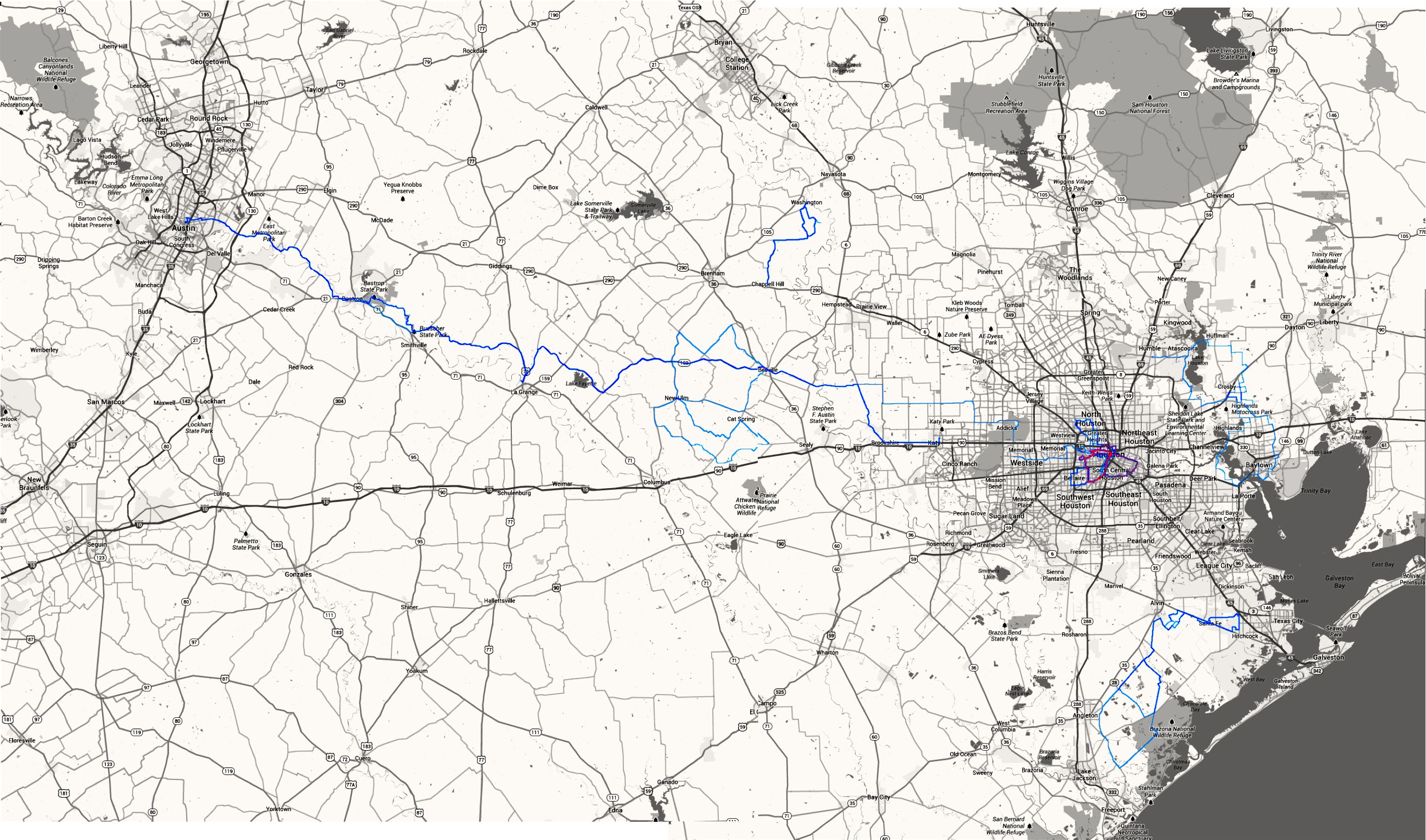
The heat map below shows where I rode for the first six months of 2010.  The most-ridden routes are depicted in red.  Click on the heat map to open the image in a new window.  You will see that most of my kilometers were accrued on the West End Tuesday and Thursday evening rides, and the Sunday Taco rides through Houston.

2010 Heat Map

Heat Map courtesy of Strava

I had some big rides outside metro Houston:  The Humble Lions Club Ride, The Space Race, and the BP MS150.  But I didn’t have a kilo month, which is my term for riding more than 1,000 kilometers in a month.

In mid-2010 I moved with my biker chick to The Netherlands.  The excellent cycling infrastructure there gave me more opportunity to ride, albeit on my own as I didn’t connect with a cycling group until the following year.

I started riding with the Not Possibles in March 2011.  The Saturday and occasional weekday rides with them boosted the distance I rode in 2011 to 6,985 kilometers.  In 2012 that number increased to 11,054 kilometers.  Almost of those kilometers were around Den Haag, with the 2011 and 2012 Ronde van Vlaanderen sportives, and the 2012 UCI World Championships sportive in Belgium thrown in for good measure.

Heat map courtesy of Strave

Heat Map courtesy of Strave

I racked up my first kilo month in August 2011.  The fine summer weather allowed me to ride eighteen times that month for a total of 1,085 kilometers.

Somewhat surprisingly I didn’t have another kilo month until January 2012, when I rode 1,091 kilometers.  I then had four more kilo months that year.  March, and three in a row from June to August.  My Not Possibles friends and I had a good summer that year.  My biggest ever kilo month was in July, when I rode 1,718 kilometers.  I had the luxury of being able to go on twenty five rides that month.

In October 2012 my biker chick and I moved home to Kuala Lumpur.   My ride frequency and average distance dropped dramatically for some months before slowly increasing again.  So it took more than a year before I had another kilo month, in September 2013.  Helped by five rides of at least 100 kilometers each.

My 2013 heat map looks a lot like my 2010 Houston heat map in that most of my rides are limited to a couple of routes.  Int his case KESAS and the Guthrie Corridor Expressway, with Putrajya and Genting Sempah thrown in for variety.  Scattered around the map are the one-off events that I rode in Johor Bahru, Kuala Terengganu, Kuantan and Penang,  My Racun buddies and I also rode to Fraser’s Hill, and I joined Dave Ern on a ride to Cameron Highlands.  You can also read about the Bike X and Broga 116 rides.

Heat Map courtesy of Strava

Heat Map courtesy of Strava

It looks like I will ride about 7,300 kilometers in 2013.  And perhaps have another kilo month this quarter.  Garmin Connect will reveal all.

Chain Checkers Do No Good Just Sitting in Your Toolbox

I have not been regularly checking my bicycle chains for wear.  I have no excuse for not doing so.  I have the necessary tool for the job.  Two of them in fact.

Chain Checker

The purist will argue that a steel ruler or steel tape measure is the most accurate tool for measuring chain wear.  Using a ruler can however be error-prone because it is necessary to hold the ruler precisely and measure one end while making sure the other does not slip.  So tools like these ones have been created.  They are not as accurate as a properly-used ruler, but they are an easier and faster way to measure chain wear.

Chain wear is often referred to as chain stretch, but this is a misnomer.  The side plates of a chain do not deform under pedalling forces.  Rather it is wear to the pins, bushes and rollers that causes the distance between the pins to increase, thus giving the illusion of stretch.

This diagram shows A. pin/bushing wear, and C. bushing/roller wear.  B shows an unworn chain.  Note that roller wear does not affect pin spacing.

Illustration courtesy of par do.net at http://pardo.net/bike/pic/fail-004/000.html

Illustration courtesy of pardo.net at http://pardo.net/bike/pic/fail-004/000.html

In short, chain wear is indicated by an increase is the spacing between pins.  When I finally put my BBB chain checker to use it showed that the chain on  my titanium Alchemy bike had reached the point where it needed to be replaced.  What I didn’t know was when the chain had reached that point.  Had I been riding for too long on a worn chain, and perhaps damaged the drive train in the process?

Some of my Racun Cycling Gang had recommended Meng Thai Bicycle Centre for bike parts and service.  So I took the bike there to have a new chain installed.  Labor costs are still relatively low here as compared to the Netherlands, so I had less incentive to do it myself.  When I say low I mean a labor charge of  RM 30 / USD 9 to have a new chain installed and to get the bike serviced and tuned up.

My first ride with the new chain was up to Genting Sempah.  It quickly became obvious that I had waited too long to replace the chain.  The chain was skipping on one cog.  It didn’t matter which chain ring I was in.  The chain skipped on that one cog.

At first I couldn’t tell from looking at the cassette that there was anything wrong with it.

IMG_1663

A closer look revealed where the problem lay.

Cassette Wear

That shark-tooth profile on the fourth cog is not normal.,  The new chain rides too high up the ramp of the tooth and slips off.  The only solution was a new cassette.  I went with a SRAM PG 1070 cassette at RM 250 / USD 76 rather than replacing this SRAM OG 1090 cassette at RM 650 / USD 198.

The moral of this tale is to regularly check your chain for wear.  I now know, thanks to the late and great Sheldon Brown, that a chain that has just 1% of wear should be replaced.  Anything more than 1% chain wear and the sprockets are probably already damaged.

What is 1% of chain wear?  Ten links of a new chain are 25.4 cm long, measured from pin to pin.  If the last pin in link ten is just past 25.5 cm the chain needs to be replaced.  If the last pin is approaching 25.7 cm away then the most-used sprockets are already damaged.

I got 10,000 km / 6,214 mi out of the cassette.  I wonder how many more kilometers it would have lasted if I had replaced the chain as soon as it showed 1% wear.

I replaced the chain on the steel Alchemy a few days ago.  The cassette on that bike has 13,300 km / 8,265 mi on it so far.  Including 115 km / 71.5 mi with the new chain.

I caught that one in time.  No skips.

Velo Fit First Steps

Image

I announced the birth of Velo Fit in early April.  I had my Retül certification.  The Retül equipment and other bike fitting tools had been ordered.  The business had been registered.  The logo was being designed.  I had a location for my fit studio.

There were still things to do.  Design a website for instance.  But I was confident that I would make my target of first appointments in June.

What is it that Robert Burns said about the best laid plans of mice and men?

I opened for business in mid-August.

Here is what happened.  The lease at Van’s Urban Bicycle Co. came up for renewal and the expected rental increase was more than Vanessa, Ray and their business partners was willing to bear.  So there was a scramble to complete the renovations at the new premises and to vacate the old shop.  That pushed the availability of space for my studio to mid-July.

Also it took longer than expected to find a carpenter to build a rotating platform.  The platform isn’t an absolutely essential piece of kit, but having it makes a fitter’s life much easier.  Retül customers in the USA get a completed platform as part of their equipment order.  It is a very heavy item though.  Not surprising as it has to support the weight of at least two people, a bicycle, and a turbo trainer.  So international customers get a box of screws, washers, casters and other metal parts, and assembly instructions.

In early August my cousin Yasmin put me in touch with a carpenter who could read plans.  Two weeks later my rotating platform was delivered to the newly-opened Van’s Urban Bicycle Co. shop in Kampung Tunku.

In the meantime I had accumulated the other bits and pieces I needed to equip my studio:  some chairs, a trolley to hold a laptop, a projector, tools etc., and a massage bed for the biomechanical assessments.  I was ready for business.

My first client was Mark.

Mark Lim Fitting

My second client was Marco.  Thank you Mark and Marco for setting me on my way, and bearing through all the teething troubles as I got the equipment, and myself, up to speed.

Marco Bike Fit

As you can see I changed the studio set up as I went along.  Hanging a sheet on the back wall as a screen for the projector was a bad idea.  Here’s the studio as it is today.

Velo Fit Studio

Fortunately there is just enough space for the rotating platform to actually pivot.

I am excited to finally be up and running.  My website at http://velofit.org has already generated some appointments.  I am flashing my business card where ever I go.

Bizcard

Friends and family are helping me advertise.  The next few months will tell if this is a good idea.

In closing, here is a suggestion I got for a sticker that could go on each bike that comes through my studio:

Size doesn’t matter, but fit does!

The Cult of Strava

The Social Facilitation Theory argues that social evaluation has an impact on performance.

The psychologist Norman Triplett was the first to study this effect, starting in 1898.  He found that cyclists had better race times when in the company of other cyclists.  Further research demonstrated something we now consider obvious:  humans try harder when matched against others. Later work would demonstrate that the mere presence of others could inspire us to work harder.

Fast forward 110 years.   Social facilitation meets social sharing (think Facebook) and Strava is born.  Cyclists now have a way to record the details of a ride and compare those details with those of every other Strava member who has done the same ride.  Thanks to a smartphone app that does away with the need for a dedicated cycling GPS, some one million cyclists use Strava today, and that user base continues to grow.  Cyclists now have access to social evaluation on a massive scale.

Thousands of Strava users have created segments, or specific sections, of their cycling routes.  Any segments will be displayed as part of your ride data in the Strava application.

Strava Segment

The segments table shows your performance on the current ride relative to your previous efforts on the same ride.  Each segment is identified, and the segment distance, elevation, and your performance parameters are displayed.  If your latest performance on a segment is one of your better ones you get a little medal:  gold for a Personal Record, silver for a 2nd best and bronze for a 3rd best time.

Click on a segment and social facilitation comes into play.

Strava Leaderboard

Note: Rider names have been deleted

Now you see your best performance on a segment relative to every other rider on Strava who has ridden the same segment.  I see I need to ride this segment just 0.1 kph faster to be in the top 50!

If I want a hit to my ego I can view the results for men only.  Fortunately for my ego there is only one woman ahead of me on the leaderboard for this segment.  For now.

If I want to feel better I can view the results by age group.  There are only six of us in the 55 to 64 age group for this segment so I am definitely in the top ten!

The ability to virtually compete against others should be a boon, and it is for most riders.  Strava was created to encourage cyclists to train, to climb higher and go faster.  I get a kick out of achieving new personal bests, and this is true for many others as well.

I don’t have the physical gifts to challenge for King of the Mountain (KOM) status.  So there is no chance of seeing one of these, which signifies being atop a segment leaderboard,  on my Strava profile.

Strava KOM

I have been known to push hard for the fastest time in my age group for certain segments though.  Social facilitation in action.

The same social facilitation effect can be a bane as well.  There are people out there who are so competitive that every ride is a do-or-die race in the hunt for KOM crowns.   In some cases literally.  William Flint was killed when he collided with an oncoming car on a downhill stretch of road while apparently trying to reclaim his KOM status.

And in a sad reflection of the recent state of affairs in the professional peloton, riders so inclined can now even artificially enhance their Strava results by giving their data a boost with the help of the website DigitalEPO.com.

I’ll leave the KOM sniping to the insanely driven Type A personality riders.  But I do wonder if I can knock two seconds off my time for the Puchong Jaya climb tonight.

Road ID iPhone App Review

I have worn a Road ID Wrist ID Sport for more than three years.  I never go on a ride without it.  Fortunately my Road ID has never been used for what it was designed:  to identify me, list medical information, and provide emergency contact details to first responders to an accident or medical emergency.

My Road ID tag does give me some peace of mind when I am on my bike.  So I was very happy to get an email from Edward Wimmer, the co-owner of Road ID, inviting me to test their all-new Road ID app for the iPhone.  This app is designed to take advantage of the GPS and internet access capabilities of the iPhone to complement the Road ID tag.

Click on the Road ID app icon below to go to the iTunes Preview of the app.

Road ID App Icon

There are three things that you can do with this app.

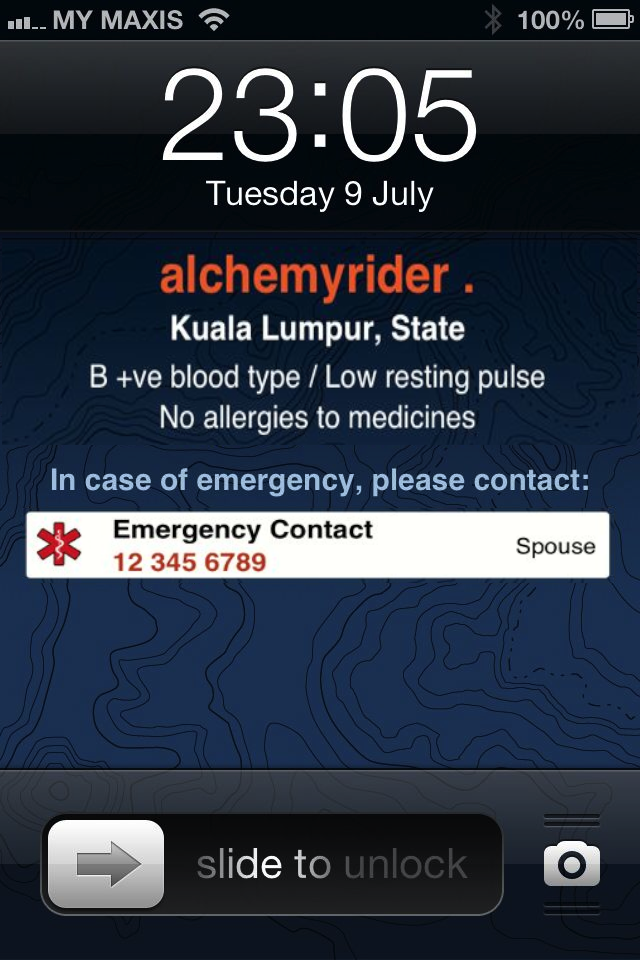
The first is to create an image to use as the Lock Screen for your iPhone.  This image is displayed whenever your iPhone is turned on. Entering the data to be displayed is straight forward.  The app then creates the image for you.  The final step is to go into your iPhone Settings app to select this image as your Lock Screen, Home Screen, or both.  The Lock Screen looks like this.

Template

This screen identifies you, lists essential medical information, and shows emergency contact details for up to three people.  If you can’t speak for yourself, your Road ID Lock Screen will.

The second thing you can do with this app is to track your movements.  Road ID calls this eCrumb tracking.  You can select up to five of your contacts to receive a link that allows them to track your movements using any web browser on any device.  The app transmits your location on a regular basis, which is plotted as a track on a map.

I tested eCrumb tracking during the Iskandar Johor Mega Ride.  This is the map showing where I started from, the route I took, and where my ride ended.  My biker chick followed my progress ‘live’ over the 100 km / 62 mi course.

Road ID App Map

The third thing this app can do is to send a Stationary Alert Notification to your selected contacts in the event that you stop moving for a pre-defined period of time.  The worst case scenario being that you have had an accident or a medical emergency and are immobile and / or unconscious.

The Alert message is customizable.  An audible 60 second countdown is activated if you stop moving for the chosen period of time.  That gives you the opportunity to cancel the Stationary Alert Notification if your stop is not because of an emergency.

You can activate eCrumb tracking only, or Stationary Alert Notification only, or both at the same time.

I have replaced the default Lock Screen on my iPhone with a Road ID Lock Screen.  When someone turns my phone on they see the same details that I have on my wrist tag.

The eCrumb tracking works well and is a fun way for others to follow your progress while you are biking, running, skiing, hiking or whatever outdoors.

I have not tested the Stationary Alert Notification.

The Road ID iPhone app is currently in beta.  Edward Wimmer is actively soliciting feedback from early users to drive bug fixes and future enhancements.

I am very pleased with this app.  My only complaint is that eCrumb tracking cuts my iPhone battery life to just over three hours.  I think that eCrumb tracking should run for at least five  hours before completely depleting the phone battery.

Apart from the battery power management issue, I think this app is ready for prime-time.  It is an excellent safety aid for anyone.

Rapha Grand Tour Shoes Review

My Trek FX 7.5 had platform pedals.  I didn’t need special shoes to ride it.  My steel Alchemy would be delivered with clipless pedals.  Any shoe would no longer do.  I needed cycling shoes.  Some research on the internet pointed me toward the Sidi Genius 5-Pro Mega.  The “Mega” designation indicates that this shoe is wider than the standard Sidi Genius 5-Pro.
Sidi Genuis 5

I was guilty of showrooming with this purchase.  I tried the shoes for size at a bike store, but bought online.  A practice that does not support local retailers.  A practice that I try not to repeat.

Despite being “Mega” the Sidis are slightly narrow in the forefoot for me.  This isn’t a problem on shorter rides, but I develop “hot foot” once the ride exceeds about 60 km / 37 mi or so.  At times I have had to completely unfasten the caliper buckles and loosen the velcro straps to get some relief.

The Sidis came with me to Den Haag.  I swapped out the insoles, which helped a bit with the “hot foot” problem.  Perversely the shoes didn’t keep my feet warm enough in the Dutch winters.  There wasn’t enough room in them for thick woolen socks.  A pair of Endura neoprene  shoe covers delayed, but didn’t prevent, the onset of frozen toes.

My next cycling shoe purchase was the Shimano SH-RW80 Winter Road Shoe.  I liked those shoes so much that I wrote a review that appeared on roadbike review.com.  I took the advice of other reviewers and went two sizes larger than my Sidis.  That gave me plenty of room in the toe box for my wide feet and thick socks.

20080_1_Shimano_SH_RW80GORE_TEXRennrad_Winterschuh-700x525

As Spring 2012 approached I saw posts in cycling blogs about a new shoe.  The Rapha Grand Tour shoe.  First John Watson posted thirty nine captioned photographs of these shoes in his excellent Prolly is Not Probably.  Soon after Wade Wallace ran a review and posted more photographs in his equally excellent Cycling Tips.

I looked at the Rapha site.  I was smitten with the version of the shoes in white.  My biker chick liked them too.  All of a sudden I needed new shoes!

Rapha Grand Tour New 2

It was my good fortune to be in the UK in April 2012.  I went into Condor, Rapha’s retail partner in London.  They had a pair in my size.  The shoes smelled soft and warm in the way that only leather does.  The perforated uppers had style.  The single black strap and the absence of large logos gave the shoes a minimalist look.

I love my Grand Tours.  I still have the Genius Pro-5s, but they are very much my back-up shoes.  The only time I wear them is when the Grand Tours are sitting in a cool airy spot, tongues flipped up and insoles removed, drying out after a wet ride.

You can read the online reviews of these shoes or go to the Rapha site to get all the technical details.  For me the winning qualities are the fit and comfort that make these shoes unnoticeable when I am riding.

I have put almost 11,000 km / 6,835 mi into these shoes in fourteen months.  They get better with age.  Like the leather in Brooks saddles, the leather in these shoes breaks in with use.  The Grand Tours have moulded to the contours of my feet.  The customizable cork / EVA footbeds have also formed themselves to the soles of my feet.  These shoes fit like gloves.

Robust gloves at that.  This is what the sole of the shoe looks like out of the box.

Rapha Grand Tour Sole 1

These are the soles of my shoes today.

Rapha Grand Tour Sole Now

The heel cups and toes are scuffed, and the soles are scratched from the times I walked on stones and gravel.  The white rubber bumpers on the heels show the most wear.  These are non-replaceable so it will be interesting to see how long it is before they wear down to the carbon soles.

Rapha Grand Tour Toe

One buckle bears evidence of a low-speed fall.

Rapha Grand Tour Buckle Now

Apart from that the shoes are holding up very well.

Rapha Grand Tour Now

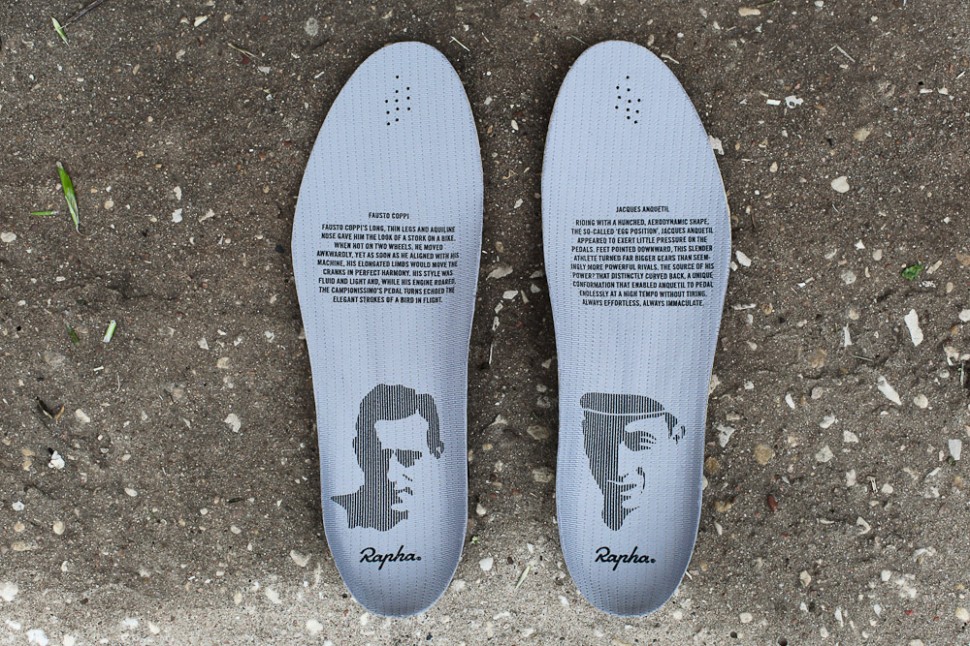
Even the insoles, with their homage to Fausto Coppi on the left and Jacques Anquetil on the right, show little sign of wear.  These are the insoles before any use.

Rapha Grand Tour Insole New

These are mine now.  The images and text are still legible despite thousands of kilometers in all weathers.

Rapha Grand Tour Insole Now

The Grand Tours have not needed any special care.  Just a wipe down with a damp cloth, careful drying when they get soaked, and the application of some shoe cream once in a while has kept them looking good.   I expect to get at least another 11,000 km out of these excellent shoes.

Apart from a proper bike fit and quality bib shorts, shoes are the key to a comfortable ride.  In that regard the Rapha Grand Tour shoes are worth their weight in gold.

Flying the Colors

I thinned down my collection of cycling jerseys when we came home to Kuala Lumpur.  Among the jerseys that I kept were my local club jerseys.  The camaraderie that those jerseys represent makes them near and dear to me.

“Club” sounds a bit formal.  “Group” is a better word.  My first cycling group was West End.  So named because our rides started outside the West End Bicycles shop on Blossom Street in Houston, Texas.  The shop owner, Daniel Murphy, told me about the group and the rides that they do.  There are Tuesday and Thursday evening rides that start at 6.30 pm, and Ted’s Taco Ride on Sunday mornings.

I met Daniel not long after I started cycling.  In my days of riding my Trek 7.5FX hybrid bike in my baggy shorts, t-shirt and tennis shoes.  My first ride with the West End group was spectacularly unsuccessful.  I got dropped within the first few kilometers.  Dropped so badly that I lost sight of everyone’s tail lights.  I didn’t know the route so I had to go home.

The next ride went much better.  Largely due to a few riders hanging back to make sure I didn’t get lost again.  I can’t thank them enough for that.

The West End group introduced me to riding further than 16km / 10mi in one go, how to change a flat tube, what to bring with me on a ride, and the culinary delights of Jax Grill and Doña Maria.

West End Bicycles sold these jerseys.  I know about Frank, the dearly-loved and sadly-departed shop cat.  I don’t know anything about the dog in the shop logo though.  I can tell you that the West End group lives up to the motto on the collar.  Fast and Friendly.

West End

There have also been a series of 6.30 jerseys.  Including this one, which I no longer have.  I donated this jersey, along with others, to an aid organization in Den Haag.  Perhaps someone is still sporting this jersey somewhere in South Holland.

Photo courtesy of West End Bicycles

Photo courtesy of West End Bicycles

It took a while to find a group to ride with in Den Haag.  All the Dutch cycling clubs that I encountered were very serious.  In the typically Dutch way they were very well-organised and had excellent facilities.  They were also geared toward the competitive rather than the recreational cyclist.  Some even required that you met a qualifying time for membership.  Ride 40km / 25mi in an hour for instance.

So a year had gone by before I heard of the Not Possibles.  A group made up largely of expatriates living in the Den Haag area.  Weather permitting, the Not Possibles meet outside the DAKA sports store in the Leidsenhage shopping center on Saturday mornings.  The route for the day often depends upon the prevailing wind, and is usually about 40 to 60km / 25 to 37mi long.

Th group was described to me as one that rode at a pace between 20 to 25kph / 12.5 to 15.5mph.  I learned on my first ride with them that this was not strictly true.  They averaged about 25kph / 15.5mph for the entire ride.  Including the slow rolling start from Leidsenhage, the stops at traffic lights and the slow rolling through built-up areas.  I spent most of my first ride with the Not Possibles frantically trying not to lose sight of the tail end of the group as it sped through the trees in the dunes.  This struggling on the first ride was becoming a bad habit.

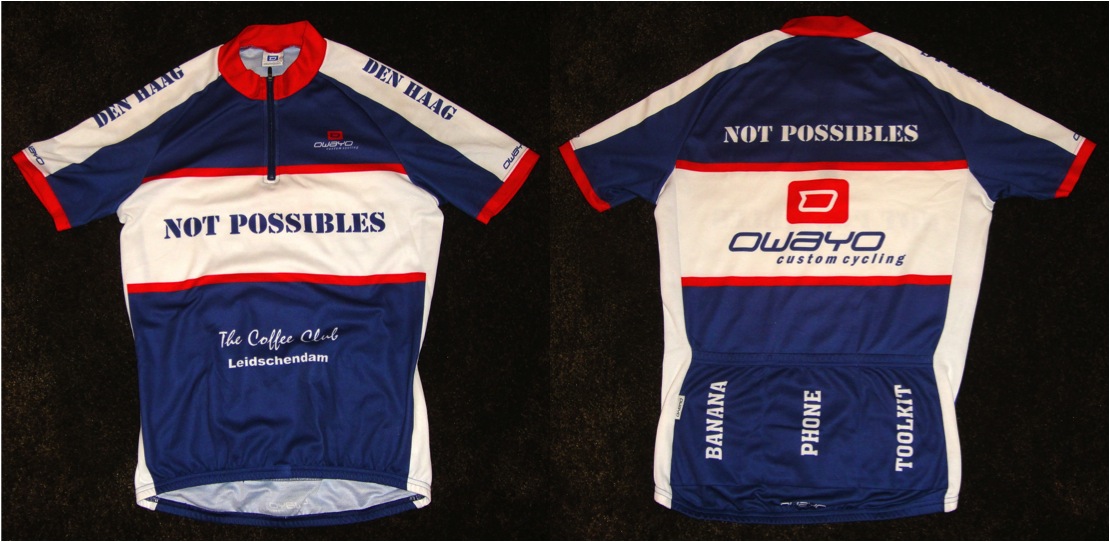
A few months after I hooked up with the Not Possibles we decided that we needed group jerseys.  This is what we came up with.

Not Possibles

The Not Possibles introduced me to routes north, east and south of Den Haag (west was not possible because the North Sea gets in the way),  riding in the rain, harnessing a tail wind for 60km / 37mi and taking the train to get home, and the delights of apple pie and coffee at the Coffee Club.

I hooked up with a group of cyclists within a few days of arriving in Kuala Lumpur.  As soon as my bikes arrived I was off on a ride with the Racun group.  “Racun” is the Bahasa Malaysia word for “poison.”  In this case the name refers to how people are poisoned by the cycling bug.  One bike becomes two bikes becomes three bikes.  Every bright and shiny new accessory becomes a must-have.

The name is especially appropriate because the Racun group are linked to Van’s Urban Cycling Co.  Where new temptations are constantly presented.  Like the new Knog Blinder Road light.  I am not the only one in the group who is sorely tempted by this light.

The Racun group has introduced me to the world of folding bicycles, urban night rides, breakfast at Sharif Roti Canai, and orange + green apple + lychee juice.

Van’s was sold out of the original yellow and black Racun jerseys.  Fortunately for the new joiners a second batch of jerseys was made up.

Racun

The jerseys may be different, but they represent the same things.  A love of cycling, fun and friendship.  I fly these colors with pride.

I Don’t Leave Home Without Them

Posted on

For a quarter of a century the advertising campaign featuring the words “Don’t leave home without them” referred to these.

AMEX Travelers Cheques

I have never ridden with a traveler’s cheque in my jersey pocket.  I don’t know anyone who has.  All cyclists have some things that we regularly carry with us on our rides.  Some cash for example.  Or a Road ID.

There are very few items that I have with me on every ride.  I have forgotten to pack socks.  I often dispense with gloves.   I have left my mobile phone at home.  There is however one thing that I always bring with me on my rides.

Cleat covers.

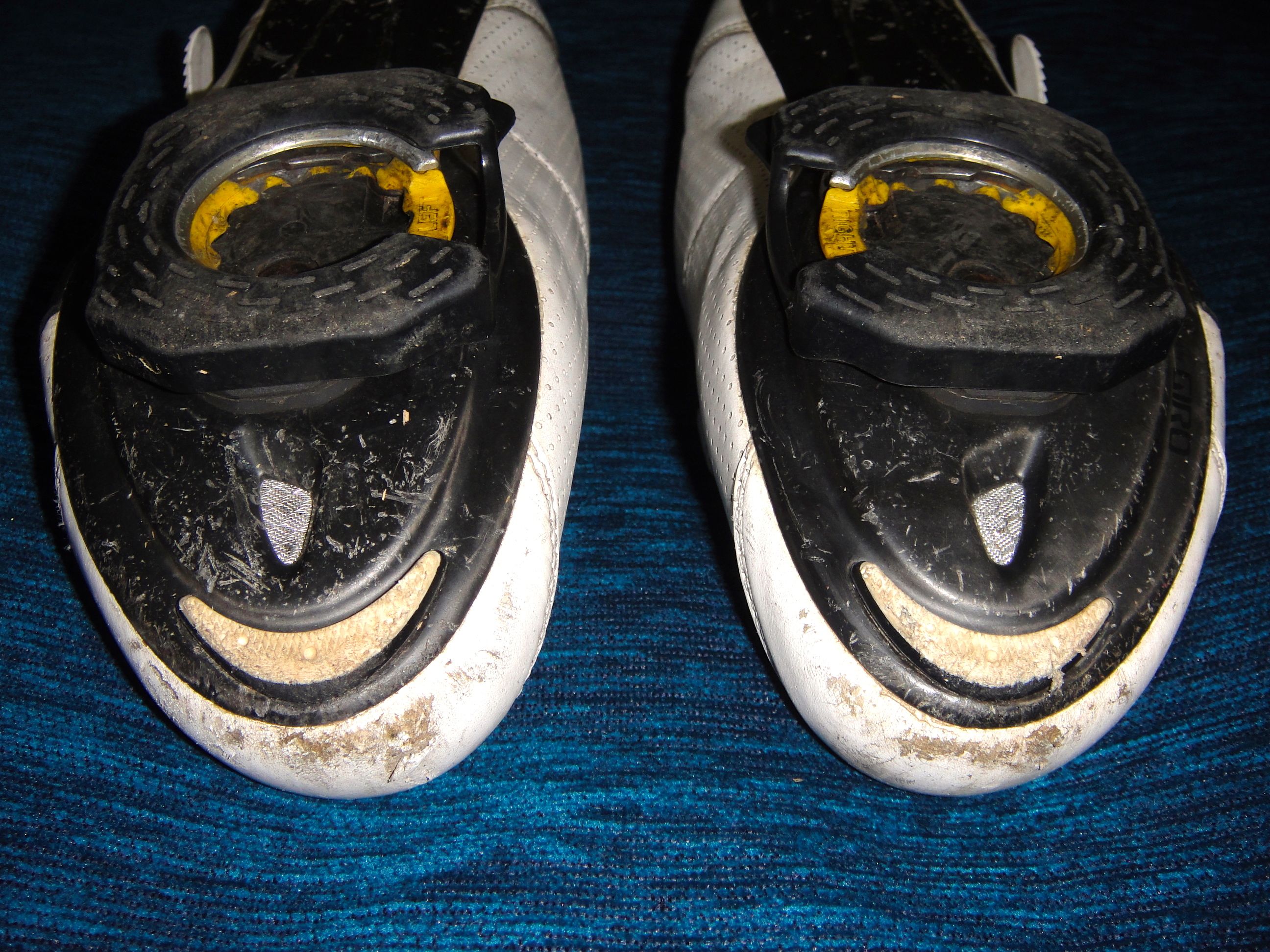
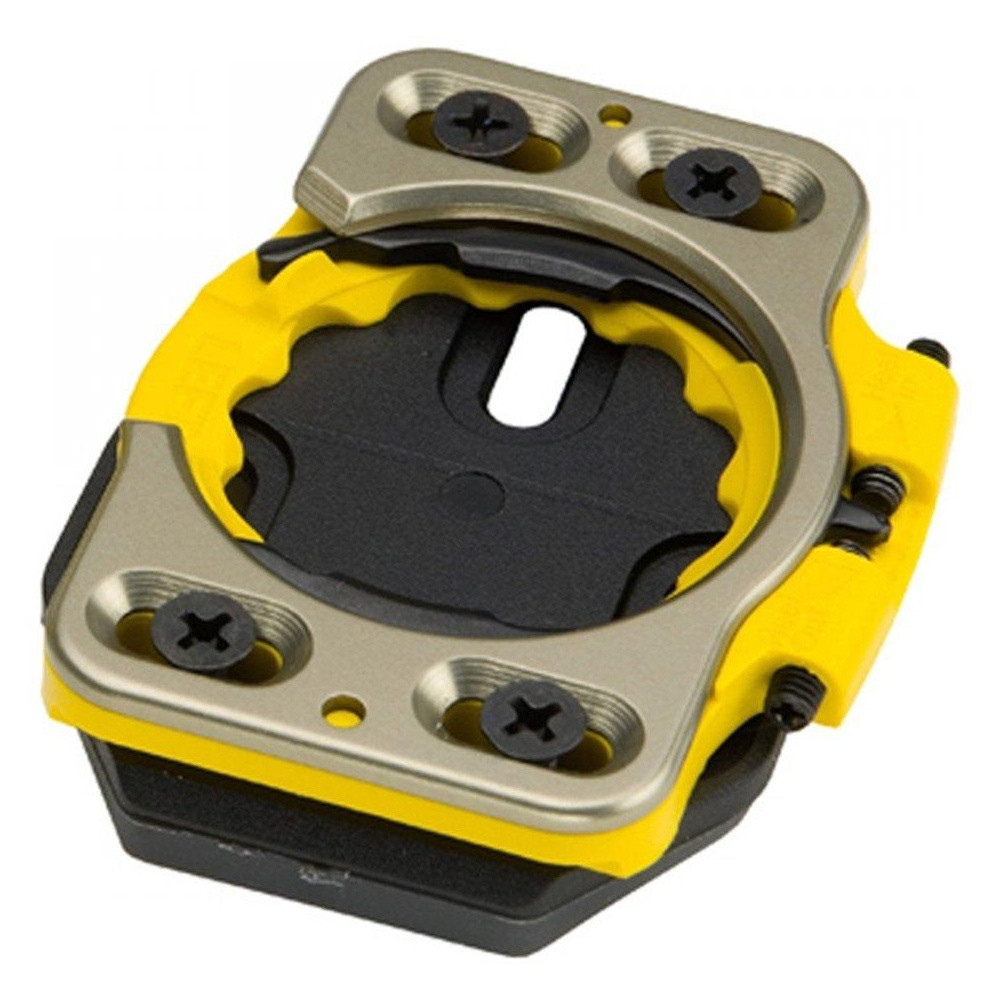
I use Speedplay Zero pedals.  They were recommended to me when I bought my first road bike.  It is the only pedal system I have used since.  I like them a lot.  Like other users I have encountered the two main drawbacks with Speedplays.  Both to do with the cleats.

Speedplay Zero Cleat

When I walked in my cycling shoes the cleats got clogged up with dirt and mud.  The large metal surface area also made them quite slippery on hard floors.  I had a few near misses as I skated on concrete and the like.

It wasn’t long before I invested in a set of Coffee Shop Caps.

Coffee Shop Caps

These clip onto the cleats to keep dirt out and provide traction while walking.  I would put then on my cleats when I got off my bike, and stuff them into a jersey pocket when it was time to ride again.  My only mishap with the Coffee Shop Caps was that one fell off while I was walking around a rest area during a charity ride. I never found it, but later came across one that someone else had lost.

I found an alternative to the Speedplay branded covers while surfing the internet.

Kool Kovers Speedplay

Kool Kovers make covers for Shimano and Look cleats as well.  I haven’t tried the Kool Kovers though.  I found a better option.

My go-to cleat covers now are these Keep On Kovers.

Keep on Kovers

The big advantage of these covers is that are designed to stay on at all times.  No more muddy cleat covers in my jersey pocket.  I can clip in and out of the pedals with the covers on.  These covers still keep dirt and mud out of the cleat springs despite the opening for the pedal.  I have yet to lose a cover either.

I don’t leave home without them.  Ever.