Category Archives: Cycling in Malaysia

Share the Road

I have a “Share the Road” sticker on my car.  It reminds other drivers to do their bit to help make our roads safer for cyclists.

During last Sunday’s ride up Genting Peres I was reminded that cyclists share roads and bike paths with more than just vehicles.  I have encountered enough birds and animals while on my bike to stock a small zoo.

Dogs are of course everywhere.  Fortunately I haven’t been chased by any.  Though I do recall a particularly ornery dog that used to lie in wait on Sylvan Road in Houston for us to ride by.  Our Taco Rides would be enlivened by this dog barking furiously as it burst onto the street.  I keep a wary eye on the feral dogs that roam the back roads of Hulu Langat and Genting Sempah, though I have yet to hear even a whimper out of any of them.

I expected to see more cats than I did in the Netherlands.  A lot of our riding was through villages and towns, but I guess the majority were house cats and therefore weren’t out and about.

Ducks, geese and swans were another matter.  Water birds are everywhere in the Netherlands.  I had to stop frequently for various birds as they ambled across the bike path.  More infrequent were pheasant bolting across the bike paths when we passed too close to their nests.

In Malaysia we come across the occasional chicken trying to cross the road.  The challenge with chickens is that they often change their minds about the direction they want to head in.  I haven’t seen anyone hit a chicken yet, but there have been some near misses.

I’ve had a few near misses with rabbits.  The dunes along the coast north and south of Den Haag teem with baby rabbits in the spring.  The best tasting greenery always seemed to be on the other side of the bike path.  Like chickens, baby rabbits often don’t have the courage of their convictions, and turn around mid-path.  Much to the alarm of cyclists.

The dunes are also home to foxes, which don’t like to be out in the open and move very quickly when exposed.  I saw very few foxes, and when I did it was late in the evening.

The same is true of hedgehogs.  Out late in the evening I mean.  Not moving very quickly.

It was broad daylight when the Not Possibles got the shock of our lives.  A large deer  appeared out of nowhere and ran beside us for a good fifty meters or so before veering off into the bushes and trees of the dunes.

Many bike paths in the Netherlands are shared with people on horseback.  Although to be honest we spent much more time dodging piles of manure than we did skirting around horses and ponies.

I’ve mentioned the monkeys on the roads in Malaysia in previous posts.  Monkeys feature on this sign at the summit of Genting Peres.  It warns road users that this is an area where wild animals cross the road, and lists what drivers should do when animals are on the road..

IMG_1222

I’ve yet to encounter the other two species on this sign.  It would be quite something to share the road with a tapir.

Velo Fit is Born

I mentioned in Bike Fit that I was thinking about starting a bike fitting business in Kuala Lumpur.  The seeds were planted when I decided to become a certified Retül fitter.  Those seeds, to use a spring analogy, are bursting into bloom.

Retul Certified Logo_2013

Not long after I got my certification, I decided to go for it.  I know I will enjoy doing bike fits, and I do see a need for a bike fitting service in Kuala Lumpur.  Encouragement from everyone I spoke to about my proposed venture helped a lot too.

My first step was to think of a name for my business.  All the official steps to set up a business require a business name.  I bounced a few thoughts around with my biker chick.  We settled on Velo Fit.

Last week Retül notified me that I was officially a Retül member.  That gives me access to the Members Zone on the Retül web-site.  I can create a profile that visitors will see when they search for a Retül fitter in Malaysia.  That got me thinking about a logo for Velo Fit.

I briefly entertained the thought of creating my own logo.  Then common sense prevailed and I went looking for professional help.  I started by asking my SIL Delani if she knew any graphics designers.  Delani works in advertising, so the answer of course was “yes.”  I didn’t take her long to come back with some options, and more importantly, costs.  I had no idea what a logo designer charges.  Alot, as it turns out.  Anything from RM1,000 to RM5,000 / USD325 to USD1,625.  One designer offered to select a typeface to suit a an existing logo for the bargain price of RM1,000 / USD325.  I reckon I could do that, even with my limited design skills.

I cast my net further.  I Googled “Malaysian logo designers.”  I spent a few hours looking at on-line portfolios, reading reviews and deciding on a suitable design package.  I dialed two contact numbers to find out if the design revision process would be conducted on-line or it I could speak to the designer.  The end result is that for less than it costs to have someone select a typeface, I will work with a designer from logodesign.my to get a logo that I like.  I will also get designs for business cards, letterheads and envelopes.

Logo Design

Now all I notice are logos!

A few weeks ago I started looking at exactly what I needed to do to register a business.  The Companies Commission of Malaysia, properly known as Suruhanjaya Syarikat Malaysia (SSM), has an excellent website that has all the information a neophyte like myself needs.  My options were to create a Sole Proprietorship, a Partnership, or a Limited Liability Partnership.

SSM

On April Fool’s day I registered Velo Fit as a Limited Liability Partnership, or LLP.  The choice of date was entirely coincidental by the way.

LLPs are new to Malaysia.  The Limited Liability Partnerships Act 2012 became law in February 2012.  Registrations of LLPs began in June 2012.

The advantage of an LLP is that any debts and obligations of the LLP are borne by the assets of the LLP.  In a conventional partnership, the partners are jointly and severally liable with the firm.  In short my biker chick and I, as partners in an LLP, are not at risk of losing all our assets if we are sued.

The registration process is done entirely on-line.  Apart from a visit to an SSM office to activate a MyLLP account.  Once I had an active account it took all of fifteen minutes to confirm that “Velo Fit” was available as a business name, to complete the registration process, and pay the fee to create a new LLP.  The confirmation email from the SSM that my registration was successful came minutes later.

I have also spoken to Ray Ther about using some space at Van’s Urban Bicycle Co.  Either in their existing shop or in their upcoming new premises.  Sub letting space is ideal for me as I don’t need much.  Hopefully an arrangement with Van’s will be confirmed soon.

Van's Urban Bike

The big financial commitment to this venture went down last week.  I placed an order for the Retül Vantage system and the Levül Wheel Block.  I also ordered some other pieces of equipment from Purely Custom and Bike Fit.

Purely Custom

Bike Fit

One key piece of equipment came from the Ace Hardware shop at Plaza Jelutong.  I stopped there on the way home from last Saturday’s Guthrie Corridor Expressway ride to buy a 120 cm / 47 in box level.  An essential piece of equipment because the bicycle has to be level before readings are taken with the Vantage system.  Otherwise the reported angles will all be wrong.

Ace Hardware

Today I spent time looking at online appointment scheduling software.  The package that looks the most appealing so far is from Acuity Scheduling.  It is customizable, can be embedded into a WordPress blog, sends automatic booking reminders, and can process credit card payments.

image

Speaking of WordPress, my next task is to craft a Velo Fit blog page.  That is where I will list the services that I offer, take online bookings etc.  If logodesign.my comes through with a good logo I can always use their website design services when I am ready to have a standalone web site.

Wordpress

I plan to take my first Velo Fit appointments in June.  I’ll do a progress report in a month.

O Spring, Spring! Wherefore Art Thou Spring? *

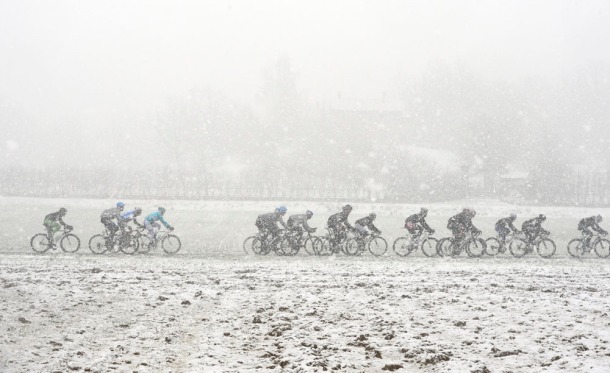
My northern latitude friends, quite reasonably, expected warmer weather by the time of the March equinox.  My northern latitude cycling friends perhaps mark the arrival of spring by the running of the first Spring Classic bike race of the year.  Milan – San Remo.  Raced this year on 17th March.

Milan San Remo

Photo courtesy of Graham Watson at grahamwatson.com

Things didn’t improve through the rest of March.  It was only 3° C / 37° F in Den Haag at 10.00am on Saturday 30th March.  It was even worse for the Not Possibles on their morning ride.  Out in the 21 kph / 13 mph wind gusts it felt like -1° C / 30° F.

To the relief of cyclists and non-cyclists alike, spring seems to be finally making its appearance in Europe.  It promises to be 10° C / 50° F this Sunday for Paris – Roubaix, the last of the Cobbled classics.  My Not Possibles friends will be hoping the warming trend continues to the first of the Ardennes classics on 14th April.  The Amstel Gold Race.  They will be joining 12,000 like-minded cyclists for the Tourversion the day before the professional race.

Here in the tropics we think in terms of wet and dry seasons rather than in terms of winter, spring, summer and autumn.  However there is some evidence around of the spring concepts of renewal and rebirth.

Macaque with Baby

Photo courtesy of Rodrigo Sala at tcktcktck.org

We saw lots of mums with new babies during the ride to Genting Sempah last Sunday.

Despite being 35° C / 95° F at the foot of the climb, it was much cooler in the breeze at 639 meters / 2,100 feet.  Almost springlike!

Photo courtesy of They Wei Chon

Photo courtesy of They Wei Chon

* With apologies to William Shakespeare.

Shine a Light, Shine a Light *

I thought about cycling technology during the ride along the Shah Alam Expressway the other night.  Specifically about how much bicycle lights have evolved since I last bought one.  My thoughts were prompted by how the spot cast by my headlight paled next to that coming from Chon’s headlight.  I had also noticed that Mark’s rear light was so bright that I had to avoid looking directly at it.  Not an easy task when you are on his wheel.

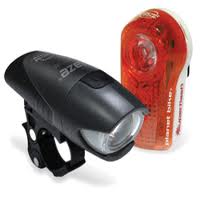
The first bike lights I bought, in 2008, were from Cateye.  They came in a set.  They looked something like these ones.

Cateye Light Set

I say something like these one because these are the current models.  The HL-EL 135.  I don’t remember my headlight having three LEDs (light-emitting diodes) like this one.  What I didn’t realise at the time was that Cateye designed this headlight to be seen by others, and not to help the rider see what is in front of them.  To their credit Cateye makes no secret of this in their 2012 Headlight Chart.

In 2009 I started riding regularly at night with the West End Bicycles 6.30 group.  I needed a brighter headlight.  So I bought a Planet Bike Blaze headlight and Superflash rear light.  Again as a set.

Planet Blaze

The headlight and rear light were noticeably brighter that their Cateye equivalents.  The only downside was that the headlight run-time on two AA batteries was only five hours at high output.

In 2010 I bought my first road bike.  A second downside of the Planet Bike headlight became obvious.  The headlight and mount were bulky.  This wasn’t a problem on my hybrid bike because my hands were usually on the handlebar extensions.   On my road bike however the headlight took up space on my bars where I wanted to put my hands.  So before long I bought another headlight.  A Niterider MiNewt Mini-USB.

Niterider MiNewt

The Niterider MiNewt had three advantages over the Planet Bike headlight.  The MiNewt was one third the size of the Planet Bike.  It could be mounted on my helmet, thus freeing up space on my handlebars.  Lastly it was the first bike headlight that could be recharged via a USB port.

I must admit that the separate light and external battery pack is not as convenient as an all-in-one unit.  NiteRider do provide a velcro strap for attaching the battery pack to the stem or head tube.  They also include a 1 meter / 39 inch extension cord so it is possible to ride with the battery pack in a jersey pocket.

In 2011 I bought my second road bike.  By then Niterider was selling the MiNewt Mini.150-USB.  As the name implies, the output had increased to 150 lumens from the previous 110 lumens.  There was also a flash mode.  Best of all the run time was unchanged.  Brighter being better, I bought one.

Note:  Bicycle light manufacturers often use lumens as the measure of light their equipment produces.  Some use candelas.  A few use lux.  Unfortunately there is no regulation or consistency in the bike light industry with respect to how light output is measured and reported.  Caveat emptor applies.

Light output is not the whole story either.  The shape of the beam is a big determiner of the effectiveness of the light.  A broad beam may not properly light the road or path ahead.  A focused beam may light up close objects, or those farther away, but not both at the same time.  Beam shape and pattern are a function of bulb angle and shape, reflector shape and lens shape.

What is the current state of play as far as bicycle lights are concerned?  Niterider sells the MiNewt Pro 750.  It has five times the light output of my MiNewt Mini.150, four light levels and three flash modes.  If you don’t want a light with a separate battery pack you can buy the Lumina 650.  The Lumina 650 puts out more than four times the lumens of the Planet Bike Blaze, and it is rechargeable.

Systems with external battery packs put out the most lumens.  Chon’s headlight is an SSC-P7.  It can pump out up to 1,200 lumens, though at the expense of run time.  Chon tells me that the run time at 1,200 lumens is ridiculously short, so he runs his headlight at 600 lumens.  Still plenty bright.

SSC P7

What’s the brightest bicycle headlight on the market today?  That seems to be the Lupine Betty R12.  This light has a claimed output of 3,600 lumens.  Better yet, in a review of LED bike lights, mtbr magazine measured the actual output of this light at 3,625 lumens.  In comparison, the xenon bulbs used in High Intensity Discharge car headlamps (the ones with a bluish tint), produce about 3,000 lumens.

As with all things top-end, the Lupine Betty R12 comes at a price.  About USD930 / RM2,900 online.

Finally, Mark’s rear light is a Cateye Rapid 5.  The main LED looks to be just as bright as the one in the Planet Bike Superflash.  However the Rapid 5 has five LEDs in all while the Superflash has three LEDS.  The Rapid 5 has four modes.  The Superflash has two modes.  See what I mean about bike light evolution.

Cateye Rapid 5

I am tempted by the latest bright and flashy.  I think I’ll stick with my MiNewt Mini.150 and Superflash.  I am going to pull my Tacx Lumos lights out of storage tonight though.

Tacx Lumos

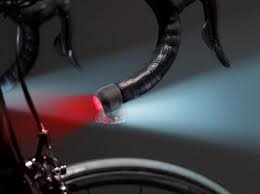
These mount in the handlebar drops.  Each light has a white LED for forward lighting.  There is a red LED for visibility from the rear.  And there is a button-activated amber LED that is a turn-indicator.

Tacx Lumos On

I don’t need no high-output headlights!

* Title courtesy of Elton John and Bernie Taupin.

Is This a Cycling Blog or a Food Blog??

I haven’t eaten any satay since I came home to Kuala Lumpur almost six months ago.  I mentioned satay in Another Place to Eat three days ago.  We stopped for satay last night.

Karma?  Coincidence?  You decide.

Tuesday and Thursday nights have become KESAS ride nights.  I wrote about this route, along the Shah Alam Expressway to give the road its proper name, in Another Uncle Wiggily.

WhatsApp is our current messaging medium.  My mobile phone starts pinging with weather updates from 5pm or so.  Confirmation that the ride is on comes at about 7.30pm.  Between then and the 9pm start time the messages are usually of the “I’m on the way” and “Stuck in traffic” variety.  It was no surprise to get a message from Chris at 8.50pm, telling us that Chon and he were close by.  What was unusual was his second sentence.  “Satay ride.  Chon is hungry.”

It turns out that there are two choices for a satay stop.  Both are Sate Kajang Haji Samuri outlets.  The first is about 10km into the ride, at the Taman Kinrara Rest & Service area.  The other is on the opposite side of the expressway at the Awan Besar Rest & Service area.  About 19km from the start.

Chon chose the nearer one.

Sate RR-Kinrarakinrara1

Kajang has been traditionally known as the “Satay Town.”  There was a time when you had to make the 20km drive south from Kuala Lumpur to Kajang to get authentic Kajang satay.  These days there are numerous stalls and shops selling Kajang satay.

Sate Kajang Haji Samuri is a Malaysian equivalent of a fast-food chain.  They have twenty outlets.  Three in Kajang and the rest scattered around the Klang valley, Seremban and Port Dickson.  If the quality of their satay is consistent across all their outlets, they are doing something right.

We had chicken satay.  It came piping hot from the grill.  Tender and juicy, with the right hint of lemongrass in the marinade.  A key part of a good meal is the kuah satay or peanut sauce.  This one was good enough to eat by itself.  And in a nice touch the kuah satay and the sambal, or chilli paste, for the sauce came separately.  So each of us could add as much or as little sambal to our individual bowls as we wanted.  I skip the sambal completely.

We also got a generous serving of cucumber and nasi impit, or compressed rice cakes.  These are the traditional accompaniments to satay.  There was a time when ketupat instead of nasi impit was served with satay.  The difference being ketupat is cooked in a woven palm-leaf pouch, while nasi impit is cooked in a far less labor-intensive plastic pouch.

Satay During Kesas Ride 03

Photo courtesy of Mark Lim

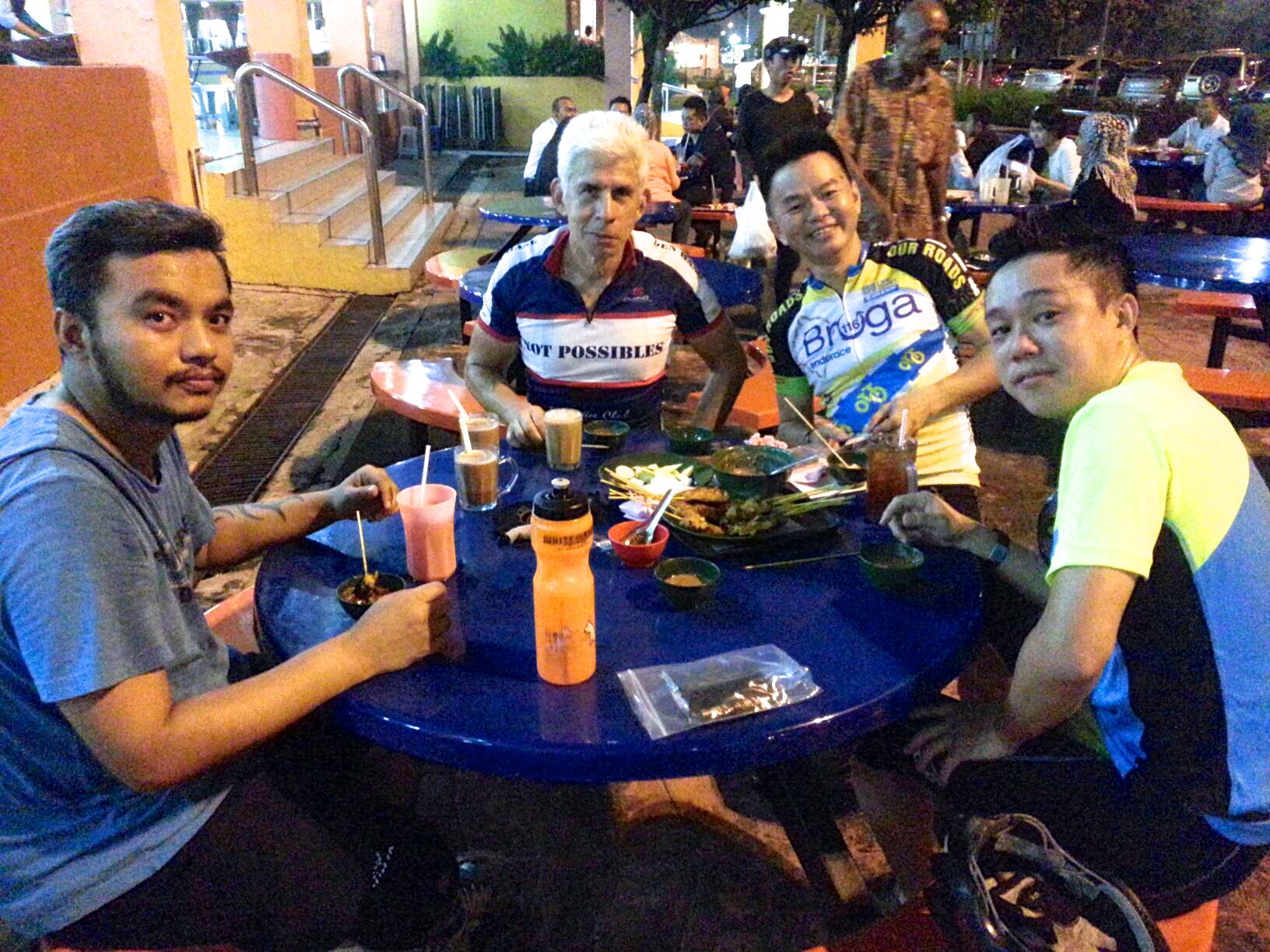
Happy days for Gary, Chon, Chris and myself!

Photo courtesy of Mark Lim

Photo courtesy of Mark Lim

As an aside, the short zip on my Not Possibles jersey may have been adequate for Dutch weather, but it didn’t work so well last night in the heat and humidity of Malaysia.  Especially as we averaged about 32kph getting to the satay, and the same afterward to burn it off.

That satay was worth the effort!

Another Place to Eat

Life in Malaysia is all about food.  So it stands to reason that cycling revolves around finding new places to eat.

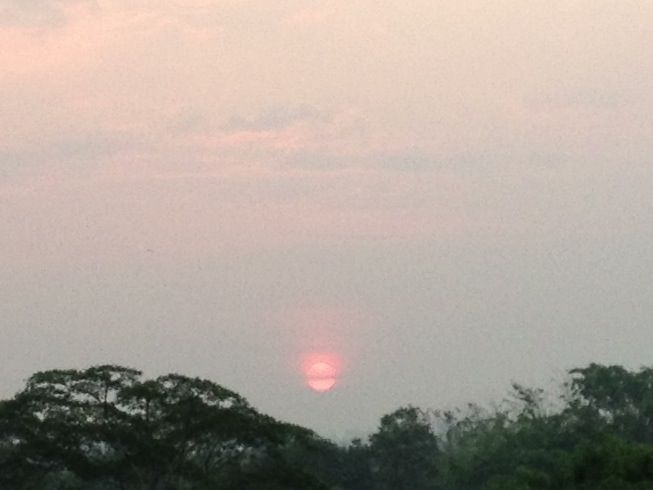
Last week Mark had noticed a particularly well-patronized stall on the Kampung Sri Kundang route.  So we set out from Bukit Jelutong just before dawn to check that place out.  Our hope was that we would get most of our riding done before it got very hot.  The sun had other ideas.

IMG_1211

So we kept the pace relaxed along the Guthrie Corridor Expressway and Jalan Kuala Selangor.  Mark slowed down as we made the left turn at Kampung Sungai Pelong.  He thought we were close to the stall he was looking for.   Sure enough, it was 300 meters down the road.

IMG_1208

Sate Sri Subang has made a name for itself as a place to get good satay.  Satay is an archetypal Malaysian dish.  In my days of business-class travel on Malaysian Airlines, courtesy of my employers, the beef and chicken satay served onboard was always a highlight.

The satay grill comes to life in the evenings.  In the mornings the offerings are nasi lemak and nasi dagang.  Nasi lemak is available everywhere in Malaysia.  Nasi dagang is a dish more commonly found in the northern states of Kelantan and Terengganu.  It was no surprise that the ladies running the stall this morning were from Kelantan.  Immediately identifiable as such by their Kelantanese dialect.

Having been denied our nasi lemak last Sunday, we had our minds set on some today.  As we waited for our nasi lemak to be plated up we were tempted by a range of savory and sweet items laid out on the table.

IMG_1206

Being weak-willed when it comes to food, we added curry puffs, pulut panggang, and kuih koci to our plates.

We will be stopping at Sate Sri Subang again.

So now we have two breakfast options during our Guthrie Corridor Expressway rides.  A stop at Sharif Roti Canai in Kampung Sri Kundang is compulsory though.  We haven’t found a better teh halia anywhere else.

Beat the Heat

Chris and I rode to Kampung Sri Kundang and back this morning.  We got on the road at 6.50am.  Just as it was getting light.

We made our usual stop for roti canai and teh tarik halia.  We have recently added soft-boiled kampung eggs to the breakfast list.  Fresh from the backyard chicken coop.  I will take a photograph of the bright orange yolks next time.

We were hungry.  Everything smelled so good.  It all tasted so good.

By the time I thought to take a photograph – this was the scene.

IMG_1201

The sun was out on our ride back to the 7-Eleven at Bukit Jelutong.  We got there before 10am so the thermostat was not yet on maximum.  We were sweating anyway.

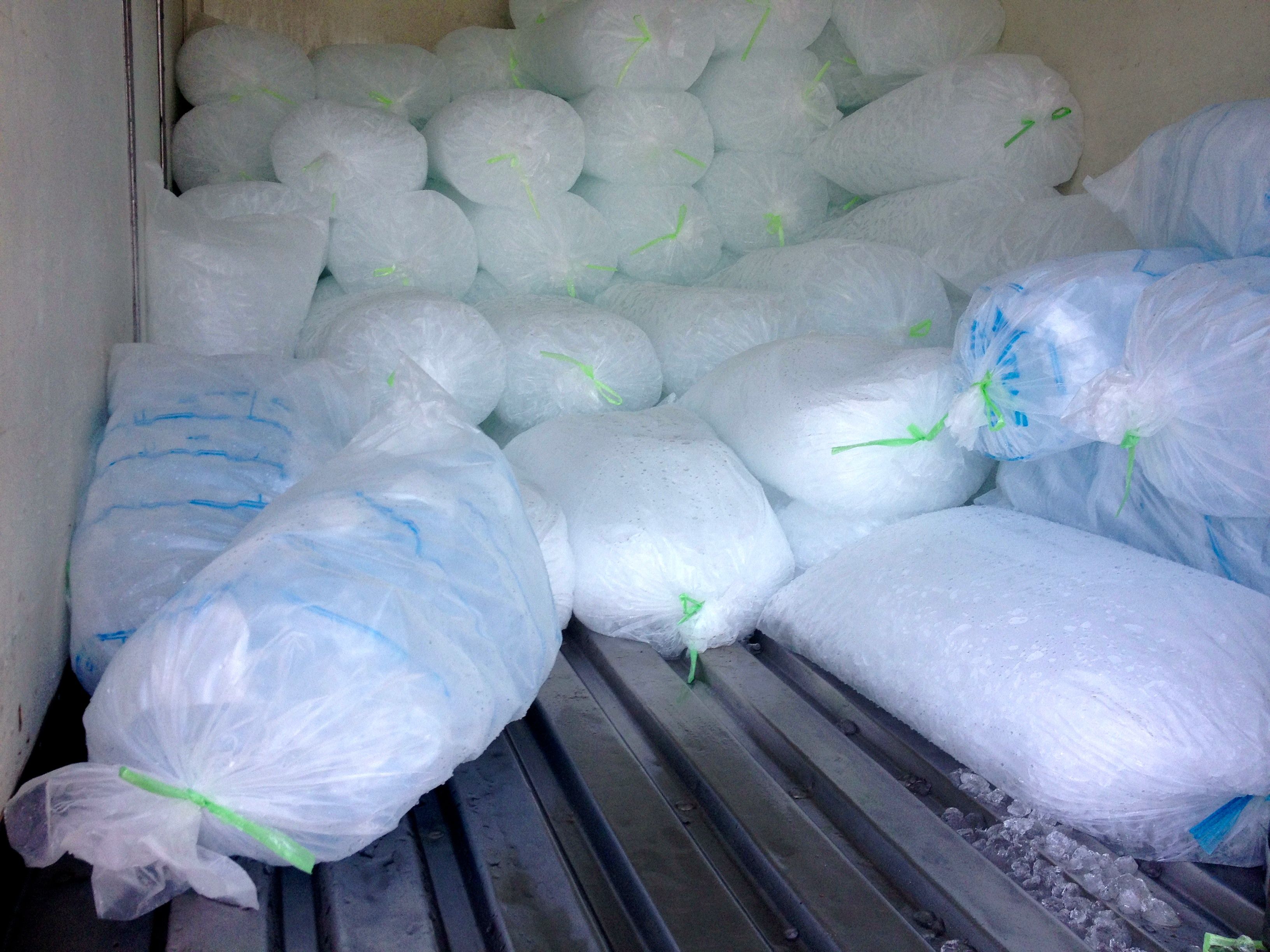
A delivery truck pulled up.  We stood so close to the open doors we were almost inside the truck.  It was exactly what we needed.

IMG_1205

Tick Tick Tick

It stands to reason that as soon as ISKY 1 stopped creaking, ISKY 2 would start ticking.  As with the apparent source of the noise from the purple bike, the ticking seemed to come from the bottom bracket of the orange bike.

Hoping to benefit from past experience, I started my hunt for the source of the tick with the rear hub.  It was in a better state than the one on ISKY 1 had been.  It still needed to be cleaned and re-greased.  The freewheel runs quieter now. But the ticking persisted.

The next step was to remove the cranks and take a look at the bottom bracket.  The bearings looked fine, apart from needing a good clean and some fresh grease.  I did discover this though.

Disc Spring

This disc spring sits on the drive-side crank spindle.

There is a new disc spring in place of this cracked one now.

ISKY 2 is still ticking though.  But, unless I am imagining things, not as loudly as before.

The optimist in me thinks the ticking will just fade away.

The realist in me knows that there is more work to be done.

Let’s Get Wild Ride

These pre-dawn starts to bike rides are getting to be a habit.  The latest Dave Ern-organised ride was scheduled to start from Bandar Sri Sendayan.  About 70km from home.  At 7.30 am.  Chon, Chris, Mark, Marvin, Shahfiq and I were among the thirty five or so bleary-eyed souls who convoyed to the Sendayan Galleria for the start of the “Let’s Get Wild Ride.”

Photo courtesy of Dave Ern

Photo courtesy of Dave Ern

This ride would take us to Raptor Watch 2013 in Tanjung Tuan, Port Dickson.  Regular readers of my blog will recall that Dickson is apparently one of a number of Scotsmen who have given their names to places in Malaysia.

For the last fourteen years the Malaysian Nature Society has organised a Raptor Watch event around the migration of birds of prey like the Oriental Honey-buzzard , Black Baza, Chinese Goshawk and Japanese Sparrowhawk.  These hunting birds migrate north between mid-February and mid-April to their breeding grounds in Mongolia, China, Russia, Siberia, the Korean Peninsula and Japan after a taking refuge from the harsh winter in the south.

Tanjung Tuan is the nearest landfall across the Straits of Malacca from Pulau Rupat in Sumatra, Indonesia.   The birds have to traverse just 10 nautical miles / 18.5 km of open water to catch the thermals at Tanjung Tuan to help them on their way back to their habitats in the northern hemisphere.  If the weather is right it is not unusual to see a hundred or more raptors swirling overhead in the updrafts.

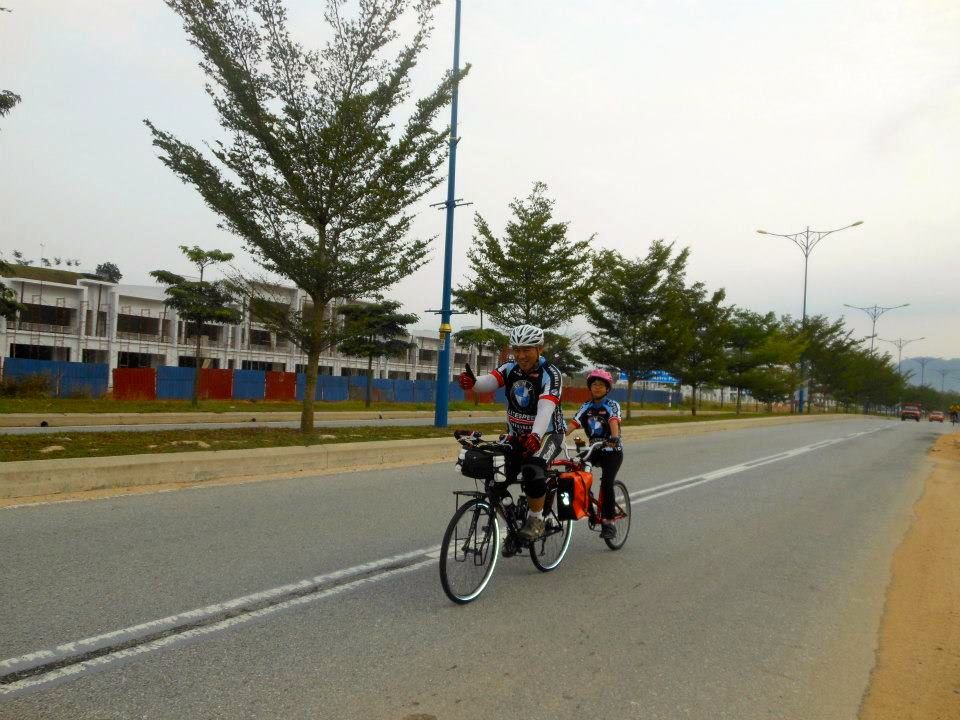
The usual mix of road bikes, mountain bikes, folding bikes were joined by a tandem-like bike ridden by Dave Ern with his young daughter on a tag-along.

Photo courtesy of Ann Daim

Photo courtesy of Ann Daim

Our 40 km or so route to Tanjung Tuan along the old trunk road took us southward through rolling countryside and under the Seremban – Port Dickson Highway.  This highway  now carries the bulk of traffic between Seremban and Port Dickson.  We then went south-west, under the highway once more and through the town of Lukut to Port Dickson, or PD as it is commonly called.  From there is was about 15 km to Tanjung Tuan.

Tanjung Tuan Route

It was relatively cool when we started riding.  So we were presentable enough to be photographed.  This is Marvin and I.

Photo courtesy of Ann Daim

Photo courtesy of Ann Daim

We were less presentable by the time we got to Tanjung Tuan.  The sun had come out at it had warmed up considerably.  It was definitely arm-cooler and Sweat Gutr conditions.

Migrating raptors not withstanding, Tanjung Tuan, or Cape Rachado as it was once known, is perhaps best known for it’s lighthouse.  Local folklore states there has been a lighthouse at that location since the Portuguese colonization of Malacca in the sixteenth century.

There is a paved path from the entrance to the Tanjung Tuan Recreational Forest up to the base of the steps leading to the lighthouse.  It is a stiff climb on a bike. 75 meters / 250 feet of elevation in 900 meters / 3,000 feet of path.  We all needed a bit of a rest before we tramped up the steps to the lighthouse.

Tanjung Tuan Lighthouse 05

Photo courtesy of the Malaysian Nature Society at http://mnsraptorwatch.wordpress.com/about-rw/

The area inside the balustrade is not normally open to the public.  However the keepers of the lighthouse agreed to open the area to the public for this weekend.  So we joined everyone else on the courtyard facing the sea, hoping to spot a raptor or two.  It had rained the day before, which kept the birds away.  It has to be a hot day to generate the thermal updrafts that the raptors depend upon.  It was certainly hot when we were there.  We were perhaps a bit too early though.  All we saw were a pair of native White-Bellied Sea Eagles.

It had been some time since I was last in PD.  I lived in the Sunggala army camp in PD for a couple of years from when I was seven.  My memories include the barber who arrived at our home on a bicycle, the neighbors who had one of the few televisions in the camp, the friend of my mother who would visit bearing a packet of ginger biscuits for a sweet-toothed little boy, the Officers’ Mess where my parents played tennis in the evenings and then watched Shindig on perhaps the only other television in the camp, and of course the long stretches of almost empty beach.

When I was nine or ten we moved to KL.  PD became a regular weekend destination.  The Sri Rusa Inn was a favorite spot.  We also spent a lot of time at the Port Dickson Yacht Club, especially after my father acquired a speed boat.  We would often fortify ourselves for the drive home with excellent Cantonese style fried noodles from a stall along the seafront in town.

Things are a little different today.  The army camp must be at least four times the size it was when I lived there.  It even houses an Army Museum.  The Si Rusa Inn is sadly derelict.  The Yacht Club has a Royal designation.  And much of the beach frontage is built-up.  Unfortunately the hotel and resort boom of the 1990s was curtailed by the Asian Financial crisis.  So amongst the resorts, hotels, villas and bungalows are many unfinished and abandoned projects.

I had to be back at my car by about 2pm.  The other five were happy to head back before the day got really hot.  Before we got going again we replenished our potassium reserves with coconut water.  As fresh as can be, straight out of a green coconut that had been opened to order.  The stall also sold cold canned drinks.  My bidons were almost empty so I topped them up with two cans of 100 Plus.

We made our way down from the lighthouse at about 11am.  Lunch somewhere in PD was the plan.  We made a photo stop about half way between Tanjung Tuan and PD town.  The road runs along a rise right alongside the beach at that point, so nothing has been built on the beach side of the road.  Which preserves views of the beach and the sea that I remember from many years ago.

IMG_1149

IMG_1148

Shahfiq, Chris, Mark and Marvin.  Chon was behind me taking photographs of the views

IMG_1156

We rode into town in the vicinity of the noodle stall that I remember so fondly.  Except the area is now covered with rows of shops and restaurants.  Including the McDonalds that we patronized.  Obviously ‘fast,’ ‘predictable.’ and ‘air-conditioned’ were qualities that appealed to us.  The restaurant was surprisingly crowded.  It turned out that the locals knew something that we didn’t.

IMG_1153

It wasn’t yet noon when we got to the counter.  Our server told us we would have to wait a few minutes before she would take our order.  Something about a special offer.  Promptly at noon the menu boards were flipped to reveal all.  25% off double cheeseburger meals!

It was 12.45 pm and broiling when we left McDonalds.  We had been smart to take advantage of the free refills to recharge our bidons.  In no time I was sweating buckets and dipping into my bottles.  To the relief of all, it started to rain.  Patchy at first, but pretty heavily for the last 7 km.  We all got soaked to the skin but were thankful for the respitefrom the heat the rain provided.  The final 15 km of rolling hills were challenging despite the cooling rain.  That final section might have been just a bit too wild in the full heat of the day.

Thirsty Work

Nineteen of us set off from outside the 7-11 at Bukit Jelutong on the Van’s Urban Bicycle Co. group ride this morning.  We were a roughly 50-50 mix of folding bikes and road bikes.  Our route to Kampung Sri Kundang was a bit different this time.  Instead of heading north on the Guthrie Corridor Expressway we took the hillier option along Jalan Batu Arang to the west.  Hillier to the tune of  200 meters / 650 feet of elevation in the first seventeen kilometers.

Kundang Route

We made regular stops to regroup and to ensure that no one got lost.  This was our first break at the bus stop outside the UITM Puncak Perdana campus.

Reverse Dragon's Back to Kundang 05

Photo courtesy of Van’s Urban Bicycle Co.

From here it was five more climbs before the right-hand turn toward Sungai Buloh and Kuala Selangor.  Everyone was relieved that the rest of the way to Kampung Sri Kundang was flat.  Hence the smiles at the traffic light at the junction with Jalan Kuala Selangor.

Reverse Dragon's Back to Kundang 02

Photo courtesy of Van’s Urban Bicycle Co.

Reverse Dragon's Back to Kundang 04

Photo courtesy of Van’s Urban Bicycle Co.

It was a warm morning, but there were lots of clouds in the sky.  So we weren’t in direct sun.

Reverse Dragon's Back to Kundang 03

Photo courtesy of Van’s Urban Bicycle Co.

Even so the humidity was high so the ride was sweaty work.  We were all glad to get to Kampung Sri Kundang.  As always the roti canai and teh tarik was worth the ride.  By the time we saddled up again the sun had come out in full force.  It was at least 35°C / 95°F during the 33km back down the Guthrie Corridor Expressway.  And a tough 33km for those who weren’t used to riding as far or climbing as much as we did today.

We were all hot and thirsty by the time we got back to Bukit Jelutong.  I had emptied both my bottles in addition to the two teh tarik I had with my roti canai.  I went straight into the 7-11.  Firstly because it is air-conditioned, and secondly to buy a 1.5 liter bottle of 100 Plus.  I had never drunk a liter and a half of anything in one go before.  There is a first time for everything.