Monthly Archives: February 2024

The Evolution of How I Carry Things on My Bike

Soon after I bought my first bicycle in 2009, I had my first flat. This was when I learned that every cyclist must carry tyre levers, a spare tube and a pump or CO2 inflator whenever they ride. I put those items into a saddlebag, along with house and car keys. I don’t remember how I carried cash.

I went through a variety of saddlebags over the years. All were like these examples from Topeak and Lezyne.

By 2010 I was using a Rapha Tool Roll.

I liked this tool roll because I could cinch it tight under my saddle. This stopped items in the roll from rattling.

The white leather strap was held tight by teeth in the buckle. This worked well until the teeth lost their sharpness due to use and rust, and the leather strap began to fray. After one too many instances of the strap loosening and an inner tube and tools dropping onto the road while riding, I swapped the Rapha for a Silca Seat Roll Premio.

The advantage of the Premio was its BOA closure system. This was a more secure attachment method than the buckle and strap of the Rapha Tool Roll. I used the Premio from 2016 until 2018.

The reason for switching from the Premio to a Specialized KEG Storage Vessel is in this post from February 2018.

I still use the KEG to hold a spare tube, tyre levers, keys, etc.

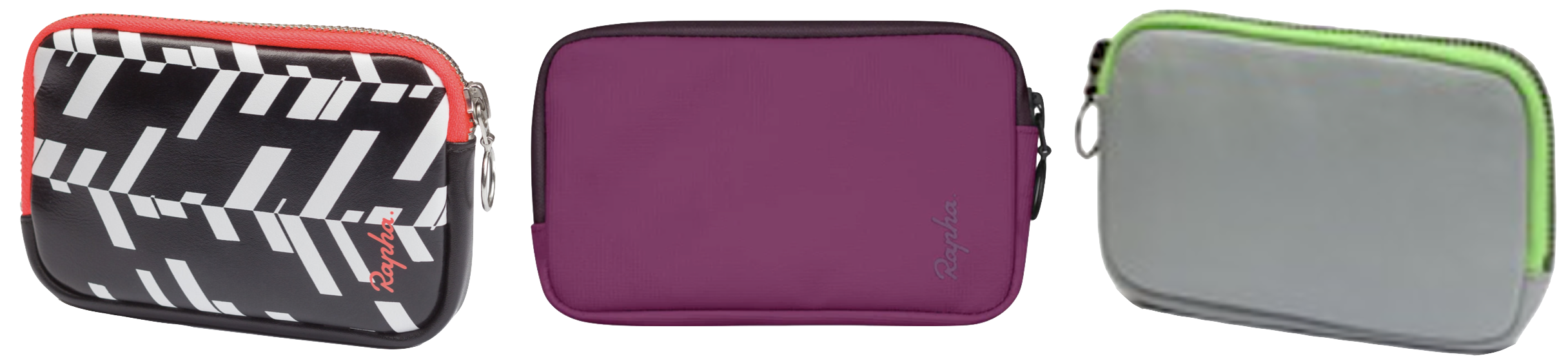
As I said at the top of this post, I don’t remember how I carried cash and a credit card in my early days of cycling. It would not have been long before I bought my first Rapha Rainproof Essentials case.

Over the next decade, that first Essentials Case was augmented by some others in different colours.
In 2018, I bought a Silca Phone Wallet. I had started doing multi-day credit card touring rides. I needed a waterproof rather than just a water-resistant wallet.

The Phone Wallet had an internal dry bag, making it ideal for protecting my mobile phone and cash. The downside was that the phone wallet was bulky. It only saw use on multi-day rides.

I stopped carrying my Essentials Case in a jersey pocket in 2018. That is when I discovered Cargo Bib Shorts with mesh pockets on the legs. No more struggling to take my wallet out of a jersey pocket while pedalling. And no more unloading a jersey pocket before settling into a chair.

The Rapha Rainproof Essentials cases were my go-to cycling wallets until the end of 2022. That is when I got an iPhone 14. The iPhone 14 was just a tad too long for the Essentials Case. So I ordered a Rainproof Essentials Case – Large. And broke out the Silca Phone Wallet, which is big enough to hold an iPhone 14, while waiting for delivery of the large Essentials Case.

Early this year, I did the Audax Pink Ride 7.0. Each participant was given a clear plastic Cycling Wallet to stop their brevet cards from getting wet.

The pouch is big enough to hold my iPhone 14. I left my large Essentials Case at home and did the Pink Ride with my mobile phone, brevet card, cash and credit card in the Cycling Wallet.

I like not just being able to see my mobile phone screen through the wallet. I can also operate the touch screen through the wallet. No need to take the mobile phone out to use it.

The Audax Randonneurs Malaysia Cycling Wallet has become my method of choice for carrying whatever doesn’t go into my Specialized KEG Storage Vessel.

A new way to carry things on my bike might be around the corner. Evolution never stops.

Graphic courtesy of wildpixel

μ = Sum of Values ÷ Total Number of Values*

Photograph courtesy of Justin Morgan at unsplash.com

I was chatting recently with a friend about bell curves. We were discussing employee performance evaluations. Whether or not to force-fit performance evaluations to a bell curve is a debate that often comes up.

A bell curve is a graphical depiction of a normal distribution. The theory is that the majority of employees should fall into the “Average Performers” category, and 15% to 20% of employees should fall into either the “Low Performers” category or the “High Performers” category.

Graph courtesy of updconsulting.com

This morning, I clicked on a link for a post titled Strava Year In Sport Trend Report: Insights on the World of Exercise. The post summarised average speed and distance data for cycling activities uploaded to Strava between October 1, 2022 and September 30, 2023. I wondered where I fell on the bell curve of cycling performance as tracked by Strava.

The post lists average cycling speed and distance by age.

There is very little difference in average speed across the four age categories. Just half a kilometre per hour separates Gen Z at 20.8 kph and Millennials and Boomers at 20.3 kph. Gen X averaged 20.6 kph.

Interestingly, Boomers had the longest rides, averaging 33.6 km per ride. Millennials had the shortest, at 22.2 km per ride. Perhaps we retired Boomers have more time to devote to cycling.

I am on the right-hand side of the bell curve for both average cycling speed and average distance per ride. For the population of cyclists posting on Strava, anyway. As a Boomer, that is a blessing.

* μ (mu) represents the average or mean of a particular sample.

Home Sweet Home

I have lived in several cities. All of which are memorable for one reason or another. As far as road cycling is concerned, I got into the sport in Houston. I saw how a city can be cyclist-friendly in The Hague.

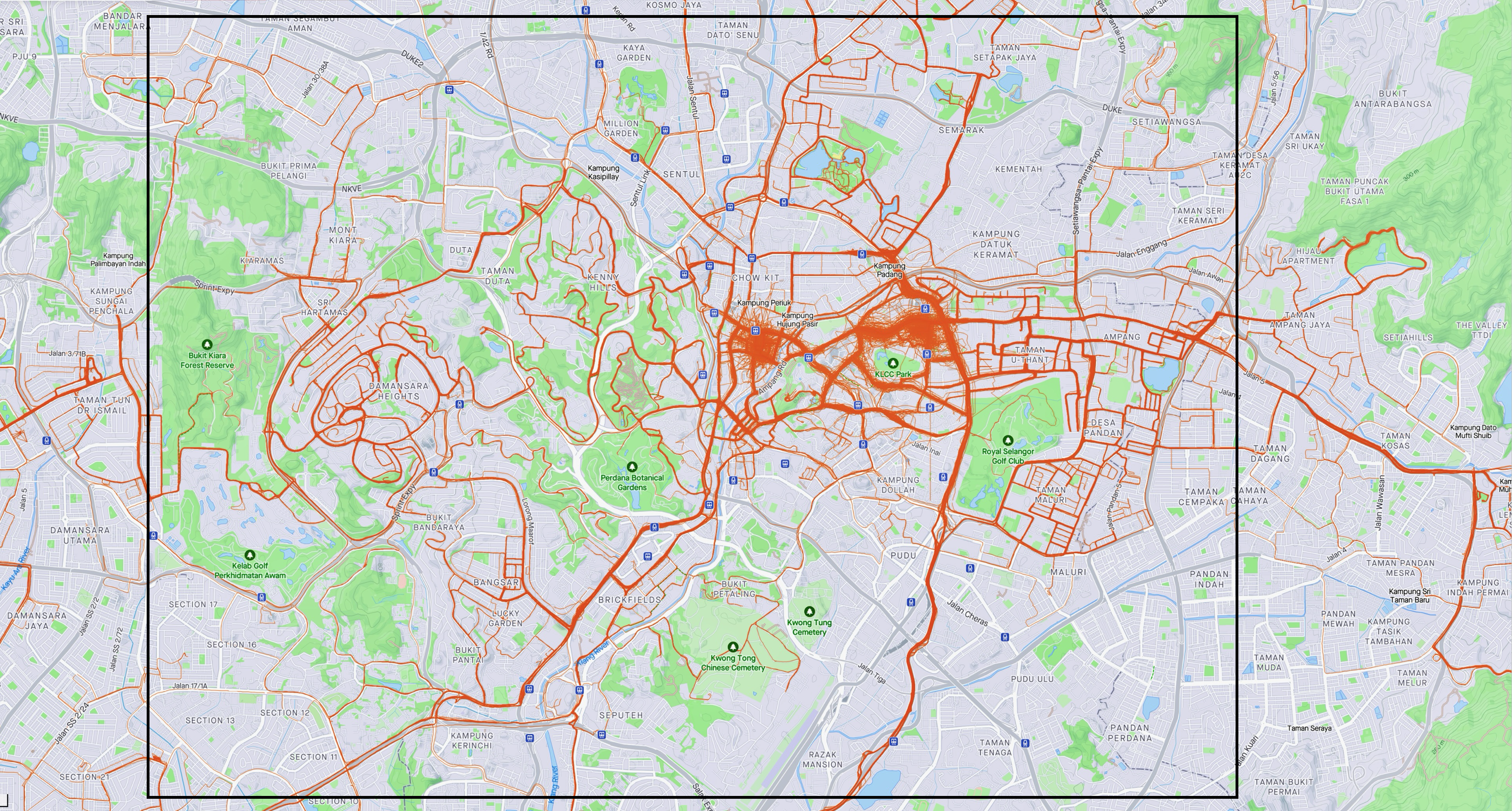
Home, though, is Kuala Lumpur, or ‘KL’. I have lived on and off in KL for almost fifty years, in twelve different homes within a 10-kilometre by 13-kilometre rectangle.

Half of those homes, including the two most recent ones, sit within a 1-kilometre by 3-kilometre rectangle. I am definitely an inner-city dweller.

My Strava history in KL started in October 2012. Since then, I have ridden many kilometres within that 10-kilometre by 13-kilometre rectangle containing all the KL homes I have lived in.

Until recently, I remembered only eleven of those homes. Of those, one has been razed and is now a car park, and three have been replaced by multi-storey buildings. I often ride past five surviving buildings where I lived and past where the four used to be. The only previous home I have not cycled past is the apartment in Taman Bukit Pantai.

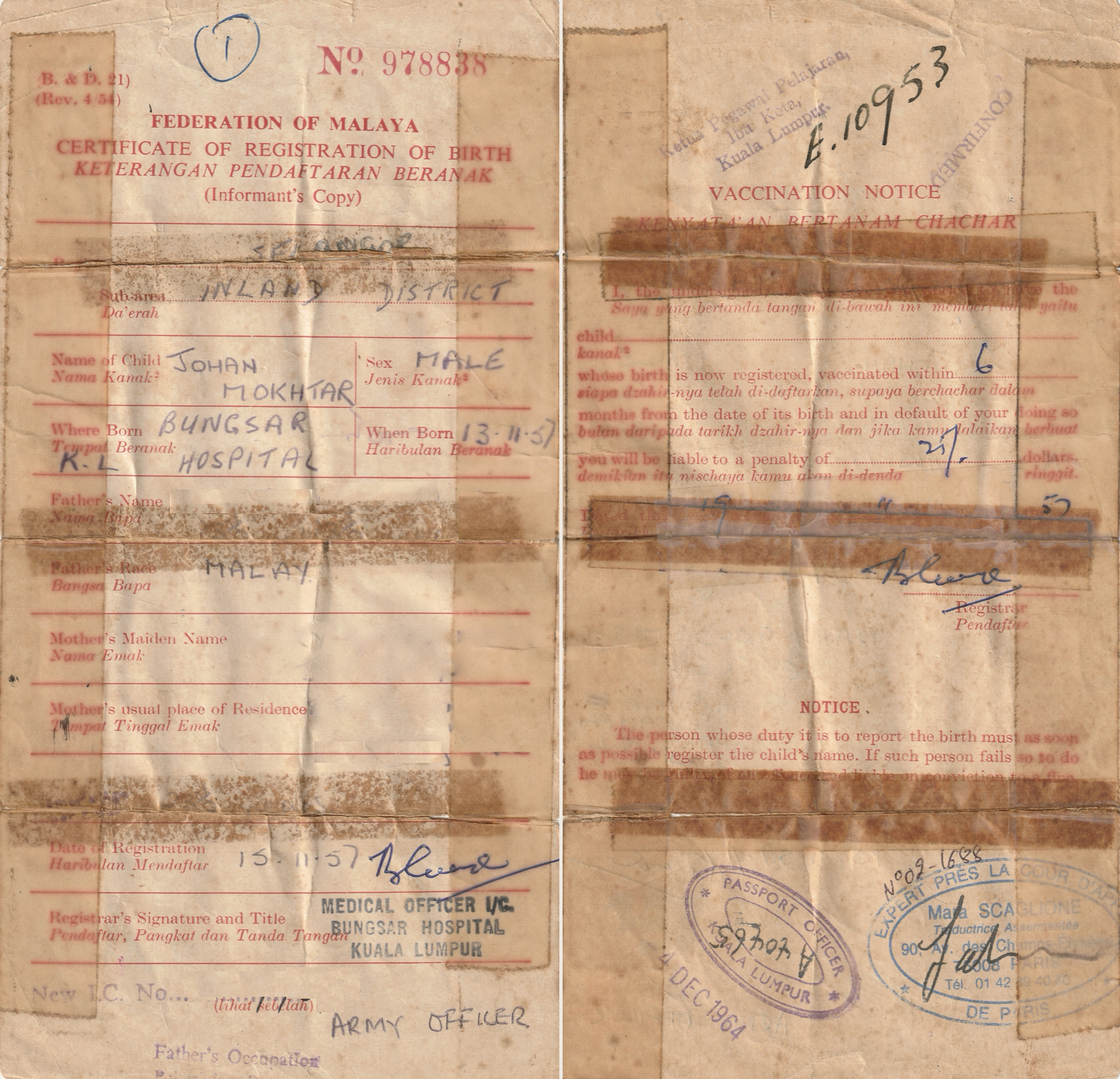
What of the forgotten home? I was digging through old documents and came across my original birth certificate. Hand-written in blue pencil on paper so creased it is held together with cellotape.

I have masked some of the details, including “Mother’s usual place of Residence.” A quick check on Google Maps revealed that I regularly cycle within 400 metres of that address.

A few days ago I took that 400 metre detour. The building is still there, sixty-six years after I was brought home to it from Bangsar Hospital.

Getting to this building involves twice merging across multiple lanes on a busy road. So, I am unlikely to ride past it much. It is nice to know it is still standing, though. Which is more than I can say for Bangsar Hospital.