Tag Archives: Strava

The Cult of Strava

The Social Facilitation Theory argues that social evaluation has an impact on performance.

The psychologist Norman Triplett was the first to study this effect, starting in 1898.  He found that cyclists had better race times when in the company of other cyclists.  Further research demonstrated something we now consider obvious:  humans try harder when matched against others. Later work would demonstrate that the mere presence of others could inspire us to work harder.

Fast forward 110 years.   Social facilitation meets social sharing (think Facebook) and Strava is born.  Cyclists now have a way to record the details of a ride and compare those details with those of every other Strava member who has done the same ride.  Thanks to a smartphone app that does away with the need for a dedicated cycling GPS, some one million cyclists use Strava today, and that user base continues to grow.  Cyclists now have access to social evaluation on a massive scale.

Thousands of Strava users have created segments, or specific sections, of their cycling routes.  Any segments will be displayed as part of your ride data in the Strava application.

Strava Segment

The segments table shows your performance on the current ride relative to your previous efforts on the same ride.  Each segment is identified, and the segment distance, elevation, and your performance parameters are displayed.  If your latest performance on a segment is one of your better ones you get a little medal:  gold for a Personal Record, silver for a 2nd best and bronze for a 3rd best time.

Click on a segment and social facilitation comes into play.

Strava Leaderboard

Note: Rider names have been deleted

Now you see your best performance on a segment relative to every other rider on Strava who has ridden the same segment.  I see I need to ride this segment just 0.1 kph faster to be in the top 50!

If I want a hit to my ego I can view the results for men only.  Fortunately for my ego there is only one woman ahead of me on the leaderboard for this segment.  For now.

If I want to feel better I can view the results by age group.  There are only six of us in the 55 to 64 age group for this segment so I am definitely in the top ten!

The ability to virtually compete against others should be a boon, and it is for most riders.  Strava was created to encourage cyclists to train, to climb higher and go faster.  I get a kick out of achieving new personal bests, and this is true for many others as well.

I don’t have the physical gifts to challenge for King of the Mountain (KOM) status.  So there is no chance of seeing one of these, which signifies being atop a segment leaderboard,  on my Strava profile.

Strava KOM

I have been known to push hard for the fastest time in my age group for certain segments though.  Social facilitation in action.

The same social facilitation effect can be a bane as well.  There are people out there who are so competitive that every ride is a do-or-die race in the hunt for KOM crowns.   In some cases literally.  William Flint was killed when he collided with an oncoming car on a downhill stretch of road while apparently trying to reclaim his KOM status.

And in a sad reflection of the recent state of affairs in the professional peloton, riders so inclined can now even artificially enhance their Strava results by giving their data a boost with the help of the website DigitalEPO.com.

I’ll leave the KOM sniping to the insanely driven Type A personality riders.  But I do wonder if I can knock two seconds off my time for the Puchong Jaya climb tonight.

By the Numbers

I bought a Garmin Edge 705 when my first road bike was delivered.  I used it initially to record where and how far I had ridden.  You can download the details of your rides to a Garmin website called Garmin Connect.  Among other things Garmin Connect displays maps showing exactly where you went on your ride, or run or hike.  It was fun to be able to show my biker chick where I had gone on my bike.

Garmin Edge 705

When I started doing longer rides with the West End group I used the speed display to help me keep a consistent pace when I took my turns at the front of the peloton.  I hadn’t bothered to install the speed sensor, or the cadence sensor for that matter.  I depended on the speed data calculated by the GPS chip. I used the heart rate monitor out of a casual interest in what my pulse rate was rather than as a training aid.

I rode solo during my first year in the Netherlands.  The “Back To Start” function came in useful on more than one occasion.  One canal, or windmill, 0r field of cows looks much like another.  No help when you are lost and 40 km / 25 mi from home.

The heart rate monitor saw some serious use once I started doing organised rides (by that I mean longer and faster than I was used to) with the Not Possibles.  By that time I had a rough idea of what my heart rate zones were.  Tracking my pulse rate helped me manage my effort so that I didn’t wear myself out before the end of the ride.

Since 31st January 2010 I have been transferring all my rides to Garmin Connect.  There are 412 rides in my account.  I took a look at all that data today.

The first set of numbers shows how much ground I have covered on my bicycles in three and a half years.  Enough to get me from Kuala Lumpur to Warsaw and back.  24,448 km / 15,191 mi.

Total KM

68% of my time since January 2010 has been spent in the Netherlands.  It follows that most of that pedaling was amongst windmills and canals.

What surprised me was the average length of my rides.

Ave KM

I hadn’t expected the average Houston ride to be slightly longer than the average Den Haag ride.  I must have done more 20 to 30 km / 12 to 18 mi rides in Holland than I thought.

I am not surprised that the average ride length has dropped in Kuala Lumpur.  I do the Damansara Heights ride fairly regularly.  That one never exceeds 16 km / 10 mi.  The Putrajaya ride tops out at just over 20 km / 12 mi.

The shorter rides in Kuala Lumpur are somewhat made up for by more frequent rides as compared to Houston and Den Haag.

Ride Frequency

I rode on average every 4 days in Houston.  In Kuala Lumpur it is every 2.6 days.  I put that down to linking up with a group of cyclists as soon as I arrived in Kuala Lumpur.  There are four or five groups rides per week in Kuala Lumpur.  There were three weekly group rides in Houston, and only one per week in Den Haag.

Elevation data is suspect.  The barometric altimeter in the Edge 705 is not accurate if it is not calibrated before every ride..  I don’t bother.  Websites like Strava and Ride With GPS allow users to overwrite GPS elevation data with data calculated using a variety of data sources and algorithms.  This “corrected” elevation data is often, but not always, more reliable.

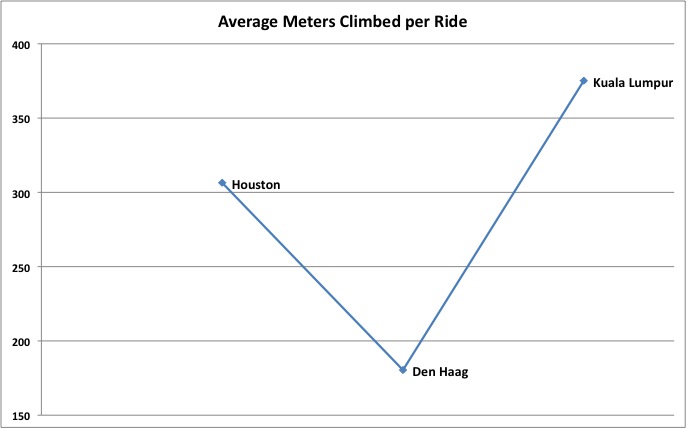
Nevertheless, it is interesting to look at elevation data for comparative reasons.  I did expect the data to show that rides in Kuala Lumpur require the most climbing.

Ave Climbing

The average for Houston surprised me at first, but upon reflection it makes sense.  Chappell Hill was within easy reach by car.  We rode quite a bit there.  Training for the hills of Austin that were to come in the BP MS150!

The Netherlands is as flat as advertised.  Cyclists are only partly joking when they say they go to a multi-storey car park to practice hill climbs.  The Dutch hide some elevation in the dunes along the coast but that is about it.  The climbing average for Den Haag is padded by a few visits to Limburg and Belgium, where there are some real hills.

Regular readers will already know that I was startled by the degree of climbing required when riding around Kuala Lumpur.

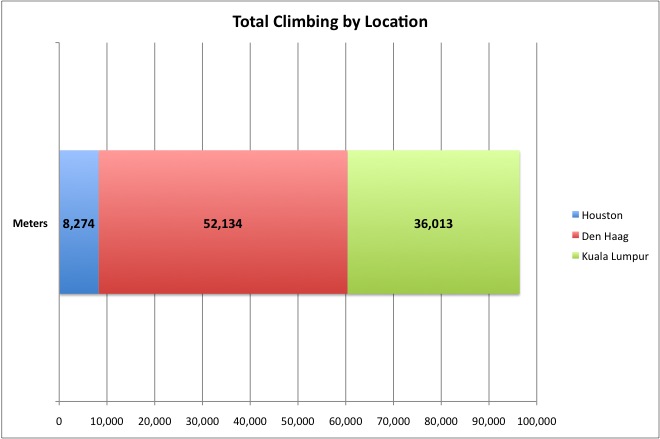
Total Climbing

It won’t be long before I surpass the number of meters I climbed whilst in the low country.

The final number is also for guidance only.  You know what I mean if you have ever looked at the “calories burned” numbers that exercise machines produce.

Bic Macs

However I won’t let details get in the way of feeling pleased with myself for burning the caloric equivalent of 1,802 Big Macs.

A milestone ahead, pardon the pun, is 25,000 km / 15,534 mi total distance.  I’ll be beyond 1,000,000 calories burned by then.  I wonder what number that would be in nasi lemak terms?