Category Archives: Cycling in Colorado

An Abridged History

Posted on

June has been a quiet month for riding.  The weather, weekend travel, illness and idleness have all kept me off my bikes.  I started 2015 with aspirations to average 1,000km a month.  So far I am 150km per month short of that goal.  Nevertheless 2015 is shaping up to be one of my better years for cycling.

I consider my first day as an avid cyclist to be Sunday January 31st, 2010.  That was the day Big Bill B guided me on a 53km loop around Houston, including a food stop at Carter & Cooley Company Delicatessen in The Heights.

It was the first time I rode with a Garmin cycling computer on my handlebar, which allowed me to commit this and all future rides to that collective memory that is the internet.  I am a bit of a ride data geek.  I started feeding that habit with Garmin Connect.  After a few years I supplemented that with Ride With GPS, and very soon after Strava was added to the mix.  Lately Veloviewer has joined the party.

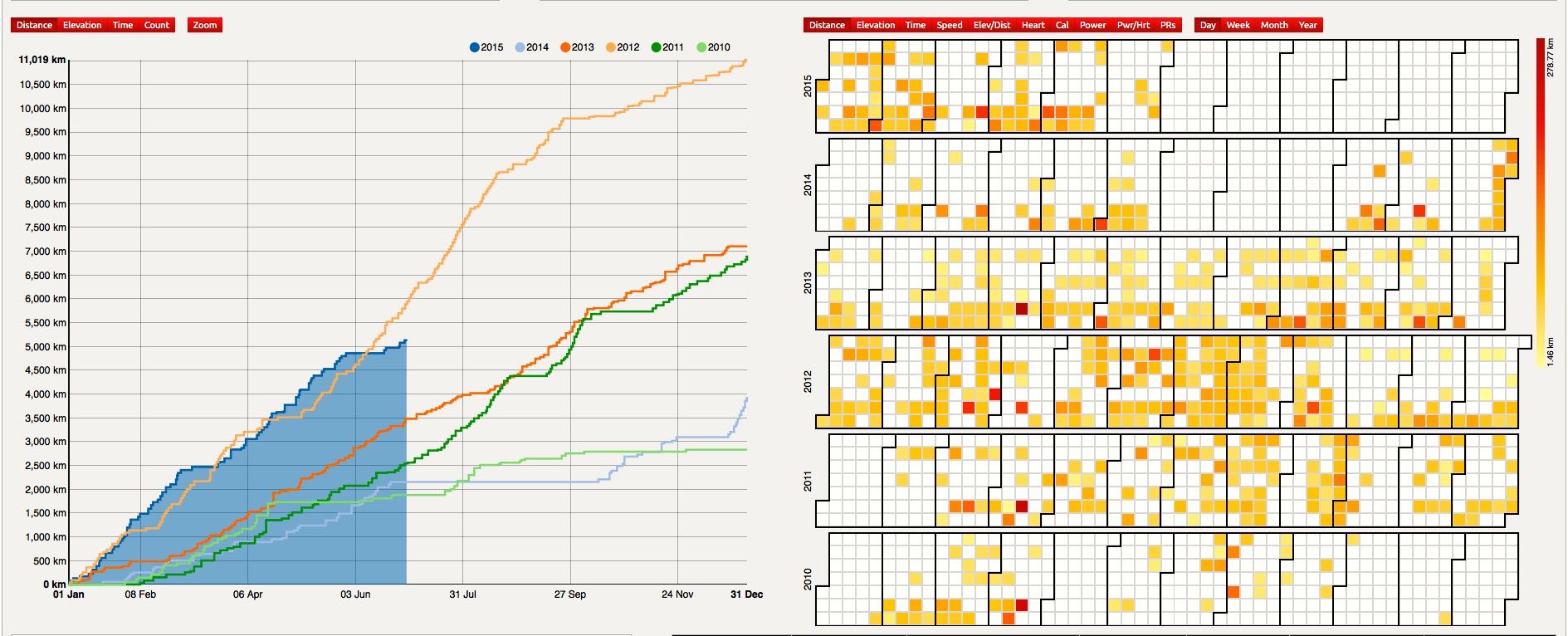
Why so many tracking apps?  In my case, mostly because they each provide different ways to view my ride data.  Ride With GPS provides nice summaries by month or year.  I can see what my buddies have been up to in Strava.  Veloviewer makes annual comparisons easy.  Charts like these ones provide the grist for this post.
Charts courtesy of Veloviewer

Charts courtesy of Veloviewer

Between January and the end of April 2010 I rode in and around Houston.  Those rides included my first century ride, The Space Race, and my first BP MS150.

Heat Map courtesy of Strava

Heat Map courtesy of Strava

My biker chick had started her new job in Den Haag, The Netherlands, in April.  So my bike spent May in a container, along with our other possessions, on a ship bound for Europe.

I spent the rest of the year exploring the bike paths around Den Haag.

I logged 2,831kms in 2010.  My average ride distance was 59kms.  My average ride time was 2 hours 28 minutes.

In 2011 my total distance covered jumped to 6,886kms.  My average distance went up slightly to 63kms.  The average ride length went up in tandem to 2 hours 33 minutes.

Much of that increase in total distance ridden is testament to the outstanding cycling infrastructure in The Netherlands.  You can’t help but get on your bicycle in a country where the riding in so safe, convenient, and scenic.

In 2012 my mileage again jumped significantly over the previous year.  To 11,019kms.  The average distance stayed almost the same at 62.25kms.  I picked up speed though, with my rides averaging 2 hours 29 minutes.

Heat map courtesy of Strava

Heat map courtesy of Strava

Almost all of my riding over these two years was in The Netherlands.  I did occasionally venture further afield.  I made my first extended cycling trip in 2011.  I went to Ninove in Belgium, to ride in the Ronde van Vlaanderen sportif.

In 2012 I did the Ronde van Vlaanderen again, which started and ended this time in Oudernaarde.  I also took two trips to Maastricht, for the UCI World Championships and the Amstel Gold sportifs.

Heat map courtesy of Strava

Heat map courtesy of Strava

In October 2012 my biker chick and I returned to Kuala Lumpur.  My bikes (by this time I had two) followed soon after by air freight.  So it wasn’t long before I was immersing myself in the relatively new and booming road cycling scene in Malaysia.

Cycling in Kuala Lumpur reminds me a lot of cycling in Houston.  You share the roads with traffic.  Sometimes a lot of traffic.  City riding is best done at night, when the roads, or motorcycle lanes where provided, are quieter.  The popular daytime cycling routes are mostly outside the city.

In 2013 I started venturing further afield.  Century rides in various cities around the country become a regular activity, including one international road trip to Hatyai in Thailand.

Despite the number of century rides, my mileage in 2013 was only 7,102kms.  My rides had become shorter, averaging 49kms and 1 hour 58 minutes per ride.  I remember that tropical rainstorms had a lot to do with curtailing riding time in 2013.

The downward trend continued in 2014.  I had four months of enforced time off my bikes because of a crash, and two unrelated surgeries.  Those breaks from cycling resulted in only 3,918kms ridden.  My average ride was surprisingly long though, at 66kms and 2 hours 35 minutes.

Heat map courtesy of Strava

Heat map courtesy of Strava

Almost all of my cycling since the end of 2012 has been in Malaysia.  The exceptions were in 2013, when I flew to the United States to ride in the BP MS150 from Houston to Austin, and to ride in the 5 Boros Ride in New York City.  In between those rides I visited an old friend in Denver, where  I managed to squeeze in a few rides as well.  I came home with bicycle number three.

Heat Map courtesy of Strava

Heat Map courtesy of Strava

That bicycle is a Ritchey Breakaway.  It came with me to Melbourne in December 2013.  My last cycling trip away from home to date.
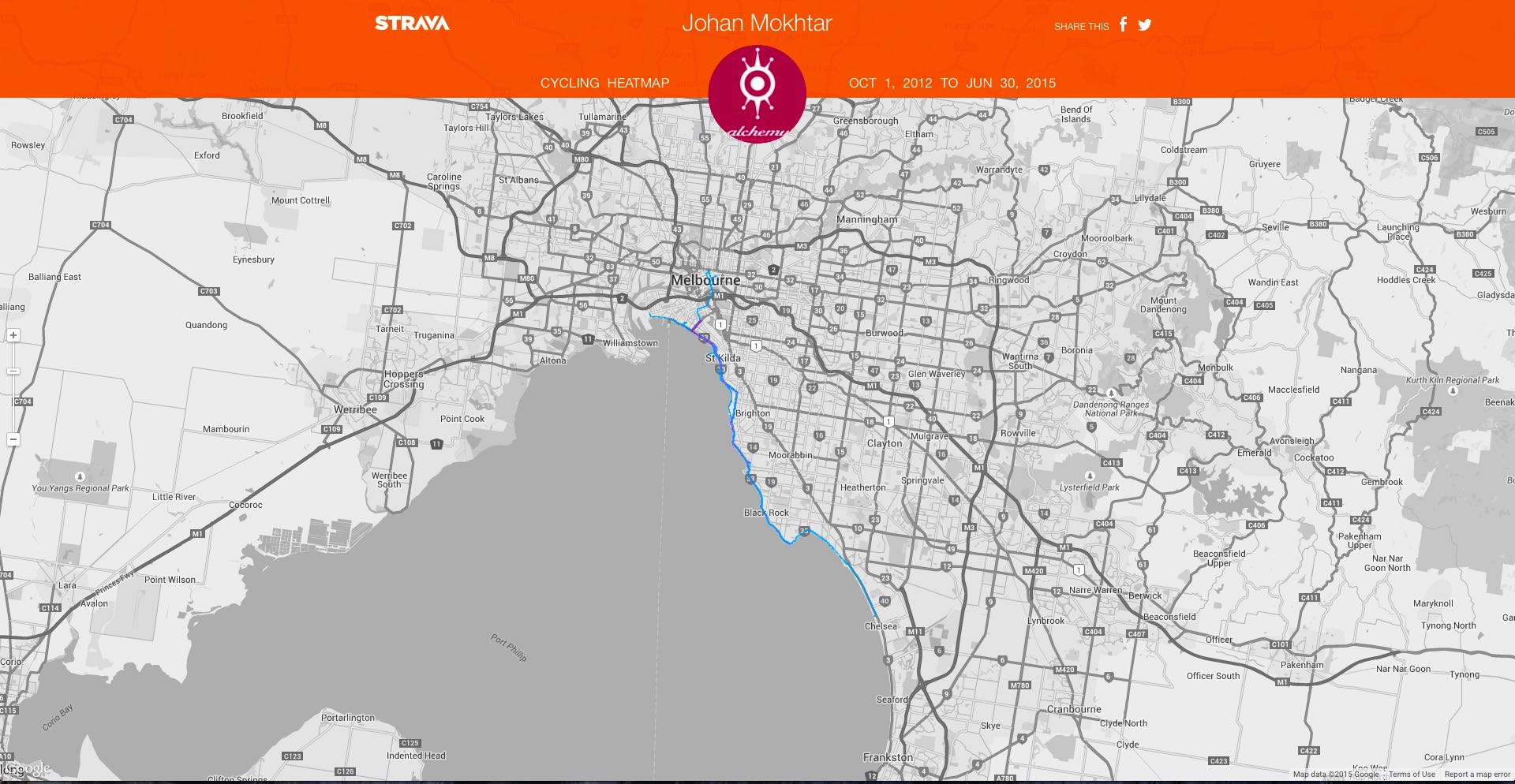
Heat map courtesy of Strave

Heat map courtesy of Strava

2015 looks good so far.  I am up to 5,078kms as at the end of June.  My average ride length for the year is 71kms.  I must be a bit fitter than I was last year too.  I am riding on average 5kms further this year as compared to last, but my average time is the saddle is only 3 minutes more, at 2 hours 38 minutes.

I’m hoping to take at least one cycling trip outside Malaysia this year.  And I am looking forward to staying healthy and spending as much time as possible riding.

JFK Quote 3

Ritchey Break-Away Road Ti / Carbon Review

Ritchey Breakaway Ti

I have had my Ritchey Break-Away for exactly two months.  We have done fifteen rides together.  I do try to be fair and alternate between my three bikes.  Although by default any rides that involve significant travel will now be on the Ritchey.  We covered 1,025 km / 635 mi.  There has been about 7,100 meters / 23,300 feet of climbing.

My other bikes are a steel framed Alchemy with carbon chain stays and fork, and a titanium framed Alchemy with carbon seat stays, chain stays and fork.  The Alchemys have identical geometries.  The Ritchey has a 56cm frame.  The tube lengths and angles of the Ritchey are as close to those of the Alchemys as dammit is to swearing.  All have SRAM group sets.  All have Ritchey carbon seat posts and cockpits.  All have Easton EA90 SLX wheels.  I like the tried and tested!

I include all that detail as a prelude to describing the differences between these bikes.  In the hope that it heads off a potential firestorm amongst all you aficionados out there around the relative virtues of steel versus titanium as a bike frame material, and the effect of tire choice, frame geometry, tube size etc. etc. on the ride quality of said bike frame materials.

The only differences that I can discern between the two Alchemys are that the titanium bike has a more ‘damped’ feel to it, and the steel bike has more flex.  A little less road chatter gets transmitted through the titanium frame.  I am no road racer but I can make the steel frame flex under pedaling load.  Not so with the titanium Alchemy.

I love the ride quality of my Alchemys.  They are very comfortable, even on the chip sealed back roads of Texas.

I love the ride quality of the Ritchey Break-Away too.  I don’t feel a difference between the titanium Alchemy and the Break-Away.  Logic tells me the Break-Away should not be as stiff as the Alchemy.  After all the Ritchey frame is in two pieces, connected at the seat tube / top tube junction and just in front of the bottom bracket.  Perhaps my senses are not tuned enough to pick up the difference.

That probably is part of the answer.  If I tested bicycles for a living my senses would be developed enough to feel some differences.  I think another part of the answer is in how well the Ritchey design eliminates flexing at the joints.

The top tube and seat tube are held in alignment by the seat post.  One bolt above the seam between the tubes and another bolt below the seam lock the tubes together.  What looks like a connection between the lower bolt and the top tube in the photograph below is actually a bracket welded to the lower bolt housing.  That bracket holds the rear brake housing stop slightly away from the top tube.

Photo courtesy of Jon Sharp at www.gearreview.com

Photo courtesy of Jon Sharp at http://www.gearreview.com

The down tube is split just ahead of the bottom bracket.  The end of the down tube has a neck that slides into the fitting at the bottom bracket.

Photo courtesy of bikeradar.com

Photo courtesy of bikeradar.com

A hinged compression clamp fits over the lips or flanges on either edge of the joint and holds the two parts of the down tube together.  The two derailleur cable couplers are visible below the down tube.

Photo courtesy of Jon Sharp at www.gearreview.com

Photo courtesy of Jon Sharp at http://www.gearreview.com

This simple design uses just three bolts tightened to 4Nm to hold the front and rear triangles together.  Very securely I might add.  Nothing worked itself loose during my rides.  The bike tracked as expected.  There were no vibrations or unexpected wobbles.  Even at better than 65 kph / 40 mph down the relatively straight Smithville Hill during the BP MS150, and close to that on the switchback descent from Genting Sempah.

Top marks for the Ritchey Break-Away as an excellent bike to ride.

That brings me to the differentiating characteristic of this bike.  The ability to fit into a case that meets airline size specifications for checked luggage.  66 x 66 x 25.5 cm / 26 x 26 x 10 in.  The staff at the check-in counters at George Bush Intercontinental Airport in Houston, Denver International Airport and Newark Liberty International Airport in New York City didn’t bat an eyelid when I put the case holding the Ritchey onto the weighing scales.  They tagged the case and sent it on its way without a second glance.

Speaking of weight, bike and case weigh 15 kg / 33 lb.  Well within the limit of 23 kg / 50 lb for a checked bag in economy class.

I opted for the S&S Edge Pull Butterfly Latch Hard Case.  I recommend it over the Ritchey soft case, which is universally panned in all the reviews I have read.  The hard case weighs more, but the added durability and protection is worth that extra kilo or two.

Photo courtesy of S&S Machine

Photo courtesy of S&S Machine

I recommend a set of compression members to keep external pressure from pushing the sides of the case into the packed bicycle.  These are strong enough to stop the side bowing inward under the weight of a person standing on the case.

Photo courtesy of S&S Machine

Photo courtesy of S&S Machine

I also like the TSA security net.  The net keeps the frame, wheels, compression members and whatever else you have packed together if a TSA inspector opens the lid of the case.

Photo courtesy of S&S Machine

Photo courtesy of S&S Machine

Packing the bike takes some practice.  There are a number of suggested ways to fit all the pieces into the case.  Ritchey includes an instruction sheet with the bike.  Ritchey also has step-by-step videos on their website.

I tried a variety of packing methods.  I prefer the S&S packing sequence, which is actually for an S&S coupled bike, but works very well for the Ritchey Breakaway too.  The first time it took quite a while to wrap all the tubes in the supplied pads, and to get all the pieces properly aligned in the case so that the lid would close.  The tricky bit was getting the handlebars into the case, and lining up the front wheel such that things like the bottom bracket fit between the spokes.  I get better at it each time I do it.

The Break-Away came through two domestic flights in the USA and one intercontinental flight from the USA to Asia via Europe unscathed.  Reassembly after each flight was straightforward and the bike was ready to ride right out of the case.

I have had one road trip.  Knowing that the case would not be subjected to any abuse, I didn’t use any of the supplied tube wraps, and I didn’t bother with the compression members and security net..  I also left the crank in the bottom bracket and the rear derailleur attached to the hanger.  That made packing simpler.  The bike was none the worse for it either.

A big help was the shorter steerer tube.  As delivered the steerer tube made the fork too long to fit flush against the edge of the case.  Which put the rest of the front triangle in the way of some of the other parts.  I had the steerer tube cut down.  Everything fits in the case much better now.

On road trips I can get away without any padding because the titanium frame is unpainted.  One of the few complaints about the painted steel frame is that it scuffs, scratches and chips easily.

Top marks for the Ritchey Break-Away as a bike that packs easily into an airline-friendly case.

I am delighted with my Ritchey Break-Away.  There is nothing about it that I am unhappy with.  It says a lot about the clever design and ride quality of this frame that the only weakness other reviewers have found with this bike is that the cable couplers sometimes rattle against the down tube on rough roads.

If you want a travel road bike that doesn’t compromise performance, the Ritchey Break-Away is for you.  Just be sure to get a hard case to go with it.

Taste the High Country

Posted on

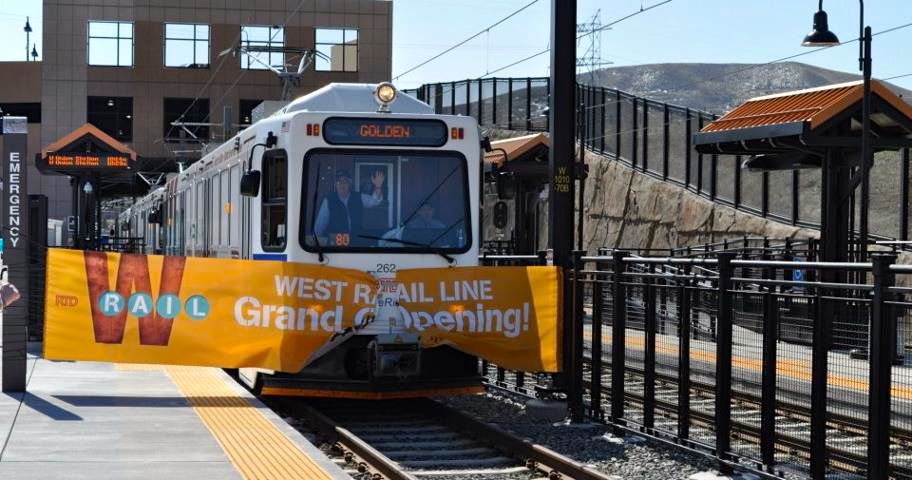
Steven and I rode the brand new West Rail Line to Golden, Colorado on its first day of operation.

Photo courtesy of the City of Golden

Photo courtesy of the City of Golden

That was fun.  It was even more fun to cycle to Golden and back the next day.

Golden Route

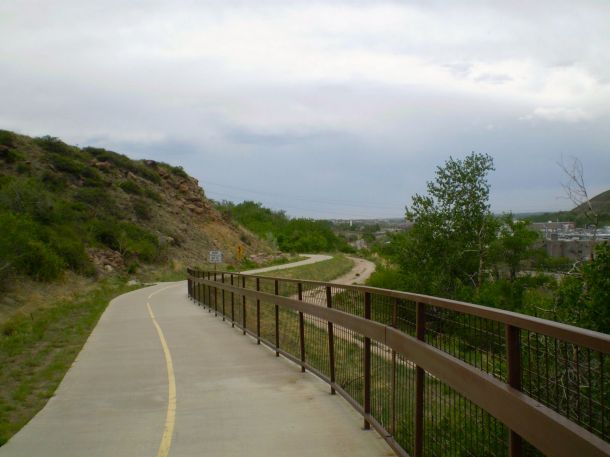
As the name implies the Clear Creek Trail follows Clear Creek from metro Denver to Golden.  We joined the trail near its mid-point as it passes through Wheat Ridge.  The trail has been upgraded over the years and now has an excellent surface for most of its length.

Photo courtesy of Remnant

Photo courtesy of Remnant

A major landmark signals your arrival at the outskirts of Golden.  The massive MillerCoors brewery.  This is just a part of it.  Steven and I were intrigued by the round structure to the left.  We don’t know what it is houses or is for.

Photo courtesy of Remnant

Photo courtesy of Remnant

Next comes the bridge across West 44th Avenue.

Golden Bridge

The trail then takes you through Vanover Park and alongside Parfet Park.

Photo courtesy of Robin Kanouse

Photo courtesy of Robin Kanouse

Then comes History Park with its late 1800s mountain ranch buildings.

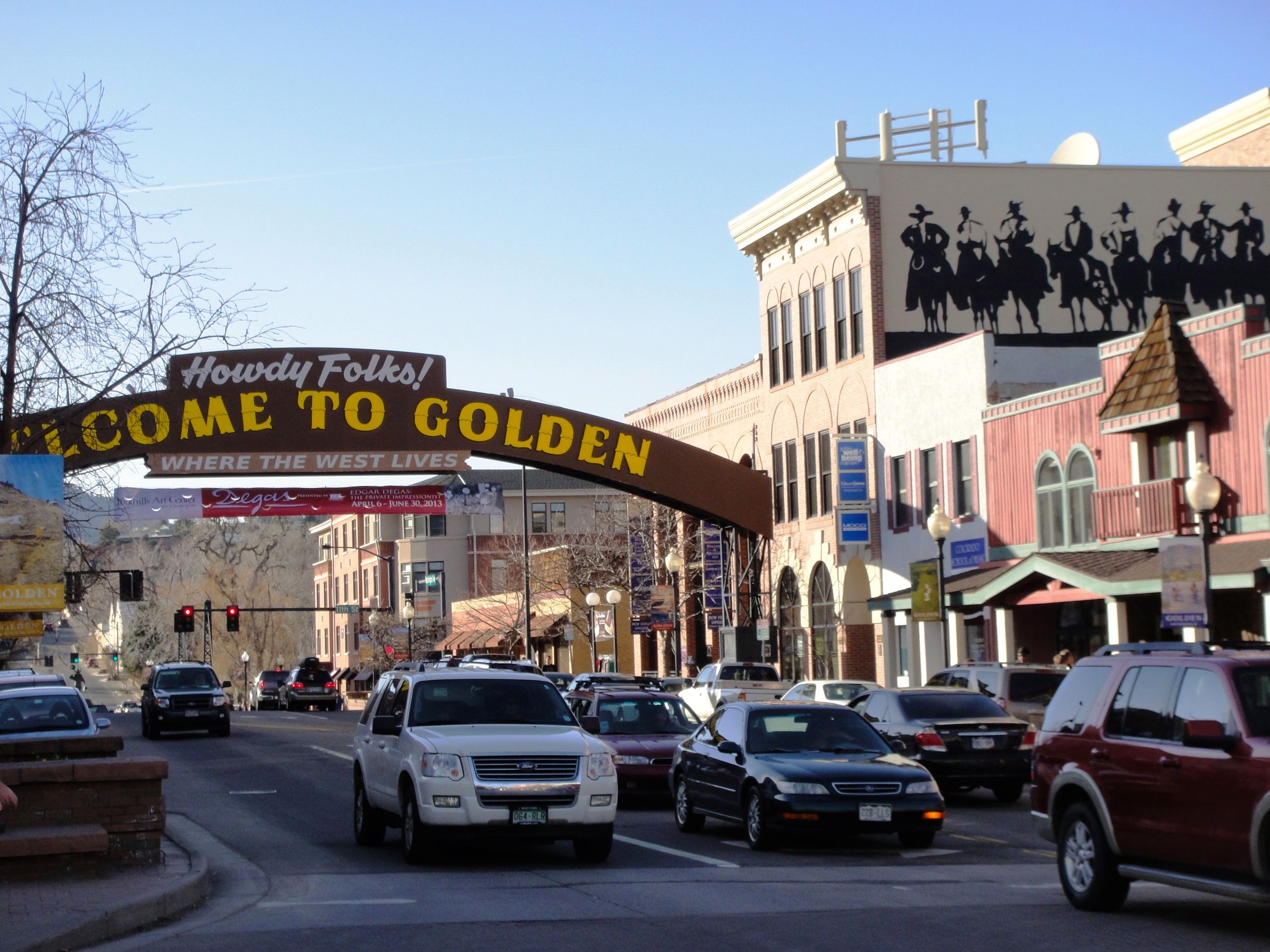
We looped around the History Park and onto Washington Avenue.

%0A					-2

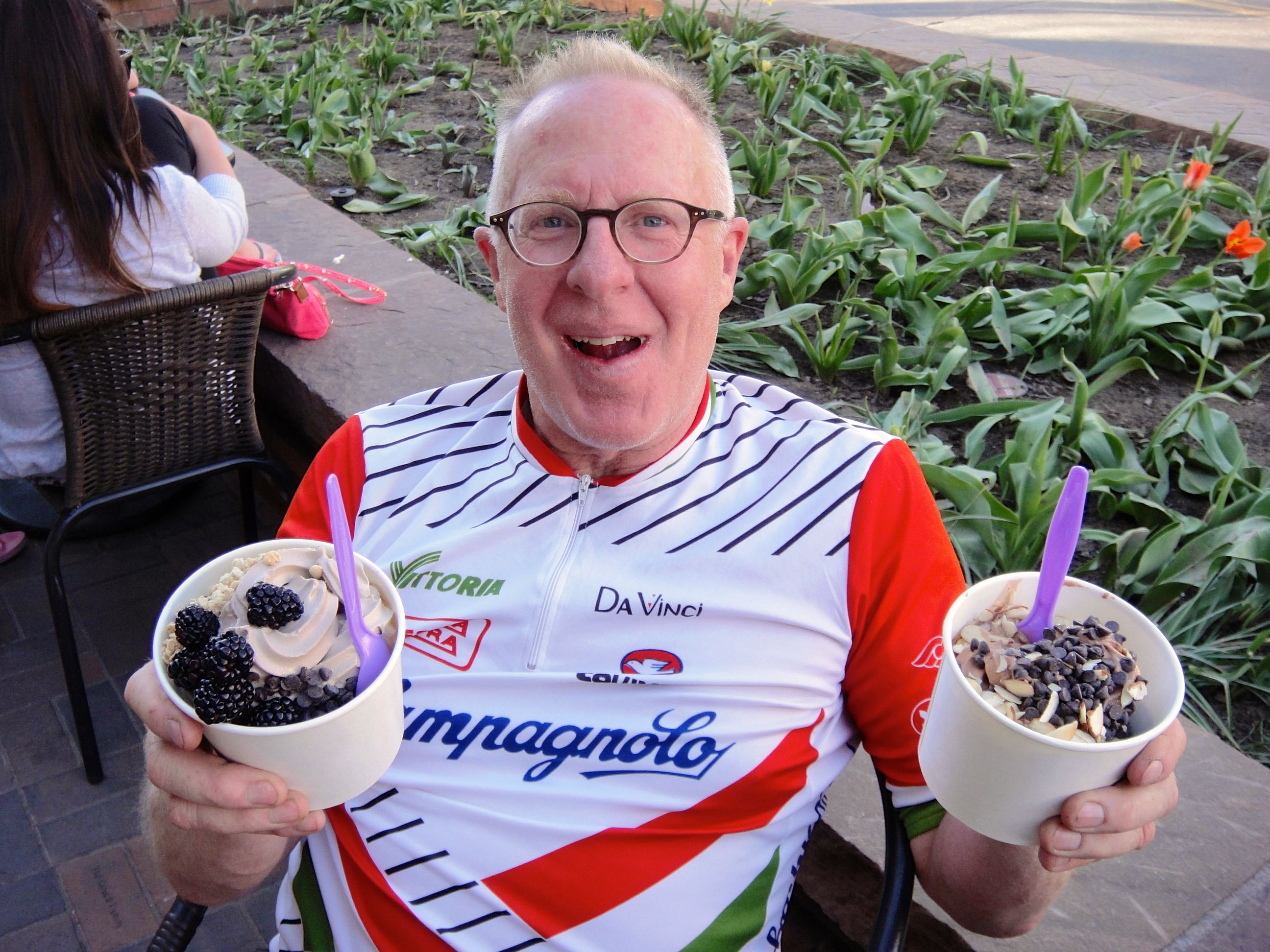
Where we parked ourselves outside Goozell Yogurt and Coffee for a treat before riding back to Wheat Ridge.

%0A