Tag Archives: Trek

Have Bicycle Prices Shot Up?

Paradoxes abound in the cycling press these days. On the one hand, the last twelve months have seen the news about bike brands like WiggleCRC, Planet X, Orange Bikes, and Islabikes going to the wall. Brands, distributors and shops have piles of unsold stock and have resorted to deep discounting, sometimes as much as 50%, to move product.

On the other hand, questions like “Why are modern bikes so expensive?” and “Are bikes more expensive than they used to be?” are being discussed on cycling podcasts.

So which view is the right one? Everyone agrees that the bike industry is in turmoil. Manufacturers with new releases in the pipeline are striving to empty warehouses by selling old stock at cost or even below it. By the same token, as soon as manufacturers get new models, they will bring the prices to more stable levels so they can start making some money again.

One way to look at the price of bicycles over the past ten years or so is to see how closely aligned bike prices are with the inflation rate. In the UK, the inflation rate between 2012 and 2024 was 37%.

Over that period the Giant TCR price went up 50%, from £1,999 to £2,999. The Specialized Tarmac went up 62.5%, £2,000 to £3,250. The Trek Madone, however, went up a whopping 160%, from £3,000 to £10,200. If the price of the Madone had tracked the inflation rate, it would cost £4,106 in 2024.

The Giant TCR and the Specialized Tarmac cost more today than their inflation-adjusted price. Not by much, though. The 2024 price of the Trek Madone, on the other hand, is eye-watering.

Data courtesy of cycling weekly.com
Inflation Calculator courtesy of bankofengland.co.uk

My experience of price drift can be seen in what I paid for the two Ti frames I bought from Alchemy and what they charge for a Ti frame in 2024. I paid $2,400 for a Ti frame with carbon seat and chain stays and an EDGE 2.0 road fork in 2011. In 2015, a Ti frame and ENVE fork cost me $3,750. Alchemy sells its Atlas All Road Ti frame and carbon fork today for $5,500.

Like prices in the UK, Alchemy’s prices for these frames have increased faster than the US inflation rate. The US inflation rate between 2012 and 2024 was 35.2%.

Over that period, the Alchemy Ti frame went up 129%. If the price of the Alchemy Ti frame had tracked the inflation rate, it would cost $3,244 in 2024. It is selling at a premium of $2,256. Interestingly, a 56cm version of the Atlas All Road Ti frame is on sale on the Alchemy website for $3,500.

Inflation Calculator courtesy of usinflationcalculator.com

There is no doubt that bicycles are more expensive to manufacture today than they were in 2012. Raw material and labour costs have increased. Freight and insurance costs have increased. A frame with internal cabling is more expensive to manufacture. Disc brakes are more expensive than rim brakes. Bike components like electronic groupsets cost more than mechanical ones.

It is also clear that manufacturers have significantly increased the prices of their high-end bicycles. The Trek Madone referenced above is one example. These bikes are skilfully marketed. “You too can ride the exact bikes that the best riders in the world use at races like the Tour de France.” These superbikes grab the lion’s share of media coverage. Much more so than lower-spec bikes.

It stands to reason that the average cyclist feels that bike prices are getting out of hand. That is certainly true of the type of bicycle most prominent in the cycling press. The bicycles that Tadej Pogačar, Mathieu van der Poel and Jonas Vingegaard race on.

A closer look at the full range of bikes from big manufacturers reveals cost-effective options for cyclists who do not want the lightest frames and the latest components. The chart below shows the cheapest offering within each model family. The cheapest bicycle in the Trek Emonda line, for example. There are, of course, better-specced and thus more expensive bikes within each model range.

Price data courtesy of the respective manufacturer’s website

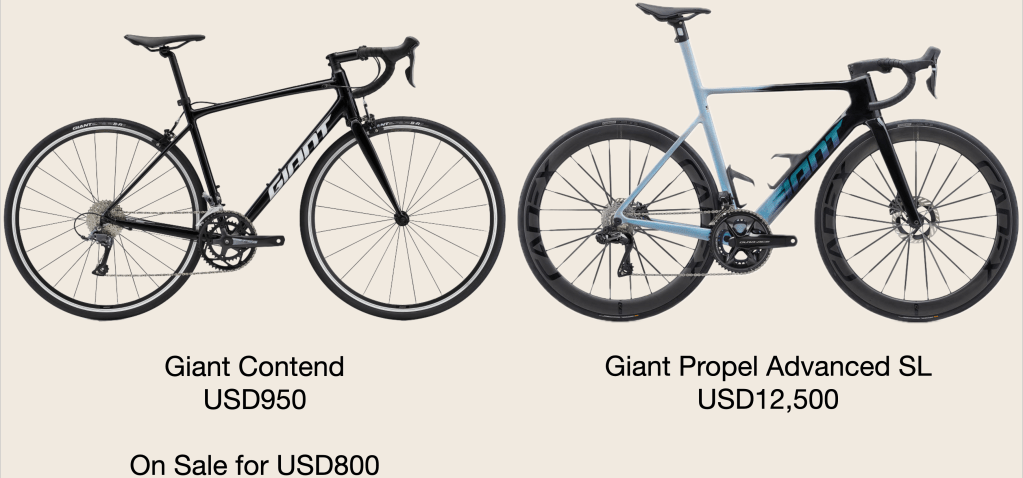
The Giant Contend and the Trek Domane AL 2 Rim are on sale for less than $1,000. These 8-speed bikes are likely to appeal to beginner cyclists only.

The reasonably specced bikes, by which I mean sold with Shimano 105 group sets, start at $1,800 for the Giant TCR Advanced 2 Pro Compact 2 (discounted online from $2,500). At $5,400, you start moving into composite frames, like the Giant Propel Advanced. This bike comes with a SRAM Rival eTap groupset, which makes it a good value.

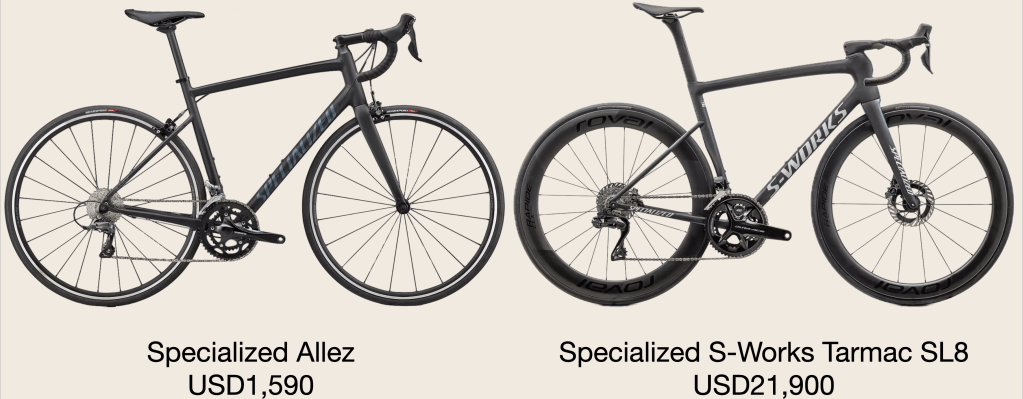
Of course, the sky is the limit when it comes to superbikes. The Specialized S-Works Tarmac SL8, and $21,900, is a case in point. You can buy a new car for less than that.

The paradox of deep discounting, including two-for-one offers, existing side-by-side with superbikes costing tens of thousands of dollars, looks to continue. It remains to be seen how long the bike industry will struggle with the post-COVID downturn in demand. It also remains to be seen how long consumers will continue to support ever-increasing prices.

In the meantime, there are bicycles for all budgets.
Cycle Computers

In May 2009 I bought my first bicycle.  A Trek FX7.5.  Before long the data geek in me was on the hunt for a cycle computer, so I could track speed and distance.  The gadget geek in me narrowed my search down to SpeedTrap compatible models.

SpeedTrap is the Trek / Bontrager name for the ANT+ 2.4 GHz digital wireless speed sensor that fits into a recess in the fork leg of the FX7.5 and other models in the Trek Range.  The Trek Incite 8i was my first cycle computer.

trek-incite-8i

Photograph courtesy of Evans Cycles

In January 2010 I got my first road bike.  I needed another cycle computer to go with it, because the Easton EC90 SLX fork on my new bike didn’t have a SpeedTrap mount.

By that time I was riding farther afield, and had already gotten lost a few times.  So a GPS-enabled device with mapping seemed like a good idea.  DC Rainmaker’s excellent in-depth review of the Garmin Edge 705 convinced me to break out my credit card and get one.

Garmin Edge 705

Fast forward to the end of 2016.  Cycle computer technology has, along with the technology in most consumer electronics, progressed by leaps and bounds since 2009. Today’s cycle computers have touch screens, are Bluetooth and wifi enabled, receive GLONASS as well as GPS signals, function as remote controls for certain lights and cameras, display missed phone call and text notifications, and do a host of other things that the Edge 705 is incapable of.

My Edge 705 is more than five years old.  It still works well, apart from the occasional spontaneous shut down, which I think I cured recently by doing a hard reset.  My Edge 705 does, however, show its vintage everytime I have to tether it to a PC via a USB cable to download ride data to Garmin Connect and Strava.  Newer devices do that wirelessly.

A more serious problem is ever-shortening battery life.  I had taken to carrying a power bank on longer rides.

The DC Rainmaker website was again my source for reviews of potential replacements for my Edge 705.  The Edge 820 is the latest Garmin offering, and DC Rainmaker’s preview post made it an appealing option.  Appealing, that is, until a trickle of negative comments from early buyers turned into a deluge.

garmin-edge-820

Photograph courtesy of Garmin

There were too many issues with the Edge 820 for my liking.  So I decided to buy a Garmin Edge 1000.  That model came out almost three years ago, but firmware updates have given the Edge 1000 most, if not all, of the capabilities of the Edge 820.  And three years should have been enough time for Garmin to flush all the bugs out of the Edge 1000.

garmin-edge-1000

Photograph courtesy of Cycle Solutions

Some people complain about the size of the Edge 1000.  At 58.0 x 112.0 x 20.0 mm (2.3″ x 4.4″ x 0.8″), it is not a svelte unit.  But those dimensions give the Edge 1000 a 30% larger display than the Edge 820, which in turn has a slightly bigger display than the Edge 705.  A key consideration, given the age of my eyes.

In November 2016 I went shopping online, and found the best deal at Bike Tires Direct.  34% off the RRP.  An Edge 1000 was soon on its way to me.

My excitement upon the unit’s arrival was quickly extinguished when it crashed and died during initial setup.  I was left with a paperweight.  A major bummer.

A visit to AECO Technologies, the authorized Garmin distributor for Malaysia, did not immediately solve the problem.  The unit would have to be sent to Taiwan for repair, at my expense.  Garmin does not provide a world-wide warranty for the Edge 1000, so I would have to foot the bill for shipping and repairs.

garmin-edge-1000-repair-cost


The alternative was for me to send the unit back to Bike Tires Direct in the United States, where the unit may have been repaired under warranty.  I decided to swallow the cost and work face-to-face with AECO Technologies folk, rather than communicate via emails and telephone calls to Bike Tires Direct and Garmin in the United States.

Anyway, the cost to send the unit to Taiwan for repair was slightly less than what I had saved via the discount I received from Bike Tires Direct.  That’s my story, and I’m sticking to it.

Six weeks later AECO called to say that the Edge 1000 was back.  It turned out to be a new unit, so there must have been something seriously wrong with the unit that failed.

Happily I had no problems setting up the replacement unit.  And it is working perfectly.

It is, however, going to take me some time to decide on my preferred layouts for all the data screens.  With the Edge 1000 you can have five data screens per activity profile, with each screen containing up to ten data fields.  You also have a map page, a compass page, an elevation chart page, the lap summary page, and the virtual partner page.  Each of those special pages allows you to specify two additional data fields on them.

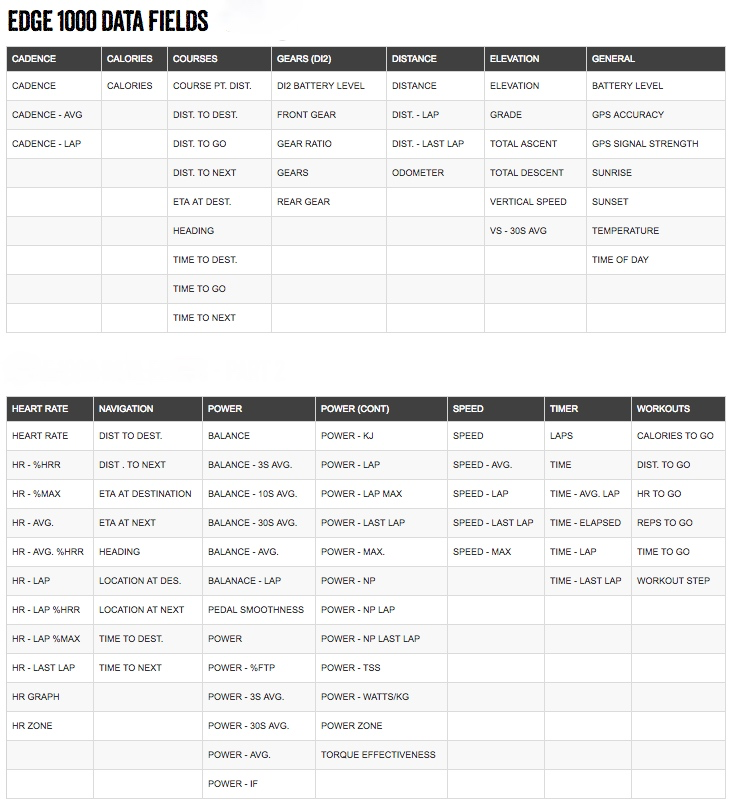
And the list of data fields to choose from is extensive.

garmin-edge-1000-data-fields

Table courtesy of DC Rainmaker

If you set up the maximum of ten activity profiles, you could have up to fifty data screens and fifty special pages to manage.  With a total of six hundred data fields.  Talk about overload!

That is all too much for me.  I deleted all but one activity profile.  For the time being I have turned off two of the five data screens, and three of the five special pages.

If managing activity profiles doesn’t take up enough of your time, you can fritter more time away by going online to the Garmin Connect IQ Store.  You can spend hours scrolling through the Applications, Data Fields and Widgets available there.

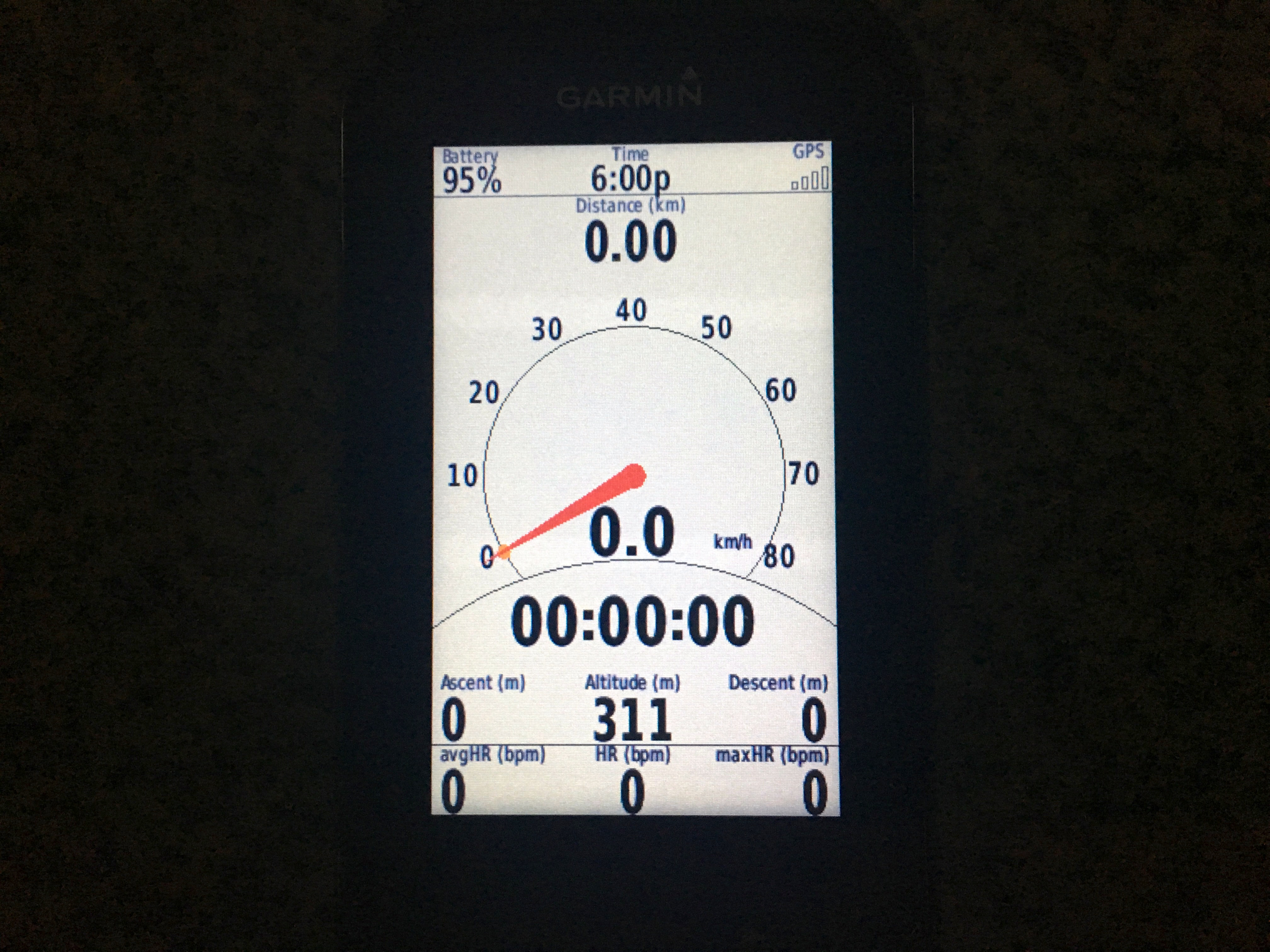
This is my favourite data screen layout – for now anyway.  My EDGE is a customizable Data Field downloaded from the Connect IQ Store.  This one data field takes up an entire data screen, but it contains multiple data items which are user selectable.  The analog speedometer is particularly cool.

garmin-edge-1000-screen

A final note.

I own two Edge 705s (it’s a long story).  On one unit, some of the threaded plastic holes, where the screws holding the case together are inserted, have cracked.  So four of the six screws are missing.  Garmin no longer stocks spare parts for the Edge 705.  Not even replacement screws.  The advice from a technician at AECO is to use the damaged Edge 705 as the donor of spare parts, as needed, for the other unit.

Fortunately, replacement batteries for the Edge 705 are available from a number of online vendors.  I bought one from BatteryShip.com.  It was simple to install.

garmin-edge-705-replacement-battery

Photograph courtesy of BatteryShip

Now have a rejuvenated Edge 705 as a backup for my Edge 1000.  For which replacement batteries are also available.  Contrary to what AECO told me about the Edge 1000 battery being non-replaceable.

A final final note.

Don’t get me started on the 36 hour battery life of Bryton cycle computers.


It Started With a Loud Pop

And a crunch.  Those were the noises my right knee made as the anterior cruciate ligament (ACL) tore.  Whatever self-preservation reflex existed in my brain, it didn’t extend to keeping my 50 year-old knees and I off the futsal court that lunchtime.  And so it was that I ended up in the capable hands of Dr. Chan Kin Yuen at the Gleneagles Hospital.  An initial manipulation of my knee and a follow-up MRI confirmed Dr. Chan’s diagnosis of a Grade III tear, where the ligament is completely ruptured.  To literally add insult to injury I had also torn the anterior and posterior menisci.

Imagine an empty space where the ACL is in the picture below and you have a good approximation of what the MRI of my knee looked like.

Illustration courtesy of uabsportsmedicine.com

Fast-forward eighteen months or so.  I will spare you the painful details.  Suffice to say that in that time Dr. Chan has rebuilt my knee.  The physiotherapists had restored my knee’s full range of motion.  Despite their best efforts I had moved to Houston with one leg significantly skinnier than the other.  I had lost a lot of upper leg muscle mass after months on crutches while my knee healed.  I needed regular exercise to build up the muscles again.  The limiting factor was that my knee hurt whenever I jogged or ran.

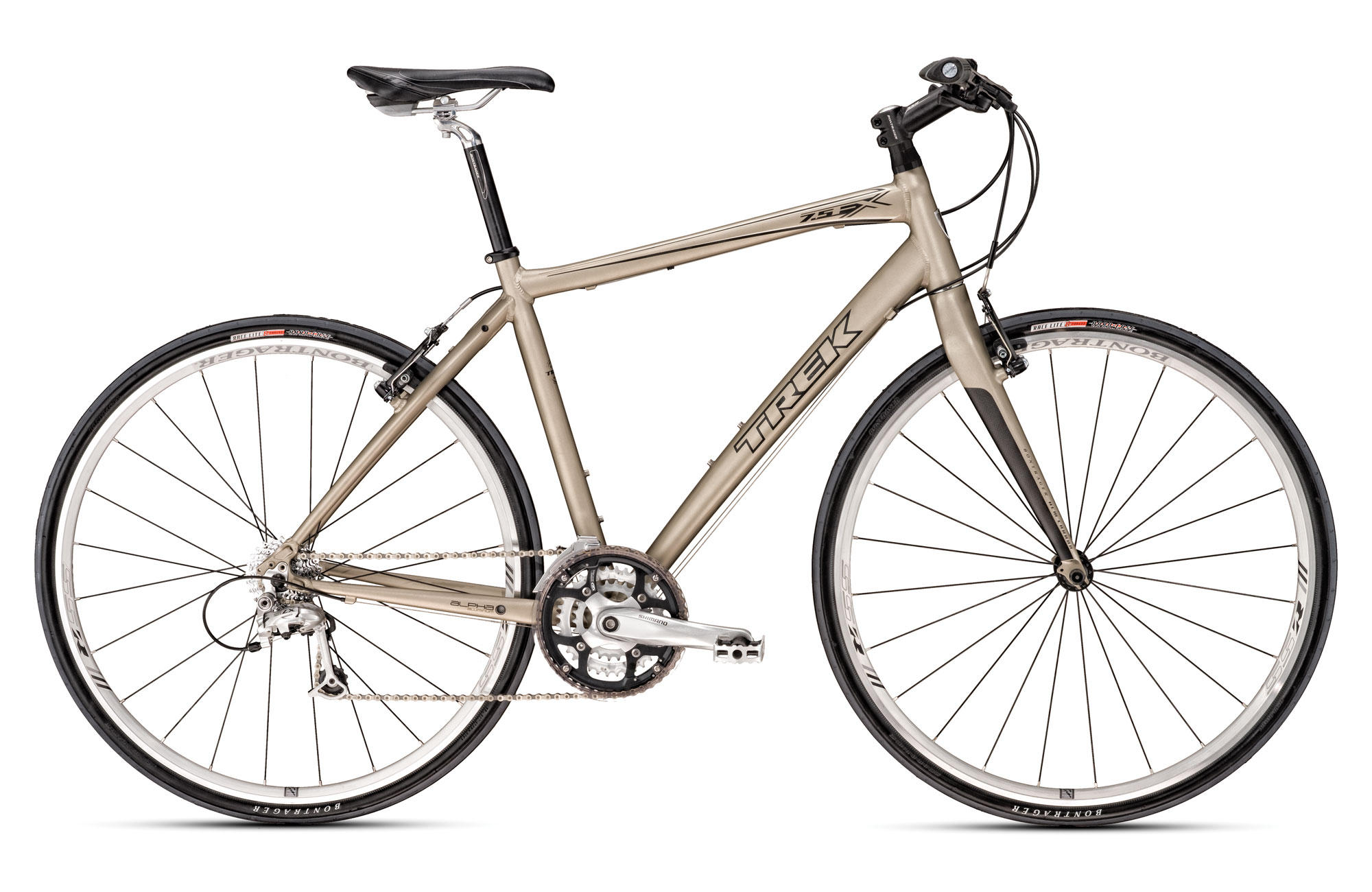
I don’t know what prompted the thought but one day I decided to buy a bicycle.  I did a bit of online research and decided that a hybrid bike was what I needed.  A comfort bike in other words.  More specifically a Trek 7.5 FX.  I went to Bike Barn and looked at what they had in stock.  I hardly knew anything at all about bicycles so my decision-making process was rudimentary at best.  The bike had good online reviews.  Bike Barn had one in my size (more on this to come!)  It felt okay as I rode it once around the parking lot.  I liked the colour.  While I was in the shop I did look at road bikes.  Trek Madones and various Specialized bikes.  I remember my eyes watering at the prices.  If only I knew then what I was getting myself into that day.

I rode home on one of these:

Photo courtesy of Viaciclante.com

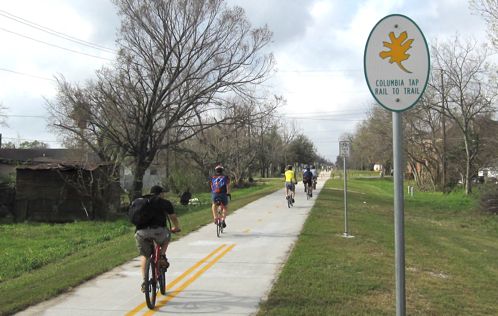
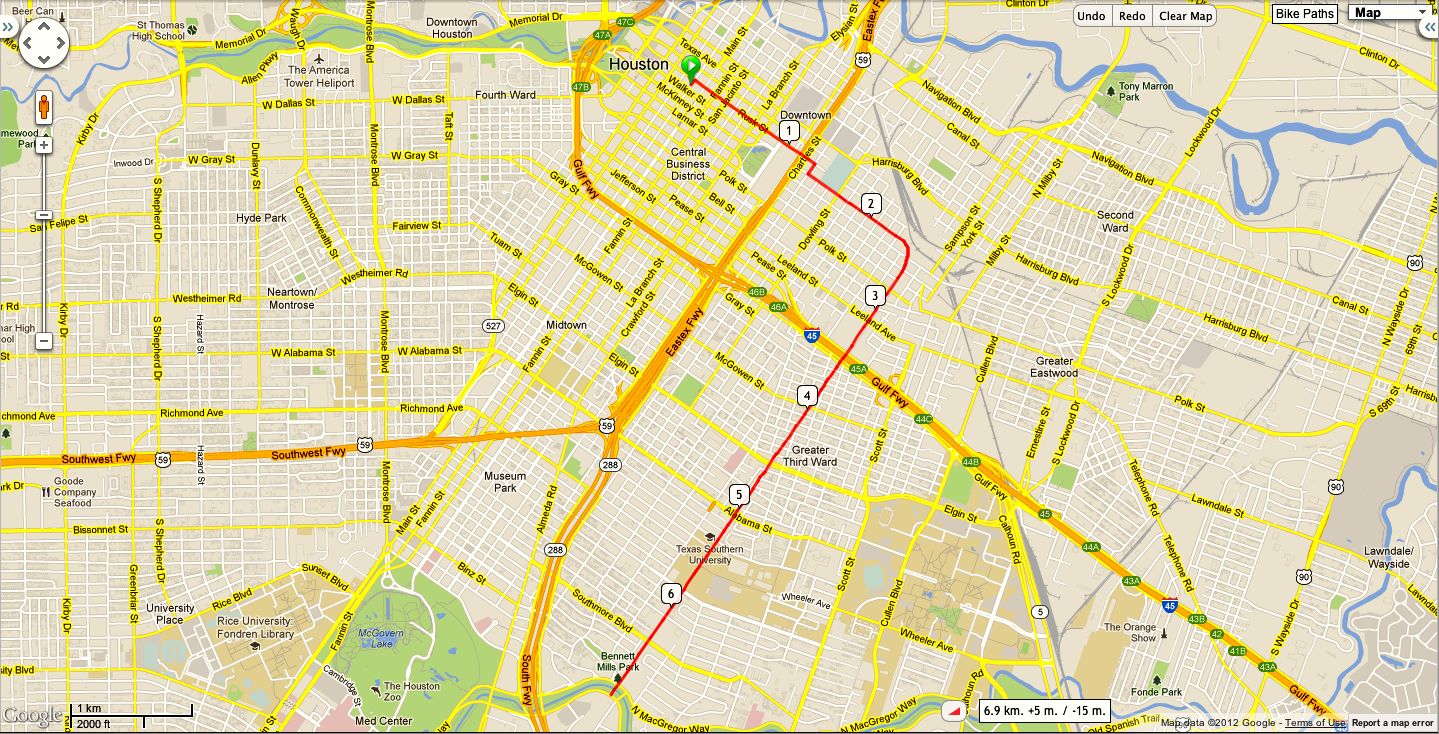
My initial forays onto the streets of downtown Houston were exciting.  One of my favorite routes was the Columbia Tap Rail toTrail.  This was a paved trail that had been created along the path of a disused railroad route.  The trail runs through the campus of Texas Southern University and through the Third Ward to Brays Bayou.

Photo courtesy of Raj Mankad at offcite.org

I would come home exhilarated at the fact that I had managed to ride 16 kilometers in only an hour.  Sometimes I would ride along Brays Bayou to add a three or four more kilometres to my ride.  I was a cyclist!

A rude shock was to come.