I wrote about chain and cassette wear in September 2013. You can read that post here: Chain Checkers Do No Good Just Sitting in Your Toolbox.
That post came after I had to replace a worn cassette on my Alchemy Eros. I replaced another worn cassette about four years ago and had to replace another this week.
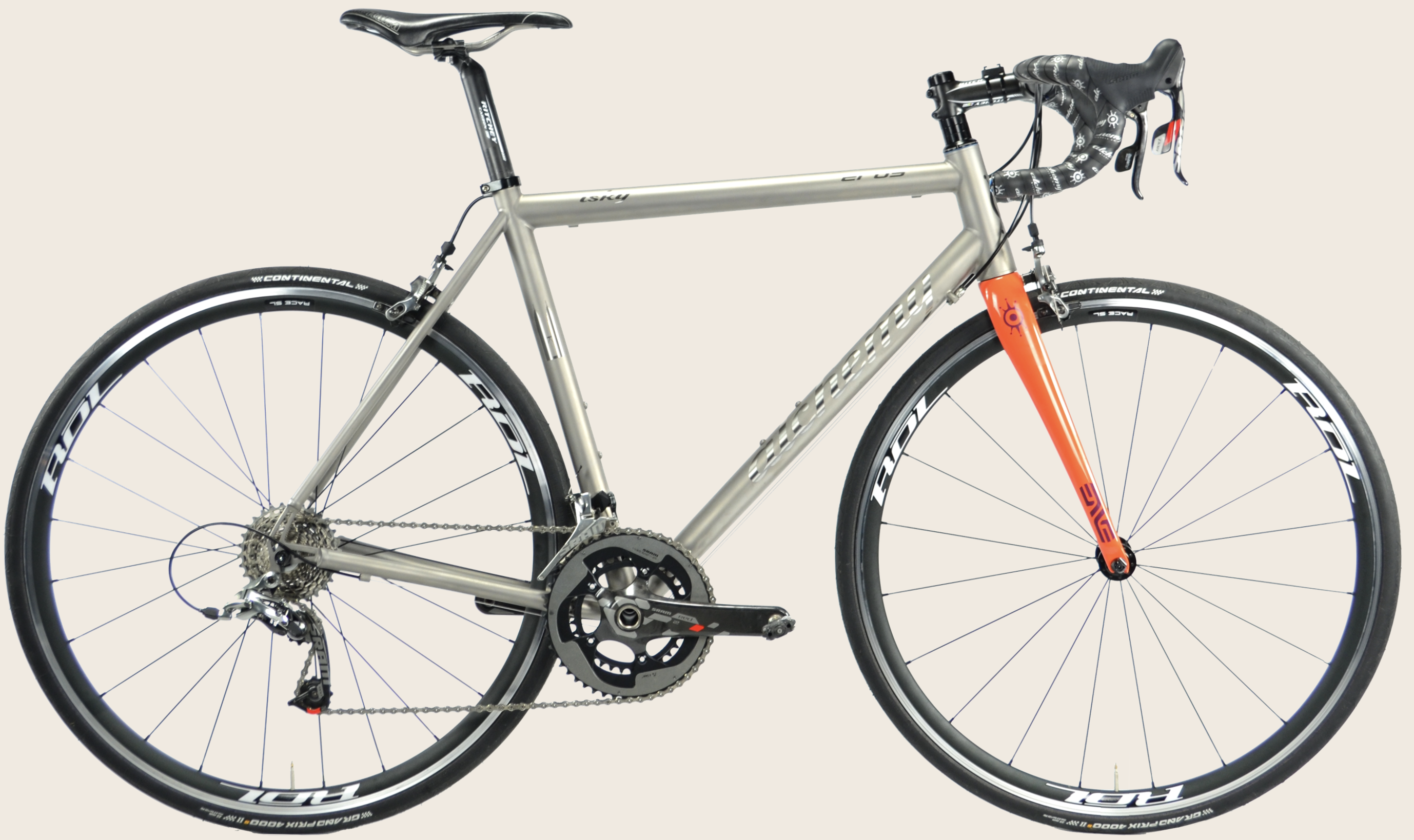
As with the previous replacements, the need to replace this cassette came after installing a new chain. Chains with just 1% of wear should be replaced. My chain was well beyond 1% of wear. Anything more than 1% chain wear and the cassette is probably already damaged.
Chain wear is often called chain stretch, but this is a misnomer. The side plates of a chain do not deform under pedalling forces. Rather, it is wear to the pins, bushes and rollers that causes the distance between the pins to increase, thus giving the illusion of stretch.
This diagram shows A. pin/bushing wear and C. bushing/roller wear. B shows an unworn chain. In short, chain wear is indicated by increasing spacing between pins. Note that roller wear does not affect pin spacing.

The guys at my LBS told me I would probably need to change the cassette. That need was confirmed during my short ride home when the chain started skipping over the teeth of my most-used sprockets. The rollers of the new chain were not meshing with the worn teeth on those sprockets.
The photographs below show a new cassette on the left and a worn cassette on the right. Both cassettes are SRAM Red OG-1090s.
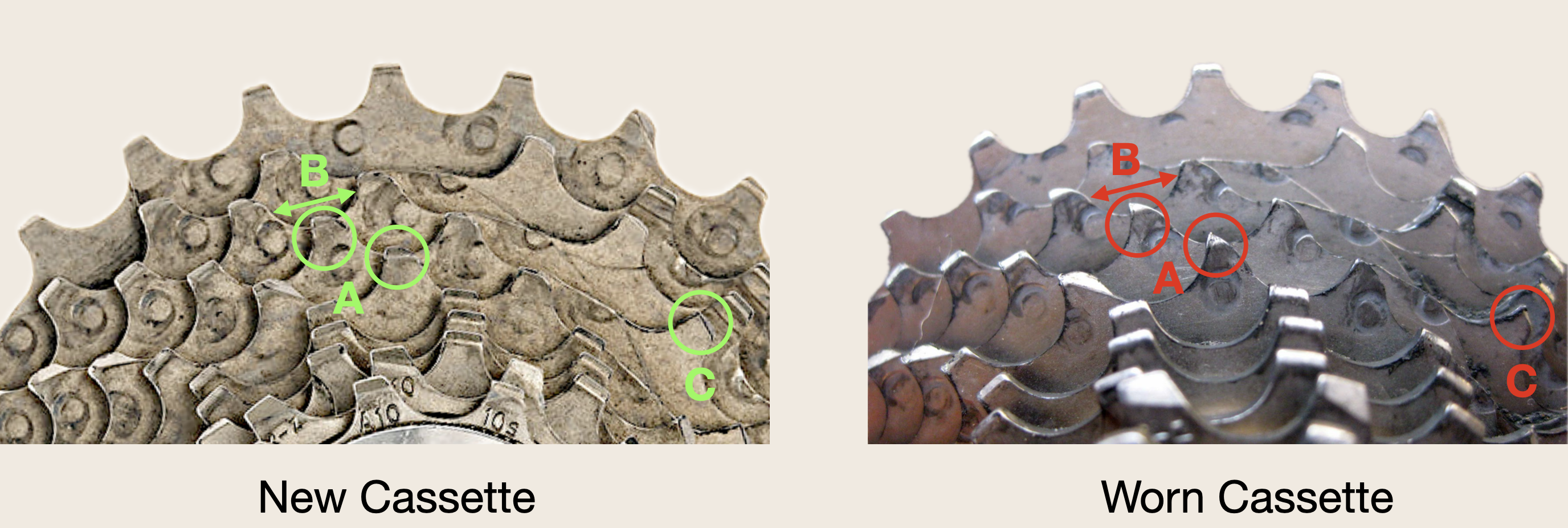
The two teeth in the green circles labelled A show a normal tooth profile. The red circles labelled A on the right show a phenomenon called “Shark Finning,” where the leading edge of a cog tooth curves inwards, making it resemble a shark’s dorsal fin. In time, this erodes the top of the tooth and causes the chain to skip.
As mentioned above, wear to the pins, bushes and rollers causes the distance between the pins to increase. As the gap between the pins, bushes and rollers widens, the ongoing wear widens the space between teeth. You can see that the gap between the teeth, shown by the red arrow labelled B, is wider than the equivalent gap, shown by the green arrow B. The narrower gap between the pins, bushes and rollers on a new chain means that the new chain rides up the sides of each tooth. The chain has less grip on the teeth and skips.
The third sign of wear is the leading edge of teeth that are mushrooming out a little. That’s from the metal being rubbed down and compressed by the chain. Think of it like a roll of cookie dough. If you slap it down on the table, the bottom will spread out, but the top will remain intact. The metal of the cassette acts the same way.
I didn’t need to see these signs of wear to know I had to replace the cassette. The skipping on the two sprockets I used the most was all the evidence I needed to spend money.
The strain on the wallet didn’t end there. The LBS guys told me I also had to replace the chainrings. I should have seen that coming. The combination of putting almost 60,000 km on them with a succession of chains in varying states of wear would lead to eroded teeth.
The challenge was to find replacement parts. My 2015 Eros has a SRAM 11-speed groupset. Groupsets today have 12 or 13 speeds. SRAM 11-speed 11-32 tooth cassettes are getting harder to find. My LBS didn’t have SRAM 11-speed 52-tooth outer and 34-inner chainrings in stock either. Fortunately, I have a son living in Australia. I put him on the case, and he got all three parts for me.

The general rule of thumb is that a chain needs replacing after 3,200 km to 4,800 km. A cassette needs replacing after three chain replacements, i.e. after 9,600 km to 14,400 km. There is less of a consensus about chainring lifespan. 60,000 km seems a reasonable expectation.
I will pay more attention to chain wear than I have in the past 😄. In the meantime, I will enjoy the silent running of my brand-new drivetrain.

 Old Roots, New Routes